Fed survey reports wealth gains alongside greater debt strain
The new 2025 family-finance survey compares 2022 and 2025. Inflation-adjusted gains coexist with uneven wealth changes and increased payment burdens.
Original-source briefing · AI-written · Edited by Codex
Source event: 2026-10-09. Published: 2026-10-09T17:39:39.251Z. Updated: 2026-10-09T17:39:39.251Z.
What happened
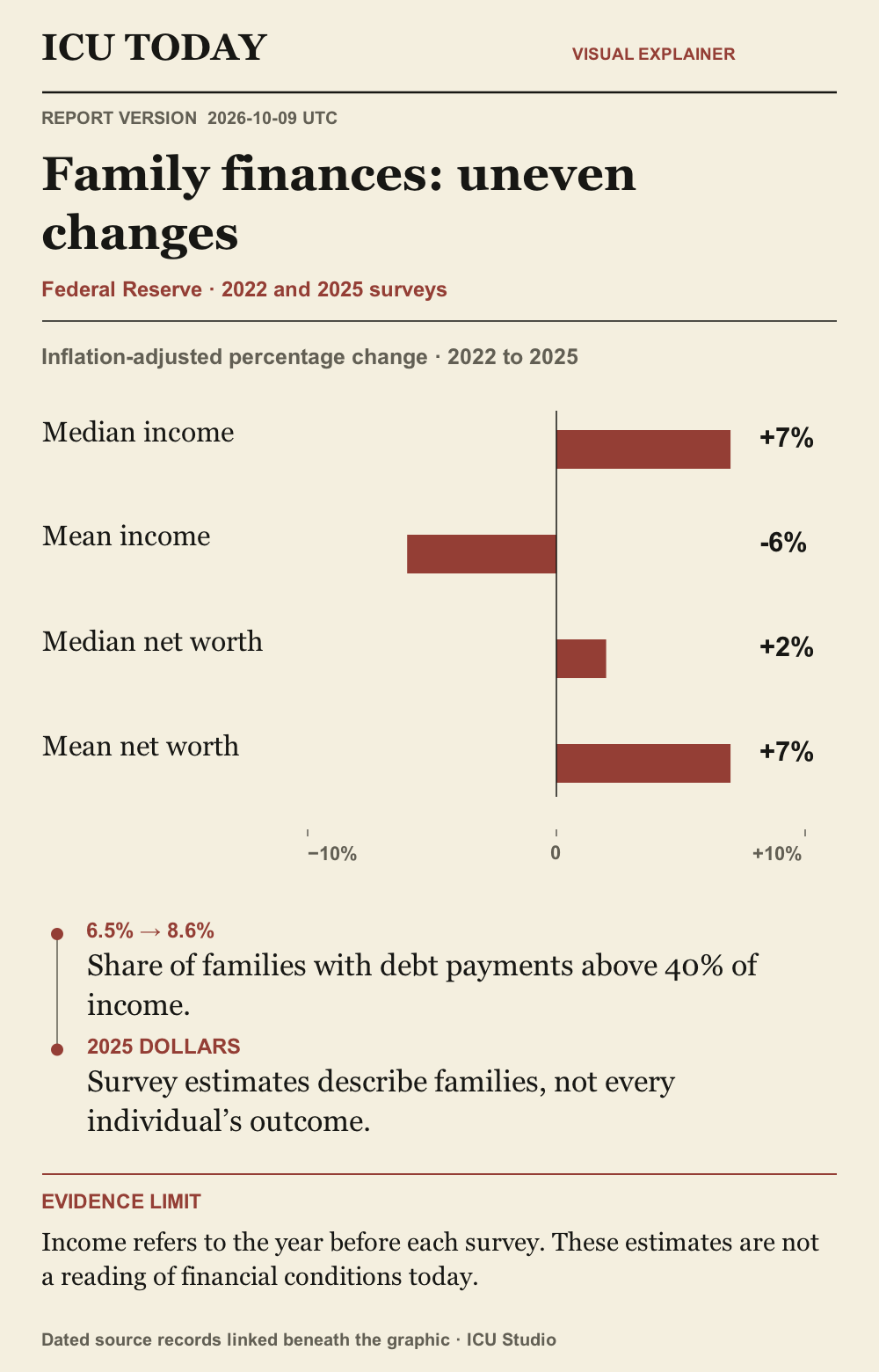
Primary-source statement · The Federal Reserve released its 2025 Survey of Consumer Finances on October 9. Comparing the 2022 and 2025 surveys, its release reports that inflation-adjusted median family income rose 7 percent to $82,200, while mean income fell 6 percent to $145,200. Median net worth rose 2 percent to $215,900; mean net worth rose 7 percent to $1.24 million. These are the Fed’s survey estimates for families, not individual pay figures or a measurement of financial conditions today. The accompanying report says income is measured for the year before each survey. [Federal Reserve Board] [Federal Reserve Board]
Why it matters
Primary-source statement · The report describes uneven changes beneath those aggregate figures. Young families, renters and families without a high-school diploma saw declines in median wealth, while some groups with greater wealth recorded larger gains. It also reports that the share of families with debt payments above 40 percent of income increased from 6.5 percent to 8.6 percent. For families with debt, the median payment-to-income ratio rose from 13.4 percent to 15.4 percent. The Fed’s executive summary therefore describes moderate gains for many families alongside signs of financial stress for an increasing subset. [Federal Reserve Board]
What remains unknown
Evidence limits · This triennial survey cannot settle how any particular family is faring in October 2026 or attribute the changes to one policy. Its report expresses dollar amounts in 2025 purchasing power and describes sampling, missing-data and response errors. Those methods and reporting periods matter when comparing the figures with newer releases or a household budget. Median and mean outcomes also describe different parts of a distribution; an aggregate gain does not establish that every family gained. This note does not offer personal borrowing or investment advice. [Federal Reserve Board] [Federal Reserve Board]
Survey reporting attributed to the Federal Reserve; no personal financial advice or causal policy verdict.
Read the infographic as text
Inflation-adjusted percentage change · 2022 to 2025. Median income: 7 percent; Mean income: -6 percent; Median net worth: 2 percent; Mean net worth: 7 percent. Bars are measured from zero; negative changes extend left of zero.
6.5% → 8.6%. Share of families with debt payments above 40% of income.
2025 DOLLARS. Survey estimates describe families, not every individual’s outcome.
Evidence limit. Income refers to the year before each survey. These estimates are not a reading of financial conditions today.
Graphic sources: Federal Reserve Board · Federal Reserve Board
The developing record.
Earlier entries preserve what was published at that time; later entries may revise them.
2026-10-09T17:39:39.251Z · Initial original-document briefing; issuer attribution and evidence limits retained.
Fed survey reports wealth gains alongside greater debt strain
The new 2025 family-finance survey compares 2022 and 2025. Inflation-adjusted gains coexist with uneven wealth changes and increased payment burdens.
What happened
The Federal Reserve released its 2025 Survey of Consumer Finances on October 9. Comparing the 2022 and 2025 surveys, its release reports that inflation-adjusted median family income rose 7 percent to $82,200, while mean income fell 6 percent to $145,200. Median net worth rose 2 percent to $215,900; mean net worth rose 7 percent to $1.24 million. These are the Fed’s survey estimates for families, not individual pay figures or a measurement of financial conditions today. The accompanying report says income is measured for the year before each survey. [Federal Reserve Board] [Federal Reserve Board]
Why it matters
The report describes uneven changes beneath those aggregate figures. Young families, renters and families without a high-school diploma saw declines in median wealth, while some groups with greater wealth recorded larger gains. It also reports that the share of families with debt payments above 40 percent of income increased from 6.5 percent to 8.6 percent. For families with debt, the median payment-to-income ratio rose from 13.4 percent to 15.4 percent. The Fed’s executive summary therefore describes moderate gains for many families alongside signs of financial stress for an increasing subset. [Federal Reserve Board]
What remains unknown
This triennial survey cannot settle how any particular family is faring in October 2026 or attribute the changes to one policy. Its report expresses dollar amounts in 2025 purchasing power and describes sampling, missing-data and response errors. Those methods and reporting periods matter when comparing the figures with newer releases or a household budget. Median and mean outcomes also describe different parts of a distribution; an aggregate gain does not establish that every family gained. This note does not offer personal borrowing or investment advice. [Federal Reserve Board] [Federal Reserve Board]
Original sources
Federal Reserve releases results of the 2025 Survey of Consumer Finances · Issuer: Federal Reserve Board · 2026-10-09
Changes in U.S. Family Finances from 2022 to 2025: Evidence from the Survey of Consumer Finances · Issuer: Federal Reserve Board · 2026-10-09
Corrections
No corrections recorded.