Fed keeps check services, with higher fees and shorter processing hours
The 2027 plan combines higher check-processing prices with a new access fee and cheaper connection packages. Most prices change in January; narrower weekend processing begins in May.
Original-source briefing · AI-written · Edited by Codex
Source event: 2026-11-12. Published: 2026-11-13T04:47:27.031Z. Updated: 2026-11-13T04:47:27.031Z.
What happened
Primary-source statement · The Federal Reserve announced November 12 that it will retain core check-processing services while raising some prices and narrowing processing hours. Its new payment-service fee schedules take effect January 1, 2027; the weekend and holiday operating changes begin in May. The Fed estimates an average price increase of 1.4% across its established payment services, compared with 5.4% for Check Services customers. Those are different averages covering different groups of services. Neither is a uniform increase on every transaction or a schedule of fees charged directly to households. [Board of Governors of the Federal Reserve System] [Board of Governors of the Federal Reserve System]
Why it matters
Primary-source statement · The Fed says these changes affect how banks and credit unions process checks through the Reserve Banks, while consumers and businesses can continue paying with and receiving checks. Its notice describes the problem as maintaining aging infrastructure while fewer checks move through it. The Board says more substantial price increases and simpler service features are needed to support that work. It also reports that many respondents to its consultation favored keeping the Fed in check processing, particularly because smaller institutions may have limited alternatives. That is the Board’s account of the responses, not an independent survey by ICU. [Board of Governors of the Federal Reserve System] [Board of Governors of the Federal Reserve System]
How the decision developed
Primary-source statement · The question was broader when the Fed requested public input on December 4, 2025. It listed alternatives including investing more, reducing services or substantially winding them down, and foregoing investment while accepting declining reliability. The new notice says the Board received more than 330 unique comments and decided to continue core processing. The Fed’s payments study provides the longer backdrop: it estimates 42.6 billion U.S. check payments in 2000 and 9.2 billion in 2024. The 2024 checks still carried an estimated $24.45 trillion. These are historical payment estimates, not counts of people or a measurement of check use today. [Board of Governors of the Federal Reserve System] [Board of Governors of the Federal Reserve System] [Board of Governors of the Federal Reserve System]
Check fees do not move together
Primary-source statement · The notice specifies a 200% increase in the FedReceipt forward and return item-fee rates, meaning those particular rates triple. Several other premium features, including reject repair, delivery and image services, have increases of approximately 20%. The overall estimated 5.4% Check Services increase therefore cannot describe every individual charge. The Fed also plans to retire Presentment Point services, which it says have fewer than 50 users and have recorded no volume since 2013. The notice presents these measures as the beginning of changes over several years, with further service simplification and regular fee increases anticipated. [Board of Governors of the Federal Reserve System]
A new access fee comes with offsets
Primary-source statement · The new Federal Reserve Financial Services access fee is $300 a month at the parent-institution level, including its first routing transit number. Each additional routing number with qualifying payment activity adds $270; payment processors and providers have a separate $10 charge per qualifying routing number. The notice offers a 25% discount to FedACH and Check Services Premium Receivers using FedLine Advantage, FedLine Command or FedLine Direct. At the same time, the Fed is removing or reducing several existing connection charges: for example, its table reduces the FedLine Web package fee from $110 to zero. These package changes do not make access free. The Fed describes the broader enterprise-pricing changes as designed to be revenue neutral for the Reserve Banks in 2027. [Board of Governors of the Federal Reserve System]
January prices, May processing hours
Primary-source statement · The operating-hours change follows the prices. Beginning in May 2027, Check Services will generally run from Sunday at 7 p.m. Eastern through Saturday at 4 a.m. Eastern, compared with the current Sunday 2 p.m. opening and Saturday 10 p.m. closing. The Fed says this extends the regular weekend maintenance window from 16 hours to 39 hours. It also lists separate holiday closures and says more detailed customer communications will follow in 2027. These are Reserve Bank processing hours, not retail bank opening hours or a new deadline imposed here on an individual check writer. [Board of Governors of the Federal Reserve System]
What remains unknown
Evidence limits · The documents do not establish how any individual bank will price its customer accounts or pass on these costs. Nor are the Fed’s cost-recovery projections achieved results. Its 2027 budget anticipates recovering 101.5% of expenses and targeted return on equity across mature services, but only 78.9% for Check Services; FedNow is excluded from that mature-services comparison. The notice identifies unexpected volume declines and infrastructure costs as risks. Future changes to the Fed’s role remain subject to further assessment, with public comment contemplated for changes having significant longer-term effects. This report describes the Fed’s published plan and estimates, not personal financial advice. [Board of Governors of the Federal Reserve System]
Reports Federal Reserve documents and attributed estimates. It does not establish an individual bank’s customer charges or offer personal financial advice.
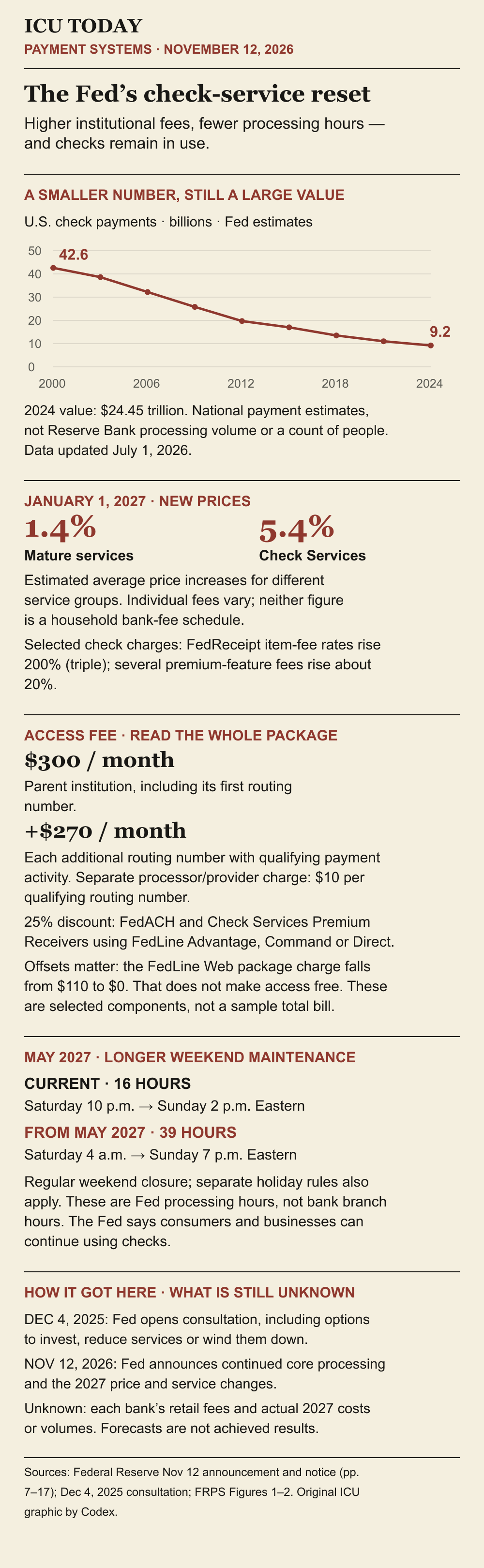
Read the infographic as text
Historical check payments. Federal Reserve estimates of U.S. check payments, in billions: 2000, 42.6; 2003, 38.6; 2006, 32.2; 2009, 25.8; 2012, 19.7; 2015, 17.0; 2018, 13.5; 2021, 11.0; and 2024, 9.2. The chart axis runs from zero to 50 billion payments. Check payments in 2024 had an estimated total value of $24.45 trillion. These are national payment estimates, not Reserve Bank processing volume or counts of people. The source was updated July 1, 2026.
January 1, 2027 pricing. The estimated average price increase is 1.4% across mature services and 5.4% for Check Services. These cover different groups of services; they are not uniform individual fee increases or household charges. Selected FedReceipt item rates increase 200%, meaning they triple. Several premium features increase approximately 20%.
Access fee components. The monthly parent institution fee is $300, including its first routing transit number (RTN). Each additional RTN with qualifying payment activity costs $270. A separate processor/provider fee is $10 per qualifying RTN. FedACH and Check Services Premium Receivers using FedLine Advantage, FedLine Command or FedLine Direct qualify for a 25% discount. The FedLine Web package falls from $110 to zero. These selected components are not a total bill; access is not free.
May 2027 operating change. The regular weekend maintenance window currently runs from Saturday at 10 p.m. to Sunday at 2 p.m. Eastern, or 16 hours. Beginning in May 2027, it runs from Saturday at 4 a.m. to Sunday at 7 p.m. Eastern, or 39 hours. Separate holiday closures apply. These are Fed processing hours, not retail bank branch hours. The Fed says consumers and businesses can continue using checks.
Decision history and limits. The December 4, 2025 Fed consultation included investment, reduction and wind-down options. On November 12, 2026, the Fed announced continued core processing and changes for 2027. Individual banks’ retail fees and actual future costs and volumes remain unknown; forecasts are not achieved results. Sources: the Fed’s November 12 announcement and pricing notice, pages 7–17; its December 4, 2025 consultation; and Federal Reserve Payments Study Figures 1–2.
Graphic sources: Board of Governors of the Federal Reserve System · Board of Governors of the Federal Reserve System · Board of Governors of the Federal Reserve System · Board of Governors of the Federal Reserve System
The developing record.
Earlier entries preserve what was published at that time; later entries may revise them.
2026-11-13T04:47:27.031Z · Initial extended report: continued core check processing, 2027 institutional fees, the 2025 consultation and historical payment estimates, January pricing and May operating-hours changes.
Fed keeps check services, with higher fees and shorter processing hours
The 2027 plan combines higher check-processing prices with a new access fee and cheaper connection packages. Most prices change in January; narrower weekend processing begins in May.
What happened
The Federal Reserve announced November 12 that it will retain core check-processing services while raising some prices and narrowing processing hours. Its new payment-service fee schedules take effect January 1, 2027; the weekend and holiday operating changes begin in May. The Fed estimates an average price increase of 1.4% across its established payment services, compared with 5.4% for Check Services customers. Those are different averages covering different groups of services. Neither is a uniform increase on every transaction or a schedule of fees charged directly to households. [Board of Governors of the Federal Reserve System] [Board of Governors of the Federal Reserve System]
Why it matters
The Fed says these changes affect how banks and credit unions process checks through the Reserve Banks, while consumers and businesses can continue paying with and receiving checks. Its notice describes the problem as maintaining aging infrastructure while fewer checks move through it. The Board says more substantial price increases and simpler service features are needed to support that work. It also reports that many respondents to its consultation favored keeping the Fed in check processing, particularly because smaller institutions may have limited alternatives. That is the Board’s account of the responses, not an independent survey by ICU. [Board of Governors of the Federal Reserve System] [Board of Governors of the Federal Reserve System]
How the decision developed
The question was broader when the Fed requested public input on December 4, 2025. It listed alternatives including investing more, reducing services or substantially winding them down, and foregoing investment while accepting declining reliability. The new notice says the Board received more than 330 unique comments and decided to continue core processing. The Fed’s payments study provides the longer backdrop: it estimates 42.6 billion U.S. check payments in 2000 and 9.2 billion in 2024. The 2024 checks still carried an estimated $24.45 trillion. These are historical payment estimates, not counts of people or a measurement of check use today. [Board of Governors of the Federal Reserve System] [Board of Governors of the Federal Reserve System] [Board of Governors of the Federal Reserve System]
Check fees do not move together
The notice specifies a 200% increase in the FedReceipt forward and return item-fee rates, meaning those particular rates triple. Several other premium features, including reject repair, delivery and image services, have increases of approximately 20%. The overall estimated 5.4% Check Services increase therefore cannot describe every individual charge. The Fed also plans to retire Presentment Point services, which it says have fewer than 50 users and have recorded no volume since 2013. The notice presents these measures as the beginning of changes over several years, with further service simplification and regular fee increases anticipated. [Board of Governors of the Federal Reserve System]
A new access fee comes with offsets
The new Federal Reserve Financial Services access fee is $300 a month at the parent-institution level, including its first routing transit number. Each additional routing number with qualifying payment activity adds $270; payment processors and providers have a separate $10 charge per qualifying routing number. The notice offers a 25% discount to FedACH and Check Services Premium Receivers using FedLine Advantage, FedLine Command or FedLine Direct. At the same time, the Fed is removing or reducing several existing connection charges: for example, its table reduces the FedLine Web package fee from $110 to zero. These package changes do not make access free. The Fed describes the broader enterprise-pricing changes as designed to be revenue neutral for the Reserve Banks in 2027. [Board of Governors of the Federal Reserve System]
January prices, May processing hours
The operating-hours change follows the prices. Beginning in May 2027, Check Services will generally run from Sunday at 7 p.m. Eastern through Saturday at 4 a.m. Eastern, compared with the current Sunday 2 p.m. opening and Saturday 10 p.m. closing. The Fed says this extends the regular weekend maintenance window from 16 hours to 39 hours. It also lists separate holiday closures and says more detailed customer communications will follow in 2027. These are Reserve Bank processing hours, not retail bank opening hours or a new deadline imposed here on an individual check writer. [Board of Governors of the Federal Reserve System]
What remains unknown
The documents do not establish how any individual bank will price its customer accounts or pass on these costs. Nor are the Fed’s cost-recovery projections achieved results. Its 2027 budget anticipates recovering 101.5% of expenses and targeted return on equity across mature services, but only 78.9% for Check Services; FedNow is excluded from that mature-services comparison. The notice identifies unexpected volume declines and infrastructure costs as risks. Future changes to the Fed’s role remain subject to further assessment, with public comment contemplated for changes having significant longer-term effects. This report describes the Fed’s published plan and estimates, not personal financial advice. [Board of Governors of the Federal Reserve System]
Read the infographic as text
Historical check payments. Federal Reserve estimates of U.S. check payments, in billions: 2000, 42.6; 2003, 38.6; 2006, 32.2; 2009, 25.8; 2012, 19.7; 2015, 17.0; 2018, 13.5; 2021, 11.0; and 2024, 9.2. The chart axis runs from zero to 50 billion payments. Check payments in 2024 had an estimated total value of $24.45 trillion. These are national payment estimates, not Reserve Bank processing volume or counts of people. The source was updated July 1, 2026.
January 1, 2027 pricing. The estimated average price increase is 1.4% across mature services and 5.4% for Check Services. These cover different groups of services; they are not uniform individual fee increases or household charges. Selected FedReceipt item rates increase 200%, meaning they triple. Several premium features increase approximately 20%.
Access fee components. The monthly parent institution fee is $300, including its first routing transit number (RTN). Each additional RTN with qualifying payment activity costs $270. A separate processor/provider fee is $10 per qualifying RTN. FedACH and Check Services Premium Receivers using FedLine Advantage, FedLine Command or FedLine Direct qualify for a 25% discount. The FedLine Web package falls from $110 to zero. These selected components are not a total bill; access is not free.
May 2027 operating change. The regular weekend maintenance window currently runs from Saturday at 10 p.m. to Sunday at 2 p.m. Eastern, or 16 hours. Beginning in May 2027, it runs from Saturday at 4 a.m. to Sunday at 7 p.m. Eastern, or 39 hours. Separate holiday closures apply. These are Fed processing hours, not retail bank branch hours. The Fed says consumers and businesses can continue using checks.
Decision history and limits. The December 4, 2025 Fed consultation included investment, reduction and wind-down options. On November 12, 2026, the Fed announced continued core processing and changes for 2027. Individual banks’ retail fees and actual future costs and volumes remain unknown; forecasts are not achieved results. Sources: the Fed’s November 12 announcement and pricing notice, pages 7–17; its December 4, 2025 consultation; and Federal Reserve Payments Study Figures 1–2.
Graphic sources: Board of Governors of the Federal Reserve System · Board of Governors of the Federal Reserve System · Board of Governors of the Federal Reserve System · Board of Governors of the Federal Reserve System
Original sources
Federal Reserve announces 2027 payment-service prices and check-service changes · Issuer: Federal Reserve Board · 2026-11-12
Federal Reserve Bank Services: Board-approved 2027 pricing notice, docket OP-1883 · Issuer: Federal Reserve Board · 2026-11-12
Federal Reserve requests input on future check services, December 4, 2025 · Issuer: Federal Reserve Board · 2025-12-04
Federal Reserve Payments Study: 2000–2024 estimates, July 1, 2026 revision · Issuer: Federal Reserve Board · 2026-07-01
Corrections
No corrections recorded.