Most banks held business lending standards steady as demand softened
The Fed’s October survey shows modest net tightening for small firms and weaker business-loan demand. Its response counts explain why tighter standards do not mean most banks changed their policies.
Original-source briefing · AI-written · Edited by Codex
Source event: 2026-11-02. Published: 2026-11-13T19:55:54.500Z. Updated: 2026-11-13T19:55:54.500Z.
What happened
Primary-source statement · Most banks answering the Federal Reserve’s October lending survey reported no change in their business-loan approval standards over the preceding three months. Yet the balance of responses pointed to tighter standards for small firms and weaker demand for business loans across firm sizes. Published November 2, the survey generally describes the third quarter of 2026. It is a view of that reporting period, rather than a measurement of lending conditions in mid-November. [Federal Reserve Board]
What the bank counts show
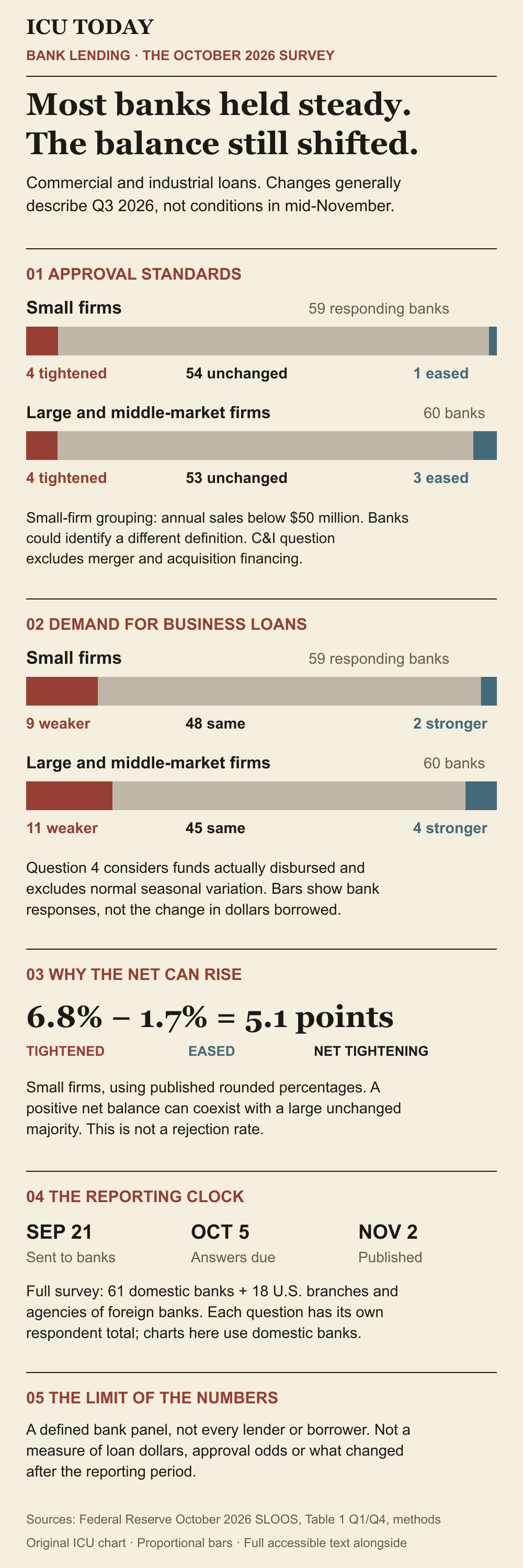
Primary-source statement · For small firms, 54 of 59 respondents said their standards were unchanged, four reported some tightening and one reported some easing. For large and middle-market firms, 53 of 60 reported unchanged standards, four tightened and three eased. The different totals matter: these are banks answering each question, not counts of businesses seeking credit. The survey’s small-firm category generally means annual sales below $50 million; the questionnaire allows banks to identify a different definition. [Federal Reserve Board]
How a small balance becomes net tightening
Primary-source statement · The Fed calculates net tightening by subtracting the share of banks easing standards from the share tightening them. For small-business lending, the published percentages are 6.8 percent tightening and 1.7 percent easing, a net 5.1 percentage points. That measure can be positive even when most banks change nothing. It is not a loan-rejection rate or a percentage decline in lending. Approval standards also differ from contract terms, such as collateral requirements or the price of a loan. [Federal Reserve Board] [Federal Reserve Board]
Demand moved in a different direction
Primary-source statement · On demand, nine of 59 banks reported weaker small-business borrowing, two reported stronger demand and 48 said it was about the same. For larger firms, 11 of 60 reported weaker demand, four stronger demand and 45 no change. The demand question asks banks to consider funds actually disbursed, excluding normal seasonal variation, rather than requests for larger credit lines. A shift in that response balance describes banks’ reported experience; it does not quantify the dollar change in borrowing. [Federal Reserve Board]
Why it matters
Primary-source statement · The Fed uses the survey to follow credit availability, demand and changing banking practices. Its methodology explains that results inform the Board and the Federal Open Market Committee through internal briefings, and also appear in public reports. The questions are mostly qualitative. Reading the underlying counts makes the survey more informative than treating a directional label as a verdict on every lender: a few banks moving one way can coexist with many reporting no change. [Federal Reserve Board]
Whose experience is represented
Primary-source statement · This round received responses from 61 domestic banks and 18 U.S. branches and agencies of foreign banks; the main summary generally describes domestic respondents. The Fed sent the survey September 21, with answers due October 5. Its methodology says the panel spans Federal Reserve districts while emphasizing larger banks, and individual questions can have fewer answers. The sample therefore needs to be read as a bank survey with a defined panel and reporting window. [Federal Reserve Board] [Federal Reserve Board]
What remains unknown
Evidence limits · These responses do not establish what terms an individual borrower would receive, how many applications were rejected or how lending has changed since the reporting period. They also do not, by themselves, identify the cause of a change in demand. The accompanying infographic keeps the approval-standards and demand questions separate, displays each denominator and shows all response categories, including the large unchanged groups. [Federal Reserve Board] [Federal Reserve Board]
Read the infographic as text
Approval standards. Small firms: 59 responding banks; 4 tightened, 54 unchanged, 1 eased. Large and middle-market firms: 60 banks; 4 tightened, 53 unchanged, 3 eased. All reported changes were in the somewhat category. These questions concern C&I loans other than financing for mergers and acquisitions. The Fed generally groups small firms by annual sales below $50 million; respondents can identify a different definition.
Demand for business loans. Small firms: 59 responding banks; 9 weaker, 48 about the same, 2 stronger. Large and middle-market firms: 60 banks; 11 weaker, 45 about the same, 4 stronger. All changes were in the moderate category. The question concerns funds actually disbursed, excluding normal seasonal variation, not requests for new or larger credit lines.
How net tightening works. Small firms: 6.8 percent tightened minus 1.7 percent eased equals 5.1 percentage points net tightening, using the Fed’s displayed rounded percentages. A positive net balance can coexist with an unchanged majority. It is not the share of loan applications rejected.
The reporting clock and sample. Survey distributed September 21, 2026; responses due October 5; published November 2. The three-month reporting period generally corresponds to the third quarter. The full survey received 61 domestic-bank responses and 18 responses from U.S. branches and agencies of foreign banks. Each displayed question has its own denominator. The main summary generally describes domestic banks.
What this can and cannot show. These are reported changes at surveyed banks. The panel spans Federal Reserve districts and emphasizes larger banks. Results do not measure the change in loan dollars, an individual borrower’s approval probability or current mid-November lending conditions. Source: Federal Reserve October 2026 SLOOS, Table 1 questions 1 and 4, and survey methodology. One institutional survey origin, not three independent confirmations.
Graphic sources: Federal Reserve Board · Federal Reserve Board · Federal Reserve Board
The developing record.
Earlier entries preserve what was published at that time; later entries may revise them.
2026-11-13T19:55:54.500Z · Initial report explaining the October bank-lending survey through response counts, separate standards and demand measures, historical reporting dates and an original detailed data infographic.
Most banks held business lending standards steady as demand softened
The Fed’s October survey shows modest net tightening for small firms and weaker business-loan demand. Its response counts explain why tighter standards do not mean most banks changed their policies.
What happened
Most banks answering the Federal Reserve’s October lending survey reported no change in their business-loan approval standards over the preceding three months. Yet the balance of responses pointed to tighter standards for small firms and weaker demand for business loans across firm sizes. Published November 2, the survey generally describes the third quarter of 2026. It is a view of that reporting period, rather than a measurement of lending conditions in mid-November. [Federal Reserve Board]
What the bank counts show
For small firms, 54 of 59 respondents said their standards were unchanged, four reported some tightening and one reported some easing. For large and middle-market firms, 53 of 60 reported unchanged standards, four tightened and three eased. The different totals matter: these are banks answering each question, not counts of businesses seeking credit. The survey’s small-firm category generally means annual sales below $50 million; the questionnaire allows banks to identify a different definition. [Federal Reserve Board]
How a small balance becomes net tightening
The Fed calculates net tightening by subtracting the share of banks easing standards from the share tightening them. For small-business lending, the published percentages are 6.8 percent tightening and 1.7 percent easing, a net 5.1 percentage points. That measure can be positive even when most banks change nothing. It is not a loan-rejection rate or a percentage decline in lending. Approval standards also differ from contract terms, such as collateral requirements or the price of a loan. [Federal Reserve Board] [Federal Reserve Board]
Demand moved in a different direction
On demand, nine of 59 banks reported weaker small-business borrowing, two reported stronger demand and 48 said it was about the same. For larger firms, 11 of 60 reported weaker demand, four stronger demand and 45 no change. The demand question asks banks to consider funds actually disbursed, excluding normal seasonal variation, rather than requests for larger credit lines. A shift in that response balance describes banks’ reported experience; it does not quantify the dollar change in borrowing. [Federal Reserve Board]
Why it matters
The Fed uses the survey to follow credit availability, demand and changing banking practices. Its methodology explains that results inform the Board and the Federal Open Market Committee through internal briefings, and also appear in public reports. The questions are mostly qualitative. Reading the underlying counts makes the survey more informative than treating a directional label as a verdict on every lender: a few banks moving one way can coexist with many reporting no change. [Federal Reserve Board]
Whose experience is represented
This round received responses from 61 domestic banks and 18 U.S. branches and agencies of foreign banks; the main summary generally describes domestic respondents. The Fed sent the survey September 21, with answers due October 5. Its methodology says the panel spans Federal Reserve districts while emphasizing larger banks, and individual questions can have fewer answers. The sample therefore needs to be read as a bank survey with a defined panel and reporting window. [Federal Reserve Board] [Federal Reserve Board]
What remains unknown
These responses do not establish what terms an individual borrower would receive, how many applications were rejected or how lending has changed since the reporting period. They also do not, by themselves, identify the cause of a change in demand. The accompanying infographic keeps the approval-standards and demand questions separate, displays each denominator and shows all response categories, including the large unchanged groups. [Federal Reserve Board] [Federal Reserve Board]
Read the infographic as text
Approval standards. Small firms: 59 responding banks; 4 tightened, 54 unchanged, 1 eased. Large and middle-market firms: 60 banks; 4 tightened, 53 unchanged, 3 eased. All reported changes were in the somewhat category. These questions concern C&I loans other than financing for mergers and acquisitions. The Fed generally groups small firms by annual sales below $50 million; respondents can identify a different definition.
Demand for business loans. Small firms: 59 responding banks; 9 weaker, 48 about the same, 2 stronger. Large and middle-market firms: 60 banks; 11 weaker, 45 about the same, 4 stronger. All changes were in the moderate category. The question concerns funds actually disbursed, excluding normal seasonal variation, not requests for new or larger credit lines.
How net tightening works. Small firms: 6.8 percent tightened minus 1.7 percent eased equals 5.1 percentage points net tightening, using the Fed’s displayed rounded percentages. A positive net balance can coexist with an unchanged majority. It is not the share of loan applications rejected.
The reporting clock and sample. Survey distributed September 21, 2026; responses due October 5; published November 2. The three-month reporting period generally corresponds to the third quarter. The full survey received 61 domestic-bank responses and 18 responses from U.S. branches and agencies of foreign banks. Each displayed question has its own denominator. The main summary generally describes domestic banks.
What this can and cannot show. These are reported changes at surveyed banks. The panel spans Federal Reserve districts and emphasizes larger banks. Results do not measure the change in loan dollars, an individual borrower’s approval probability or current mid-November lending conditions. Source: Federal Reserve October 2026 SLOOS, Table 1 questions 1 and 4, and survey methodology. One institutional survey origin, not three independent confirmations.
Graphic sources: Federal Reserve Board · Federal Reserve Board · Federal Reserve Board
Original sources
The October 2026 Senior Loan Officer Opinion Survey on Bank Lending Practices · Issuer: Federal Reserve Board · Published 2026-11-02
October 2026 SLOOS, Table 1: domestic-bank responses · Issuer: Federal Reserve Board · Published 2026-11-02
About the Senior Loan Officer Opinion Survey · Issuer: Federal Reserve Board · Updated 2025-02-03
Corrections
No corrections recorded.