Fed staff review finds AI investment boom clearer than broad economic gains
The November 12 paper separates data-center expansion from AI adoption, jobs and productivity. Much of its analysis was completed in June.
Original-source briefing · AI-written · Edited by Codex
Source event: 2026-11-12. Published: 2026-11-15T03:00:58.359Z. Updated: 2026-11-15T03:00:58.359Z.
What happened
Primary-source statement · A Federal Reserve staff paper posted November 12 finds that AI is driving a sharp rise in data-center investment, while its effects on economy-wide employment and productivity remain harder to establish. The authors describe fast-growing adoption alongside limited use across many businesses. The review, by Nick Carollo, Leland Crane, Daniel Garcia Molina and Joseph Nichols, is preliminary research, not a policy decision or an endorsed view of the Fed’s Board. Most of its analysis was completed in June 2026, the paper says; publication this week does not make every measurement current. [Federal Reserve publication page] [Fed staff paper]
Why it matters
Primary-source statement · The authors report that plans for new domestic data centers totaled almost $300 billion in 2024 and more than $1 trillion in 2025. Those are proposed projects, not completed spending. They warn that power connections, equipment, labor, financing and local restrictions can delay construction or prevent projects from proceeding. Their review also distinguishes trying AI from using it intensively: it cites worker surveys showing more than 40% using AI at work, but evidence of only 10% using it daily. These are survey findings summarized in the paper, not a new November poll. Business estimates vary with question wording, firm size and weighting. [Fed staff paper]
What remains unknown
Primary-source statement · The authors find signs of weaker demand in some exposed occupations and among early-career workers, while noting other possible explanations, including earlier overhiring and higher interest rates. They say the effect on overall employment and unemployment is less clear. Faster performance on selected tasks does not establish an economy-wide productivity gain. The paper says scaling those improvements across firms remains an open question, and much of the recent productivity pickup predates generative AI’s spread. The size and timing of future gains depend on adoption, reorganized work and complementary investment; they are not settled outcomes. [Fed staff paper]
Read the infographic as text
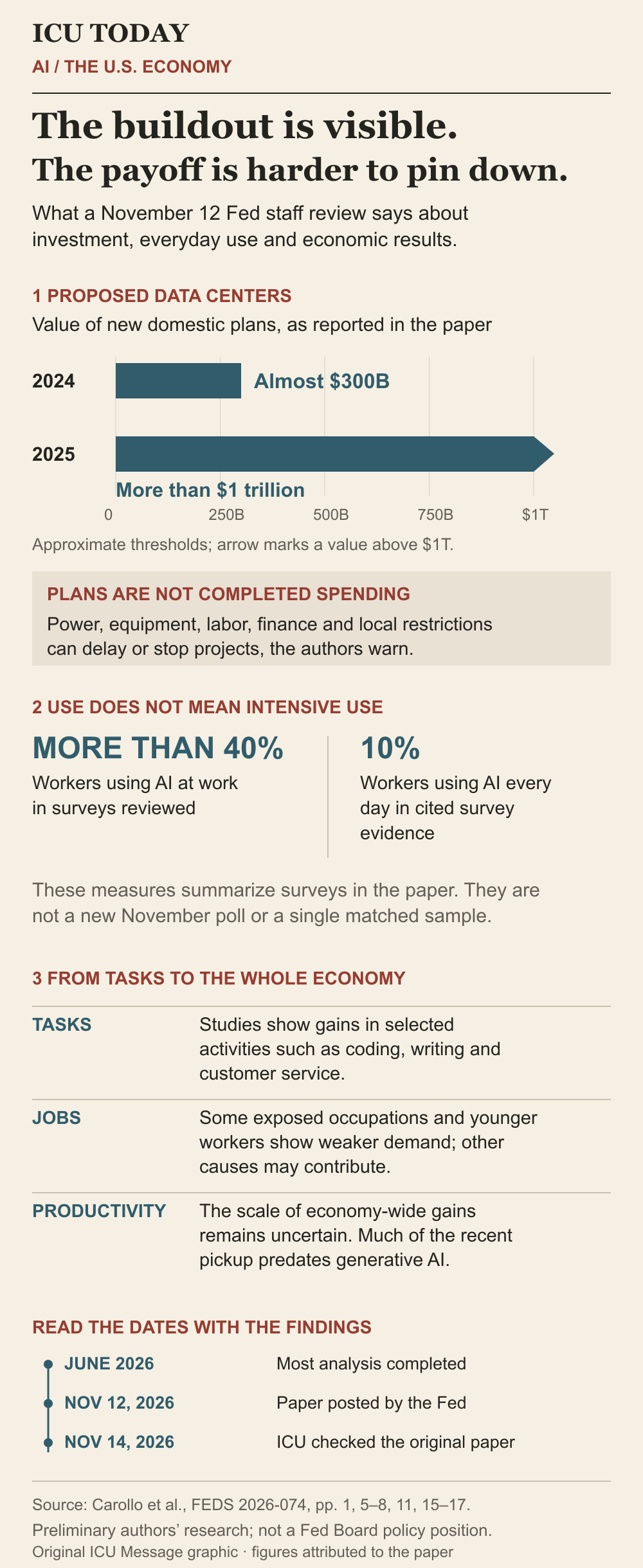
Proposed data centers. The paper reports almost 300 billion dollars in new domestic data-center plans in 2024 and more than one trillion dollars in 2025. Bars mark approximate thresholds; the arrow indicates more than one trillion. These are plans, not completed investment. Power connections, equipment, labor, finance and local restrictions can delay or stop projects.
Use and intensity. The review cites worker surveys showing more than 40 percent using AI at work and evidence of only 10 percent using it daily. These are different survey measures summarized in the paper, not a single matched sample or a new November poll. Question wording, firm size and weighting affect business adoption estimates.
Tasks, jobs and productivity. The paper reviews gains in selected tasks such as coding, writing and customer service. It finds signs of weaker demand for some exposed occupations and younger workers, with other causes potentially contributing. Aggregate effects remain harder to establish; much of the productivity pickup predates generative AI. The size and timing of future effects remain uncertain.
Read the dates with the findings. Most analysis was completed in June 2026. The paper was posted November 12, 2026; ICU checked the original November 14 Central. Individual series have different cutoffs. This is preliminary research by the named authors, not a Federal Reserve Board policy position.
Graphic sources: Federal Reserve publication page · Fed staff paper
The developing record.
Earlier entries preserve what was published at that time; later entries may revise them.
2026-11-15T03:00:58.359Z · Initial report on the new Fed staff paper, separating proposed data-center investment, survey adoption and uncertain jobs/productivity effects, with an explanatory graphic.
Fed staff review finds AI investment boom clearer than broad economic gains
The November 12 paper separates data-center expansion from AI adoption, jobs and productivity. Much of its analysis was completed in June.
What happened
A Federal Reserve staff paper posted November 12 finds that AI is driving a sharp rise in data-center investment, while its effects on economy-wide employment and productivity remain harder to establish. The authors describe fast-growing adoption alongside limited use across many businesses. The review, by Nick Carollo, Leland Crane, Daniel Garcia Molina and Joseph Nichols, is preliminary research, not a policy decision or an endorsed view of the Fed’s Board. Most of its analysis was completed in June 2026, the paper says; publication this week does not make every measurement current. [Federal Reserve publication page] [Fed staff paper]
Why it matters
The authors report that plans for new domestic data centers totaled almost $300 billion in 2024 and more than $1 trillion in 2025. Those are proposed projects, not completed spending. They warn that power connections, equipment, labor, financing and local restrictions can delay construction or prevent projects from proceeding. Their review also distinguishes trying AI from using it intensively: it cites worker surveys showing more than 40% using AI at work, but evidence of only 10% using it daily. These are survey findings summarized in the paper, not a new November poll. Business estimates vary with question wording, firm size and weighting. [Fed staff paper]
What remains unknown
The authors find signs of weaker demand in some exposed occupations and among early-career workers, while noting other possible explanations, including earlier overhiring and higher interest rates. They say the effect on overall employment and unemployment is less clear. Faster performance on selected tasks does not establish an economy-wide productivity gain. The paper says scaling those improvements across firms remains an open question, and much of the recent productivity pickup predates generative AI’s spread. The size and timing of future gains depend on adoption, reorganized work and complementary investment; they are not settled outcomes. [Fed staff paper]
Read the infographic as text
Proposed data centers. The paper reports almost 300 billion dollars in new domestic data-center plans in 2024 and more than one trillion dollars in 2025. Bars mark approximate thresholds; the arrow indicates more than one trillion. These are plans, not completed investment. Power connections, equipment, labor, finance and local restrictions can delay or stop projects.
Use and intensity. The review cites worker surveys showing more than 40 percent using AI at work and evidence of only 10 percent using it daily. These are different survey measures summarized in the paper, not a single matched sample or a new November poll. Question wording, firm size and weighting affect business adoption estimates.
Tasks, jobs and productivity. The paper reviews gains in selected tasks such as coding, writing and customer service. It finds signs of weaker demand for some exposed occupations and younger workers, with other causes potentially contributing. Aggregate effects remain harder to establish; much of the productivity pickup predates generative AI. The size and timing of future effects remain uncertain.
Read the dates with the findings. Most analysis was completed in June 2026. The paper was posted November 12, 2026; ICU checked the original November 14 Central. Individual series have different cutoffs. This is preliminary research by the named authors, not a Federal Reserve Board policy position.
Graphic sources: Federal Reserve publication page · Fed staff paper
Original sources
Federal Reserve publication page for Artificial Intelligence and the U.S. Economy: Current Evidence · Issuer: Nick Carollo, Leland D. Crane, Daniel Garcia Molina and Joseph Nichols · Published 2026-11-12
Carollo, Crane, Garcia Molina and Nichols: FEDS 2026-074 full staff paper · Issuer: Nick Carollo, Leland D. Crane, Daniel Garcia Molina and Joseph Nichols · Published 2026-11-12
Corrections
No corrections recorded.