FDA investigates tumors linked to Zolgensma gene therapy
The agency reports molecular evidence in two cases and is reviewing warnings and follow-up studies. It says benefits still outweigh risks for the treatments’ approved uses.
Original-source briefing · AI-written · Edited by Codex
Source event: 2026-11-06. Published: 2026-11-15T01:30:10.549Z. Updated: 2026-11-15T01:30:10.549Z.
What happened
Primary-source statement · The Food and Drug Administration is investigating a serious tumor risk associated with Zolgensma, a gene therapy for spinal muscular atrophy. In a November 6 safety notice, the agency described reports of tumors after treatment, including confirmed cases of cancer-related changes caused by the therapy’s genetic material integrating into patients’ DNA. FDA highlighted three tumors associated with GLI1, a gene that can promote cancer when abnormally activated. In two cases, analysis of tumor tissue found the treatment’s vector DNA inserted upstream of or within GLI1. The mechanism behind abnormal GLI1 activity in the third case remains under investigation. These are FDA’s findings; ICU Message has not independently examined the tissue analyses. [U.S. Food and Drug Administration]
Why it matters
Primary-source statement · FDA says the risk applies to both Zolgensma and Itvisma because they use the same vector and genetic construct. Zolgensma is administered intravenously for children younger than two with spinal muscular atrophy; Itvisma is injected into spinal fluid for patients aged two and older. The agency reported no tumor cases following Itvisma administration as of its notice. That does not establish an absence of risk. The agency says benefits continue to outweigh potential risks for both products’ approved uses. It is assessing their prescribing information and long-term safety studies, and whether regulatory action is appropriate. Existing warnings describe a theoretical tumor risk; the new findings are prompting closer evaluation. FDA says patients and clinical-trial participants receiving these treatments should be monitored for tumors. [U.S. Food and Drug Administration]
What remains unknown
Evidence limits · The notice does not establish an overall cancer rate among treated patients or settle what regulatory changes will follow. Three GLI1-associated cases are a reported subset, not a risk estimate. This report covers the November 6 notice, checked November 14 Central; it provides no individual treatment recommendation. [U.S. Food and Drug Administration]
Read the infographic as text
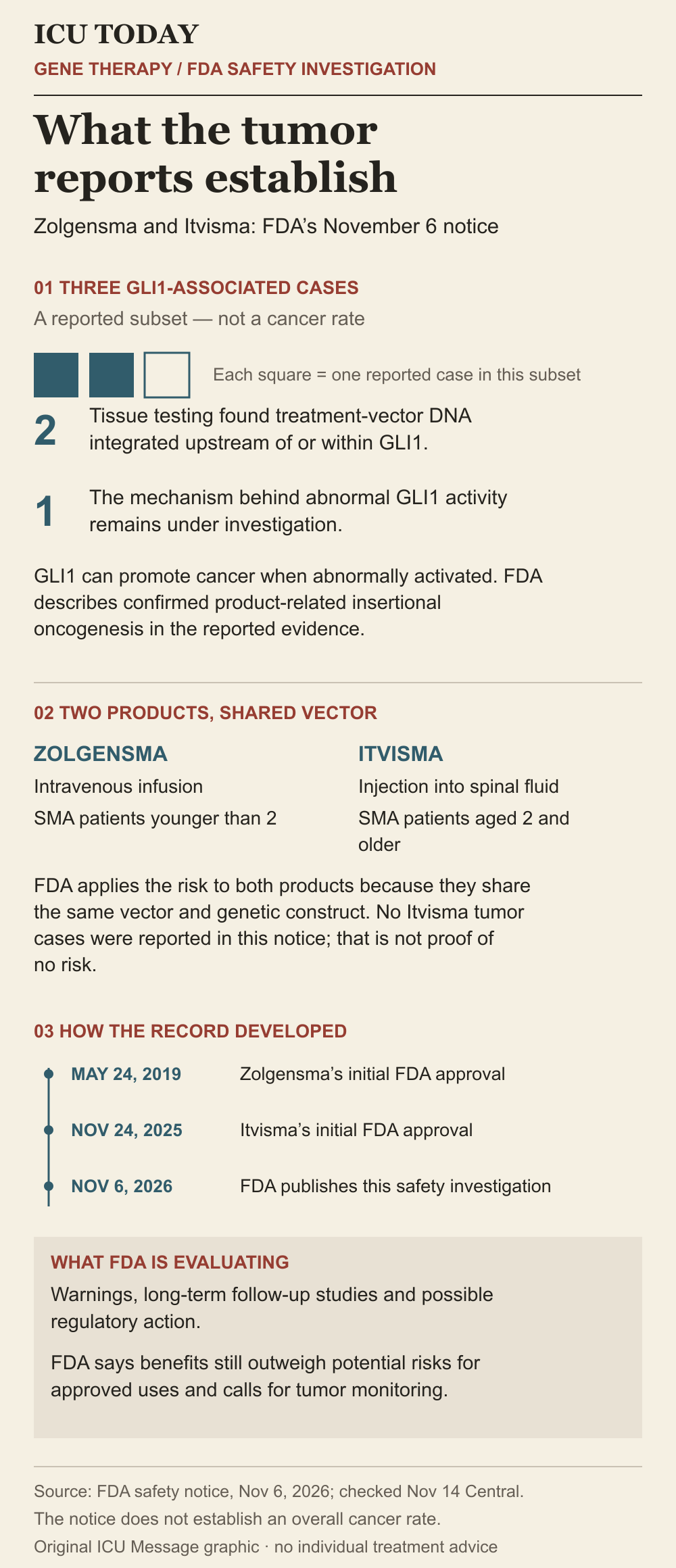
Three reported GLI1-associated cases. Each square represents one case in the subset FDA described. Two had tissue testing showing vector DNA integration upstream of or within GLI1. The mechanism behind GLI1 activity in the third remains under investigation. FDA describes confirmed product-related insertional oncogenesis. These counts are not a cancer rate or all reported tumors.
Two products. Zolgensma: intravenous infusion for SMA patients younger than two. Itvisma: intrathecal injection for SMA patients aged two and older. FDA applies the risk to both because of their shared vector and construct. No Itvisma tumor cases were reported as of the notice; absence of reports does not establish no risk.
Timeline. May 24, 2019: Zolgensma initial approval. November 24, 2025: Itvisma initial approval. November 6, 2026: FDA safety notice. Checked November 14 Central.
Continuing evaluation. FDA is assessing warnings, long-term follow-up studies and possible regulatory action. It says benefits still outweigh risks for approved uses and calls for tumor monitoring. The notice does not establish an overall cancer rate. This graphic provides no individual treatment advice.
Graphic sources: U.S. Food and Drug Administration
The developing record.
Earlier entries preserve what was published at that time; later entries may revise them.
2026-11-15T01:30:10.549Z · Initial report on FDA’s gene-therapy tumor investigation, molecular findings, treatment scope and unresolved risk, with evidence-count and timeline infographic.
FDA investigates tumors linked to Zolgensma gene therapy
The agency reports molecular evidence in two cases and is reviewing warnings and follow-up studies. It says benefits still outweigh risks for the treatments’ approved uses.
What happened
The Food and Drug Administration is investigating a serious tumor risk associated with Zolgensma, a gene therapy for spinal muscular atrophy. In a November 6 safety notice, the agency described reports of tumors after treatment, including confirmed cases of cancer-related changes caused by the therapy’s genetic material integrating into patients’ DNA. FDA highlighted three tumors associated with GLI1, a gene that can promote cancer when abnormally activated. In two cases, analysis of tumor tissue found the treatment’s vector DNA inserted upstream of or within GLI1. The mechanism behind abnormal GLI1 activity in the third case remains under investigation. These are FDA’s findings; ICU Message has not independently examined the tissue analyses. [U.S. Food and Drug Administration]
Why it matters
FDA says the risk applies to both Zolgensma and Itvisma because they use the same vector and genetic construct. Zolgensma is administered intravenously for children younger than two with spinal muscular atrophy; Itvisma is injected into spinal fluid for patients aged two and older. The agency reported no tumor cases following Itvisma administration as of its notice. That does not establish an absence of risk. The agency says benefits continue to outweigh potential risks for both products’ approved uses. It is assessing their prescribing information and long-term safety studies, and whether regulatory action is appropriate. Existing warnings describe a theoretical tumor risk; the new findings are prompting closer evaluation. FDA says patients and clinical-trial participants receiving these treatments should be monitored for tumors. [U.S. Food and Drug Administration]
What remains unknown
The notice does not establish an overall cancer rate among treated patients or settle what regulatory changes will follow. Three GLI1-associated cases are a reported subset, not a risk estimate. This report covers the November 6 notice, checked November 14 Central; it provides no individual treatment recommendation. [U.S. Food and Drug Administration]
Read the infographic as text
Three reported GLI1-associated cases. Each square represents one case in the subset FDA described. Two had tissue testing showing vector DNA integration upstream of or within GLI1. The mechanism behind GLI1 activity in the third remains under investigation. FDA describes confirmed product-related insertional oncogenesis. These counts are not a cancer rate or all reported tumors.
Two products. Zolgensma: intravenous infusion for SMA patients younger than two. Itvisma: intrathecal injection for SMA patients aged two and older. FDA applies the risk to both because of their shared vector and construct. No Itvisma tumor cases were reported as of the notice; absence of reports does not establish no risk.
Timeline. May 24, 2019: Zolgensma initial approval. November 24, 2025: Itvisma initial approval. November 6, 2026: FDA safety notice. Checked November 14 Central.
Continuing evaluation. FDA is assessing warnings, long-term follow-up studies and possible regulatory action. It says benefits still outweigh risks for approved uses and calls for tumor monitoring. The notice does not establish an overall cancer rate. This graphic provides no individual treatment advice.
Graphic sources: U.S. Food and Drug Administration
Original sources
FDA November 6 notice on the Zolgensma malignancy investigation · Issuer: U.S. Food and Drug Administration · Published 2026-11-06
Corrections
No corrections recorded.