FDA approves first treatment for a form of limb-girdle muscular dystrophy
The approval covers one genetic subtype. The FDA cited a 112-person trial that tracked walking speed and lung function.
Original-source briefing · AI-written · Edited by Codex
Source event: 2026-11-23. Published: 2026-11-24T02:56:57.025Z. Updated: 2026-11-24T02:56:57.025Z.
What happened
Primary-source statement · The U.S. Food and Drug Administration approved Welgemda, also called ribitol, on November 23 for a rare inherited disease that progressively weakens muscles. The approval covers adults and children weighing at least 30 kilograms who have limb-girdle muscular dystrophy type 2I/R9. The FDA described it as the first treatment it has approved for any form of limb-girdle muscular dystrophy. The authorization applies to this particular form of the disease. [U.S. Food and Drug Administration]
Why it matters
Primary-source statement · Walking and breathing were two of the functions researchers tracked. The FDA based its decision on a blinded trial involving 112 people whose diagnosis had been confirmed by genetic testing. Participants were assigned at random to receive the medicine or a placebo. At a planned comparison after 12 months, the FDA reported that the group receiving Welgemda improved on a timed 100-meter walk and on a measure of how much air a person can forcibly breathe out, compared with the placebo group. [U.S. Food and Drug Administration]
What remains unknown
Primary-source statement · The study called for follow-up of up to 36 months. The announcement describes the 12-month comparison and gives no numerical estimate of the difference between the groups on either test. It also says the precise way the medicine acts in this disease remains uncertain. The most common adverse reactions reported in the announcement included diarrhea, stomach pain and joint pain. [U.S. Food and Drug Administration]
Read the infographic as text
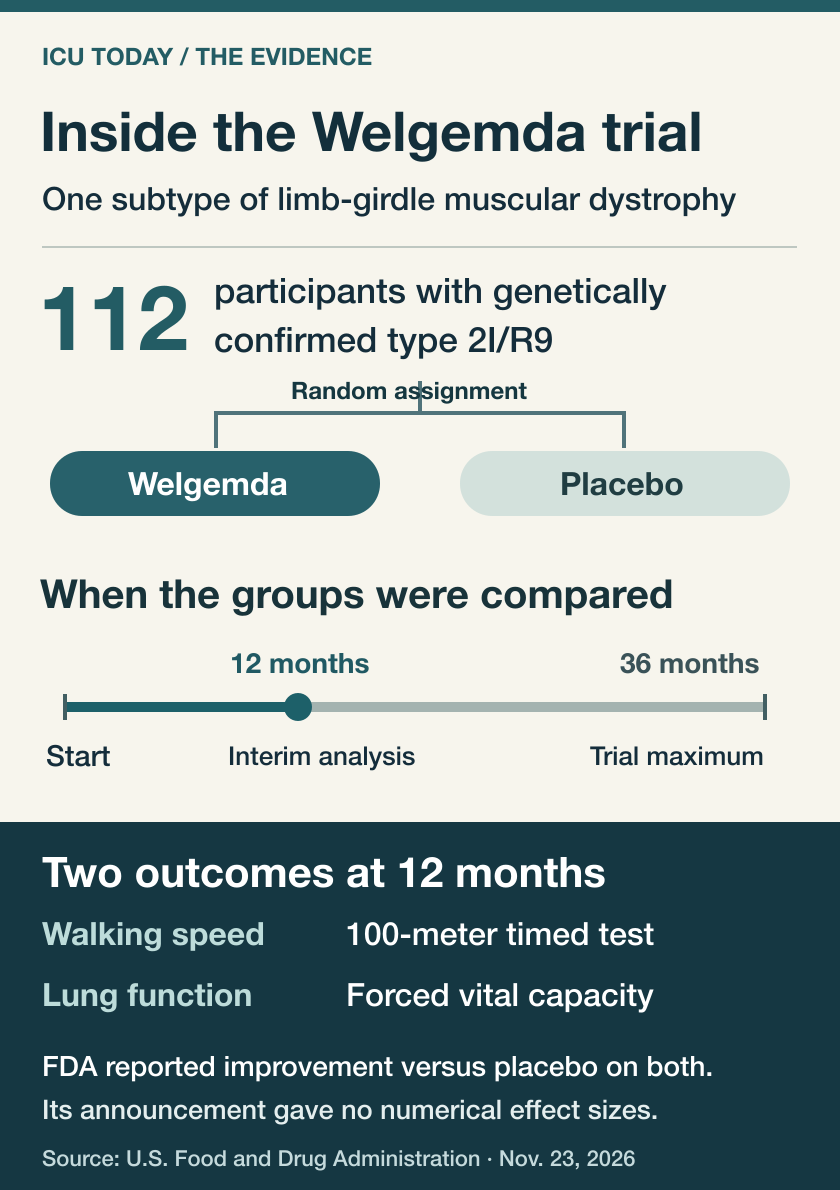
Who was studied. 112 participants had genetically confirmed limb-girdle muscular dystrophy type 2I/R9. Participants were assigned at random to Welgemda or placebo.
When researchers compared the groups. A planned analysis at 12 months compared the treatment groups. The trial allowed treatment for up to 36 months.
What changed at 12 months. The FDA reported better walking speed on a 100-meter timed test and better forced vital capacity in the medicine group relative to placebo. The release did not give numerical differences between groups.
Graphic sources: U.S. Food and Drug Administration
The developing record.
Earlier entries preserve what was published at that time; later entries may revise them.
2026-11-24T02:56:57.025Z · FDA approved ribitol for limb-girdle muscular dystrophy type 2I/R9 in patients weighing at least 30 kilograms.
FDA approves first treatment for a form of limb-girdle muscular dystrophy
The approval covers one genetic subtype. The FDA cited a 112-person trial that tracked walking speed and lung function.
What happened
The U.S. Food and Drug Administration approved Welgemda, also called ribitol, on November 23 for a rare inherited disease that progressively weakens muscles. The approval covers adults and children weighing at least 30 kilograms who have limb-girdle muscular dystrophy type 2I/R9. The FDA described it as the first treatment it has approved for any form of limb-girdle muscular dystrophy. The authorization applies to this particular form of the disease. [U.S. Food and Drug Administration]
Why it matters
Walking and breathing were two of the functions researchers tracked. The FDA based its decision on a blinded trial involving 112 people whose diagnosis had been confirmed by genetic testing. Participants were assigned at random to receive the medicine or a placebo. At a planned comparison after 12 months, the FDA reported that the group receiving Welgemda improved on a timed 100-meter walk and on a measure of how much air a person can forcibly breathe out, compared with the placebo group. [U.S. Food and Drug Administration]
What remains unknown
The study called for follow-up of up to 36 months. The announcement describes the 12-month comparison and gives no numerical estimate of the difference between the groups on either test. It also says the precise way the medicine acts in this disease remains uncertain. The most common adverse reactions reported in the announcement included diarrhea, stomach pain and joint pain. [U.S. Food and Drug Administration]
Read the infographic as text
Who was studied. 112 participants had genetically confirmed limb-girdle muscular dystrophy type 2I/R9. Participants were assigned at random to Welgemda or placebo.
When researchers compared the groups. A planned analysis at 12 months compared the treatment groups. The trial allowed treatment for up to 36 months.
What changed at 12 months. The FDA reported better walking speed on a 100-meter timed test and better forced vital capacity in the medicine group relative to placebo. The release did not give numerical differences between groups.
Graphic sources: U.S. Food and Drug Administration
Original sources
FDA Approves First Treatment for Limb-Girdle Muscular Dystrophy Type 2I/R9 · Issuer: U.S. Food and Drug Administration · Published 2026-11-23
Corrections
No corrections recorded.