FDA approves Sunharbo for stroke prevention after certain strokes or TIAs
The new factor XIa inhibitor joins antiplatelet treatment after specified strokes or TIAs. The FDA reports a reduction in ischemic stroke risk, with important bleeding cautions.
Original-source briefing · AI-written · Edited by Codex
Source event: 2026-11-09. Published: 2026-11-14T18:25:09.939Z. Updated: 2026-11-14T18:25:09.939Z.
What happened
Primary-source statement · The Food and Drug Administration approved Sunharbo (asundexian) on November 9 for adults after a recent mild-to-moderate non-cardioembolic ischemic stroke, caused by a clot that did not originate in the heart, or a high-risk transient ischemic attack. The FDA says it is the first approved factor XIa inhibitor and is used with antiplatelet therapy. The approval went to Bayer HealthCare Pharmaceuticals. It does not cover stroke prevention in patients with atrial fibrillation. [U.S. Food and Drug Administration]
Why it matters
Primary-source statement · The FDA based the decision on OCEANIC-STROKE, a randomized, double-blind study involving 12,327 adults. Participants were assigned Sunharbo or placebo within 72 hours of symptom onset; both groups received antiplatelet therapy. The agency reports a 26% reduction in ischemic stroke risk with Sunharbo over a median treatment period of 14.2 months. That is a relative reduction, not a 26-percentage-point decrease in every patient's chance of stroke. The safety findings complicate a simple benefit headline. According to the FDA, major bleeding was similar overall between groups but increased with Sunharbo among patients older than 75 and during the first 90 days of treatment. Gastrointestinal bleeding was more common with the drug, and diarrhea was the most frequently reported adverse reaction. [U.S. Food and Drug Administration]
What remains unknown
Evidence limits · The FDA announcement does not provide absolute stroke event rates for the two groups, so it cannot show how many people would need treatment to prevent one additional stroke. It also does not give a price or commercial launch date. The approval concerns the specified recent-stroke or high-risk-TIA population; it is not a general approval for every cause of stroke or evidence that Sunharbo outperforms other anticoagulants. [U.S. Food and Drug Administration]
Read the infographic as text
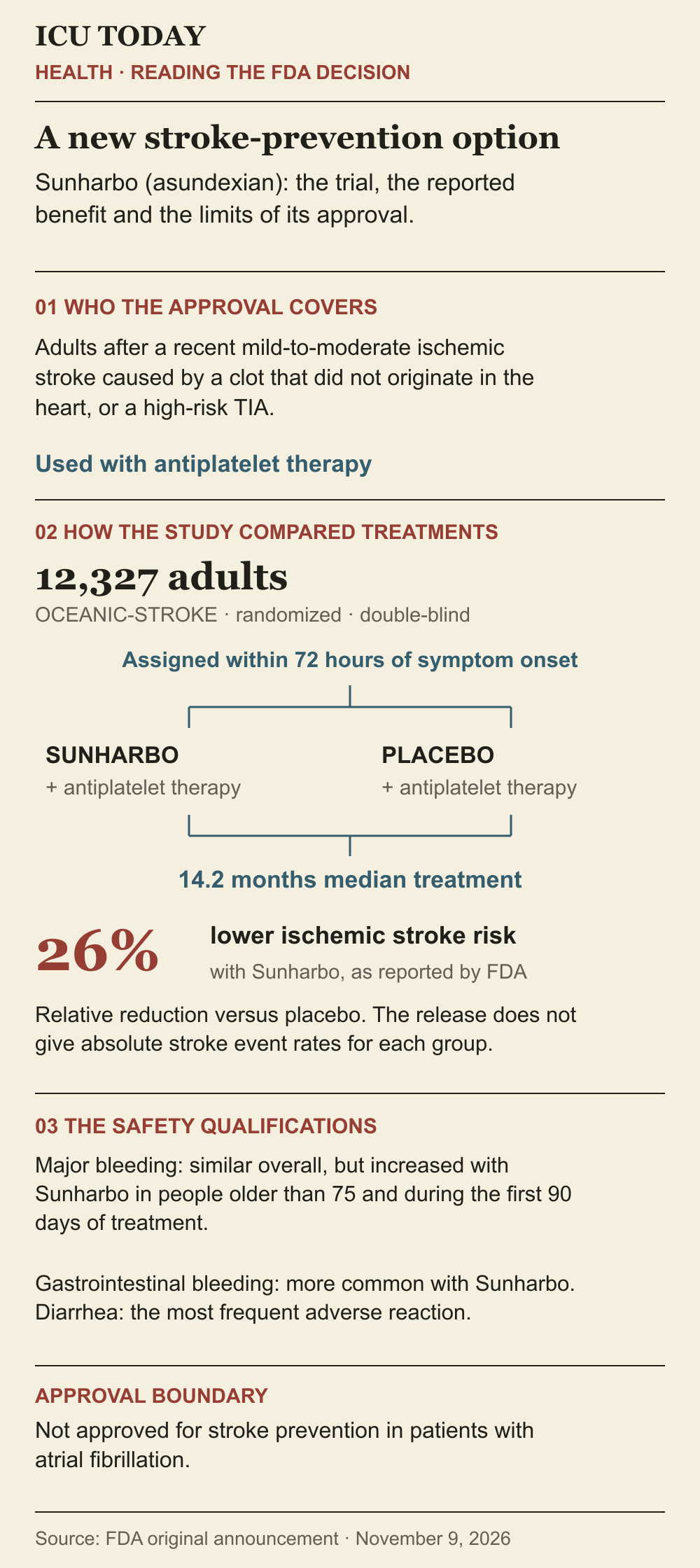
Who the approval covers. Adults after a recent mild-to-moderate non-cardioembolic ischemic stroke—a clot that did not originate in the heart—or a high-risk transient ischemic attack. Sunharbo is used with antiplatelet therapy.
How the trial compared treatments. OCEANIC-STROKE enrolled 12,327 adults in a randomized, double-blind comparison. Participants were assigned within 72 hours of symptom onset to Sunharbo or placebo. Both groups received antiplatelet therapy. Median treatment was 14.2 months.
Reported benefit and its limits. FDA reports 26% lower ischemic stroke risk with Sunharbo versus placebo. This is relative reduction, not 26 percentage points or an individual guarantee. The release does not give absolute stroke event rates for each group.
Safety qualifications and approval boundary. Major bleeding was similar overall but increased with Sunharbo in patients older than 75 and during the first 90 days of treatment. Gastrointestinal bleeding was more common; diarrhea was the most frequent adverse reaction. Sunharbo is not approved for stroke prevention in patients with atrial fibrillation. Source: FDA, November 9, 2026.
Graphic sources: U.S. Food and Drug Administration
The developing record.
Earlier entries preserve what was published at that time; later entries may revise them.
2026-11-14T18:25:09.939Z · Initial report on the FDA’s November 9 Sunharbo approval, the trial comparison, relative risk reduction and bleeding/indication limits.
FDA approves Sunharbo for stroke prevention after certain strokes or TIAs
The new factor XIa inhibitor joins antiplatelet treatment after specified strokes or TIAs. The FDA reports a reduction in ischemic stroke risk, with important bleeding cautions.
What happened
The Food and Drug Administration approved Sunharbo (asundexian) on November 9 for adults after a recent mild-to-moderate non-cardioembolic ischemic stroke, caused by a clot that did not originate in the heart, or a high-risk transient ischemic attack. The FDA says it is the first approved factor XIa inhibitor and is used with antiplatelet therapy. The approval went to Bayer HealthCare Pharmaceuticals. It does not cover stroke prevention in patients with atrial fibrillation. [U.S. Food and Drug Administration]
Why it matters
The FDA based the decision on OCEANIC-STROKE, a randomized, double-blind study involving 12,327 adults. Participants were assigned Sunharbo or placebo within 72 hours of symptom onset; both groups received antiplatelet therapy. The agency reports a 26% reduction in ischemic stroke risk with Sunharbo over a median treatment period of 14.2 months. That is a relative reduction, not a 26-percentage-point decrease in every patient's chance of stroke. The safety findings complicate a simple benefit headline. According to the FDA, major bleeding was similar overall between groups but increased with Sunharbo among patients older than 75 and during the first 90 days of treatment. Gastrointestinal bleeding was more common with the drug, and diarrhea was the most frequently reported adverse reaction. [U.S. Food and Drug Administration]
What remains unknown
The FDA announcement does not provide absolute stroke event rates for the two groups, so it cannot show how many people would need treatment to prevent one additional stroke. It also does not give a price or commercial launch date. The approval concerns the specified recent-stroke or high-risk-TIA population; it is not a general approval for every cause of stroke or evidence that Sunharbo outperforms other anticoagulants. [U.S. Food and Drug Administration]
Read the infographic as text
Who the approval covers. Adults after a recent mild-to-moderate non-cardioembolic ischemic stroke—a clot that did not originate in the heart—or a high-risk transient ischemic attack. Sunharbo is used with antiplatelet therapy.
How the trial compared treatments. OCEANIC-STROKE enrolled 12,327 adults in a randomized, double-blind comparison. Participants were assigned within 72 hours of symptom onset to Sunharbo or placebo. Both groups received antiplatelet therapy. Median treatment was 14.2 months.
Reported benefit and its limits. FDA reports 26% lower ischemic stroke risk with Sunharbo versus placebo. This is relative reduction, not 26 percentage points or an individual guarantee. The release does not give absolute stroke event rates for each group.
Safety qualifications and approval boundary. Major bleeding was similar overall but increased with Sunharbo in patients older than 75 and during the first 90 days of treatment. Gastrointestinal bleeding was more common; diarrhea was the most frequent adverse reaction. Sunharbo is not approved for stroke prevention in patients with atrial fibrillation. Source: FDA, November 9, 2026.
Graphic sources: U.S. Food and Drug Administration
Original sources
FDA approves first factor XIa inhibitor to help prevent stroke in certain adults at high risk · Issuer: U.S. Food and Drug Administration · Published 2026-11-09
Corrections
No corrections recorded.