FDA switches to “SI” in new documents and explains what its watermarks mean
The agency is changing the language it uses for artificial intelligence. It says a watermark can reflect help with editing alone, and the change adds no new requirement for product submissions.
Original-source briefing · AI-written · Edited by Codex
Source event: 2026-11-16. Published: 2026-11-19T14:51:26.499Z. Updated: 2026-11-19T14:51:26.499Z.
What happened
Primary-source statement · The Food and Drug Administration began using “Super Intelligence,” or “SI,” for artificial intelligence in new public communications on November 16, where the law permits. The FDA says the change adds no new requirement for the people and companies that send it product information. That includes manufacturers submitting established names, trade names or labeling. The agency’s updated technology resource page already uses SI and links readers to information for drugs, medical devices and other regulated products. [FDA] [FDA]
Why it matters
Primary-source statement · Someone looking up a device can now find SI on an FDA webpage and AI in a regulation that page cites. The FDA says it will preserve the wording when quoting laws and regulations. Previously issued documents continue to apply as written. The agency plans to change terminology in existing public documents at their next substantive revision. For forms, electronic submission templates and databases, the timing depends on their regular maintenance schedules. [FDA]
What remains unknown
Primary-source statement · The words on a document and the way it was prepared are separate questions. The FDA says some of its documents may carry a machine-readable watermark applied by a technology provider. Such a mark can appear even if a tool helped only with editing or formatting, so the mark alone cannot tell a reader how much assistance went into a particular review. According to the agency, its staff make the regulatory decisions and remain responsible for the documents they issue. [FDA]
Read the infographic as text
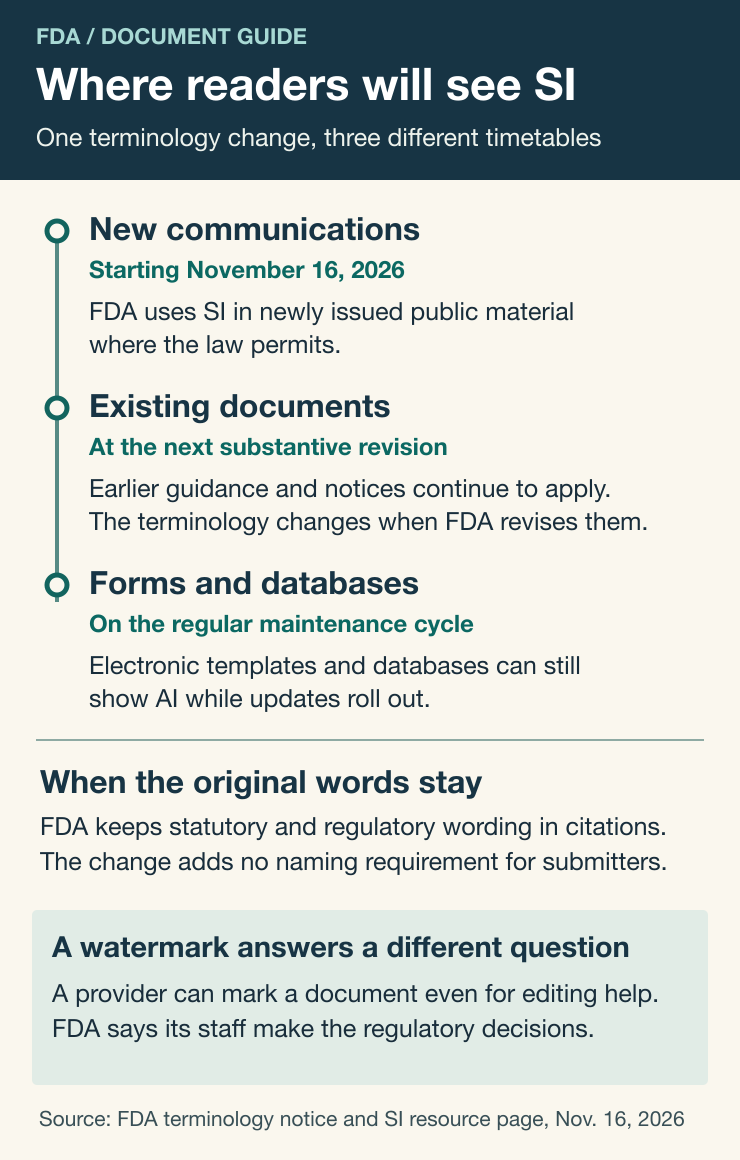
Which wording appears when. New FDA communications use SI where permitted, starting November 16, 2026. Existing documents keep their force and take on updated terms when substantively revised. Forms, electronic templates and databases follow routine maintenance.
Which words stay. When the FDA quotes or cites statutes or regulations, it retains their wording. The naming policy adds no new naming or labeling condition for companies submitting information.
What a watermark can show. A provider may apply a machine-readable mark even for help with editing or formatting. FDA says its staff own the content and make regulatory decisions.
The developing record.
Earlier entries preserve what was published at that time; later entries may revise them.
2026-11-19T14:51:26.499Z · The FDA explained its November 16 terminology change and how provider watermarks can appear in agency documents.
FDA switches to “SI” in new documents and explains what its watermarks mean
The agency is changing the language it uses for artificial intelligence. It says a watermark can reflect help with editing alone, and the change adds no new requirement for product submissions.
What happened
The Food and Drug Administration began using “Super Intelligence,” or “SI,” for artificial intelligence in new public communications on November 16, where the law permits. The FDA says the change adds no new requirement for the people and companies that send it product information. That includes manufacturers submitting established names, trade names or labeling. The agency’s updated technology resource page already uses SI and links readers to information for drugs, medical devices and other regulated products. [FDA] [FDA]
Why it matters
Someone looking up a device can now find SI on an FDA webpage and AI in a regulation that page cites. The FDA says it will preserve the wording when quoting laws and regulations. Previously issued documents continue to apply as written. The agency plans to change terminology in existing public documents at their next substantive revision. For forms, electronic submission templates and databases, the timing depends on their regular maintenance schedules. [FDA]
What remains unknown
The words on a document and the way it was prepared are separate questions. The FDA says some of its documents may carry a machine-readable watermark applied by a technology provider. Such a mark can appear even if a tool helped only with editing or formatting, so the mark alone cannot tell a reader how much assistance went into a particular review. According to the agency, its staff make the regulatory decisions and remain responsible for the documents they issue. [FDA]
Read the infographic as text
Which wording appears when. New FDA communications use SI where permitted, starting November 16, 2026. Existing documents keep their force and take on updated terms when substantively revised. Forms, electronic templates and databases follow routine maintenance.
Which words stay. When the FDA quotes or cites statutes or regulations, it retains their wording. The naming policy adds no new naming or labeling condition for companies submitting information.
What a watermark can show. A provider may apply a machine-readable mark even for help with editing or formatting. FDA says its staff own the content and make regulatory decisions.
Original sources
FDA’s use of SI terminology under Executive Order 14434 · Issuer: U.S. Food and Drug Administration · Updated 2026-11-16
FDA and Super Intelligence · Issuer: U.S. Food and Drug Administration · Updated 2026-11-16
Corrections
No corrections recorded.