FDA approves pimicotinib for adults facing difficult tumor surgery
The approval covers a defined group with symptomatic tenosynovial giant cell tumor. FDA reports a higher tumor-response rate than placebo, alongside important safety warnings.
Original-source briefing · AI-written · Edited by Codex
Source event: 2026-11-10. Published: 2026-11-14T00:27:58.841Z. Updated: 2026-11-14T00:27:58.841Z.
What happened
Primary-source statement · The Food and Drug Administration approved pimicotinib, sold as Pimjetmi by EMD Serono, on November 10 for adults with symptomatic tenosynovial giant cell tumor, or TGCT, when removing the tumor surgically could worsen physical function or cause serious harm. The authorization is tied to that clinical situation; it is not an approval for every person with TGCT or a finding that drug treatment should replace surgery for everyone. [FDA]
Why it matters
Primary-source statement · FDA based its efficacy assessment on MANEUVER, an international, randomized, double-blind trial comparing pimicotinib with placebo. Participants had symptomatic, measurable TGCT, including at least one lesion measuring two centimeters or more, and faced potential dysfunction or serious complications from surgery. Patients were assigned to the drug or placebo in a two-to-one ratio. That trial population matters when interpreting the results. [FDA]
What the study measured
Primary-source statement · At week 25, FDA reports an overall tumor-response rate of 56 percent with pimicotinib and 3.2 percent with placebo, assessed by a blinded central review under the study’s RECIST criteria. The respective 95-percent confidence intervals were 42–68 percent and 0.1–17 percent. These are tumor-response results, not cure rates. FDA also reports improvements in affected-joint movement, patient-reported pain and physical functioning compared with placebo; its announcement does not give the numerical size of those improvements. [FDA]
An earlier treatment milestone
Primary-source statement · This is not the first FDA approval for this clinical problem. In February 2025, the agency approved vimseltinib, sold as Romvimza, for symptomatic TGCT when surgery could worsen function or cause serious harm. That decision drew on a different placebo-controlled trial, MOTION. The two announcements establish separate regulatory milestones; neither reports a direct comparison between the drugs. Their response rates should not be treated as a head-to-head ranking. [FDA] [FDA]
Safety remains part of the decision
Primary-source statement · FDA lists itching, rash, swelling, fatigue, nausea and headache among common adverse reactions with pimicotinib. Its announcement also identifies warnings for liver toxicity, harm to an embryo or fetus, and increased blood creatinine without an effect on kidney function. Those warnings accompany the efficacy findings; the reported response rate does not establish that treatment is suitable for a particular patient. [FDA]
What remains unknown
Primary-source statement · The reviewed FDA announcements do not establish comparative effectiveness between pimicotinib and other treatments, a cure rate, retail availability or patient cost. This report describes the regulator’s assessment of submitted evidence, not an independent reanalysis of patient data. It provides no individualized treatment or dosing recommendation. [FDA] [FDA]
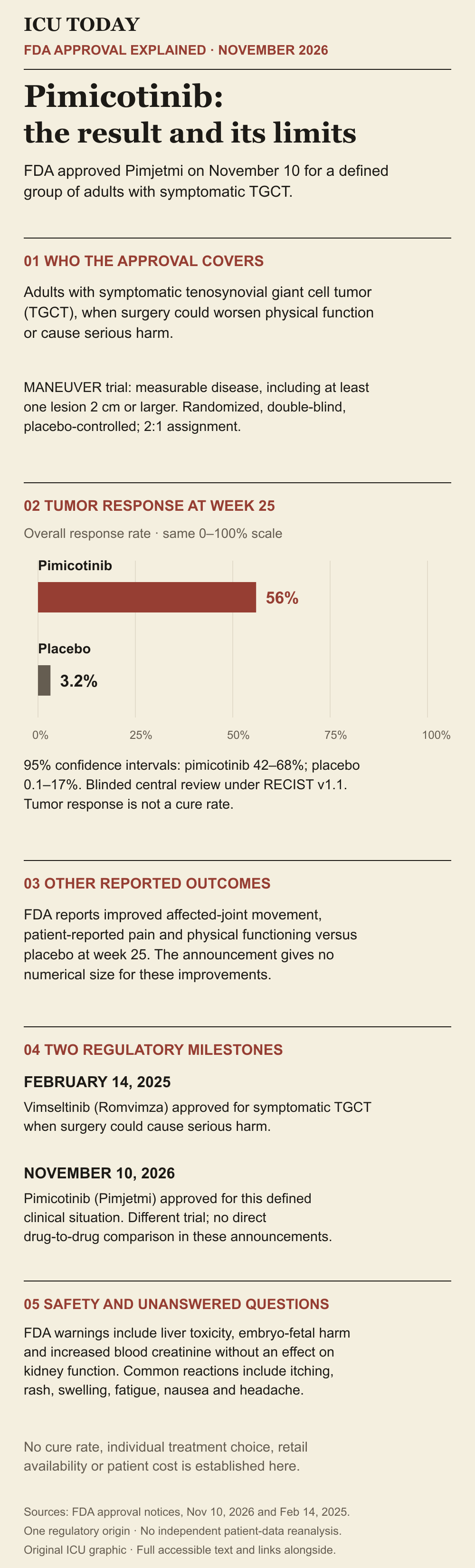
Read the infographic as text
Who the approval covers. FDA approved pimicotinib (Pimjetmi) on November 10, 2026 for adults with symptomatic tenosynovial giant cell tumor (TGCT) when surgery may worsen function or cause serious harm. MANEUVER enrolled patients with measurable disease, including at least one lesion 2 cm or larger. The international randomized double-blind placebo-controlled trial assigned patients 2:1 to pimicotinib or placebo.
Tumor response at week 25. FDA reports overall response rates of 56 percent with pimicotinib and 3.2 percent with placebo, assessed by blinded independent central review using RECIST v1.1. Respective 95 percent confidence intervals: 42–68 percent and 0.1–17 percent. Both bars use the same 0–100 percent scale with a zero baseline. Tumor response is not a cure rate.
Other reported outcomes. FDA reports statistically significant improvements in affected-joint movement, patient-reported pain and physical functioning compared with placebo at week 25. Its announcement does not give the numerical size of these improvements.
Two regulatory milestones. February 14, 2025: FDA approved vimseltinib (Romvimza) for symptomatic TGCT when surgery could worsen function or cause serious harm. November 10, 2026: FDA approved pimicotinib (Pimjetmi) for this defined clinical situation. The approvals relied on different placebo-controlled trials; the announcements contain no direct comparison between the drugs.
Safety and unanswered questions. FDA’s pimicotinib announcement includes warnings for liver toxicity, harm to an embryo or fetus, and increased blood creatinine without an effect on kidney function. Common reactions include itching, rash, swelling, fatigue, nausea and headache. These announcements do not establish a cure rate, an individual treatment choice, retail availability or patient cost. This is one regulator’s account, not independent reanalysis of patient data; this ICU report gives no dosing advice. Sources: the FDA pimicotinib approval of November 10, 2026 and vimseltinib approval of February 14, 2025.
The developing record.
Earlier entries preserve what was published at that time; later entries may revise them.
2026-11-14T00:27:58.841Z · Initial report on FDA’s pimicotinib approval, the trial’s tumor-response findings, safety warnings and limits of comparison with other treatments, with a detailed original infographic.
FDA approves pimicotinib for adults facing difficult tumor surgery
The approval covers a defined group with symptomatic tenosynovial giant cell tumor. FDA reports a higher tumor-response rate than placebo, alongside important safety warnings.
What happened
The Food and Drug Administration approved pimicotinib, sold as Pimjetmi by EMD Serono, on November 10 for adults with symptomatic tenosynovial giant cell tumor, or TGCT, when removing the tumor surgically could worsen physical function or cause serious harm. The authorization is tied to that clinical situation; it is not an approval for every person with TGCT or a finding that drug treatment should replace surgery for everyone. [FDA]
Why it matters
FDA based its efficacy assessment on MANEUVER, an international, randomized, double-blind trial comparing pimicotinib with placebo. Participants had symptomatic, measurable TGCT, including at least one lesion measuring two centimeters or more, and faced potential dysfunction or serious complications from surgery. Patients were assigned to the drug or placebo in a two-to-one ratio. That trial population matters when interpreting the results. [FDA]
What the study measured
At week 25, FDA reports an overall tumor-response rate of 56 percent with pimicotinib and 3.2 percent with placebo, assessed by a blinded central review under the study’s RECIST criteria. The respective 95-percent confidence intervals were 42–68 percent and 0.1–17 percent. These are tumor-response results, not cure rates. FDA also reports improvements in affected-joint movement, patient-reported pain and physical functioning compared with placebo; its announcement does not give the numerical size of those improvements. [FDA]
An earlier treatment milestone
This is not the first FDA approval for this clinical problem. In February 2025, the agency approved vimseltinib, sold as Romvimza, for symptomatic TGCT when surgery could worsen function or cause serious harm. That decision drew on a different placebo-controlled trial, MOTION. The two announcements establish separate regulatory milestones; neither reports a direct comparison between the drugs. Their response rates should not be treated as a head-to-head ranking. [FDA] [FDA]
Safety remains part of the decision
FDA lists itching, rash, swelling, fatigue, nausea and headache among common adverse reactions with pimicotinib. Its announcement also identifies warnings for liver toxicity, harm to an embryo or fetus, and increased blood creatinine without an effect on kidney function. Those warnings accompany the efficacy findings; the reported response rate does not establish that treatment is suitable for a particular patient. [FDA]
What remains unknown
The reviewed FDA announcements do not establish comparative effectiveness between pimicotinib and other treatments, a cure rate, retail availability or patient cost. This report describes the regulator’s assessment of submitted evidence, not an independent reanalysis of patient data. It provides no individualized treatment or dosing recommendation. [FDA] [FDA]
Read the infographic as text
Who the approval covers. FDA approved pimicotinib (Pimjetmi) on November 10, 2026 for adults with symptomatic tenosynovial giant cell tumor (TGCT) when surgery may worsen function or cause serious harm. MANEUVER enrolled patients with measurable disease, including at least one lesion 2 cm or larger. The international randomized double-blind placebo-controlled trial assigned patients 2:1 to pimicotinib or placebo.
Tumor response at week 25. FDA reports overall response rates of 56 percent with pimicotinib and 3.2 percent with placebo, assessed by blinded independent central review using RECIST v1.1. Respective 95 percent confidence intervals: 42–68 percent and 0.1–17 percent. Both bars use the same 0–100 percent scale with a zero baseline. Tumor response is not a cure rate.
Other reported outcomes. FDA reports statistically significant improvements in affected-joint movement, patient-reported pain and physical functioning compared with placebo at week 25. Its announcement does not give the numerical size of these improvements.
Two regulatory milestones. February 14, 2025: FDA approved vimseltinib (Romvimza) for symptomatic TGCT when surgery could worsen function or cause serious harm. November 10, 2026: FDA approved pimicotinib (Pimjetmi) for this defined clinical situation. The approvals relied on different placebo-controlled trials; the announcements contain no direct comparison between the drugs.
Safety and unanswered questions. FDA’s pimicotinib announcement includes warnings for liver toxicity, harm to an embryo or fetus, and increased blood creatinine without an effect on kidney function. Common reactions include itching, rash, swelling, fatigue, nausea and headache. These announcements do not establish a cure rate, an individual treatment choice, retail availability or patient cost. This is one regulator’s account, not independent reanalysis of patient data; this ICU report gives no dosing advice. Sources: the FDA pimicotinib approval of November 10, 2026 and vimseltinib approval of February 14, 2025.
Original sources
FDA approves pimicotinib for symptomatic tenosynovial giant cell tumor · Issuer: U.S. Food and Drug Administration · Updated 2026-11-10
FDA approves vimseltinib for symptomatic tenosynovial giant cell tumor · Issuer: U.S. Food and Drug Administration · Updated 2025-02-14
Corrections
No corrections recorded.