FDA will sample medicines at pharmacies and wholesalers to check what reaches patients
The agency plans to screen more products and use confirmatory tests on selected samples. Its launch documents describe how the checks work and leave their reach unquantified.
Original-source briefing · AI-written · Edited by Codex
Source event: 2026-11-18. Published: 2026-11-20T12:51:17.503Z. Updated: 2026-11-20T12:51:17.503Z.
What happened
Primary-source statement · The Food and Drug Administration will collect drug samples from retail pharmacies and wholesale distributors under a program it announced November 18. The FDA says sampling at those points will let it examine medicines closer to the point where people receive them. It plans to include drugs made in the United States and abroad and to cover a broader range of manufacturers and kinds of medicine with the resources already available. [U.S. Food and Drug Administration] [U.S. Food and Drug Administration]
Why it matters
Primary-source statement · The tests ask three different questions about a sample. Identity checks whether the expected active ingredient is present. Purity testing looks for impurities. Potency testing measures how much of the active ingredient the product contains. Under the Enhanced Approach for Sampling and Testing, known as EAST, the agency will combine faster screening with conventional laboratory methods. If a sample is referred for further evaluation, it will undergo confirmatory testing using established methods. A referral alone does not establish that a medicine failed a quality standard. [U.S. Food and Drug Administration]
What remains unknown
Primary-source statement · The FDA says the results can help it decide where to inspect next and whether a regulatory response is warranted. It plans to report findings through its drug quality sampling program. The November 18 announcement and program description give no sample total, timetable for the first results or estimate of how often testing will uncover a problem. They describe a new way to look for quality issues and identify no medicine for patients to stop taking. [U.S. Food and Drug Administration] [U.S. Food and Drug Administration]
Read the infographic as text
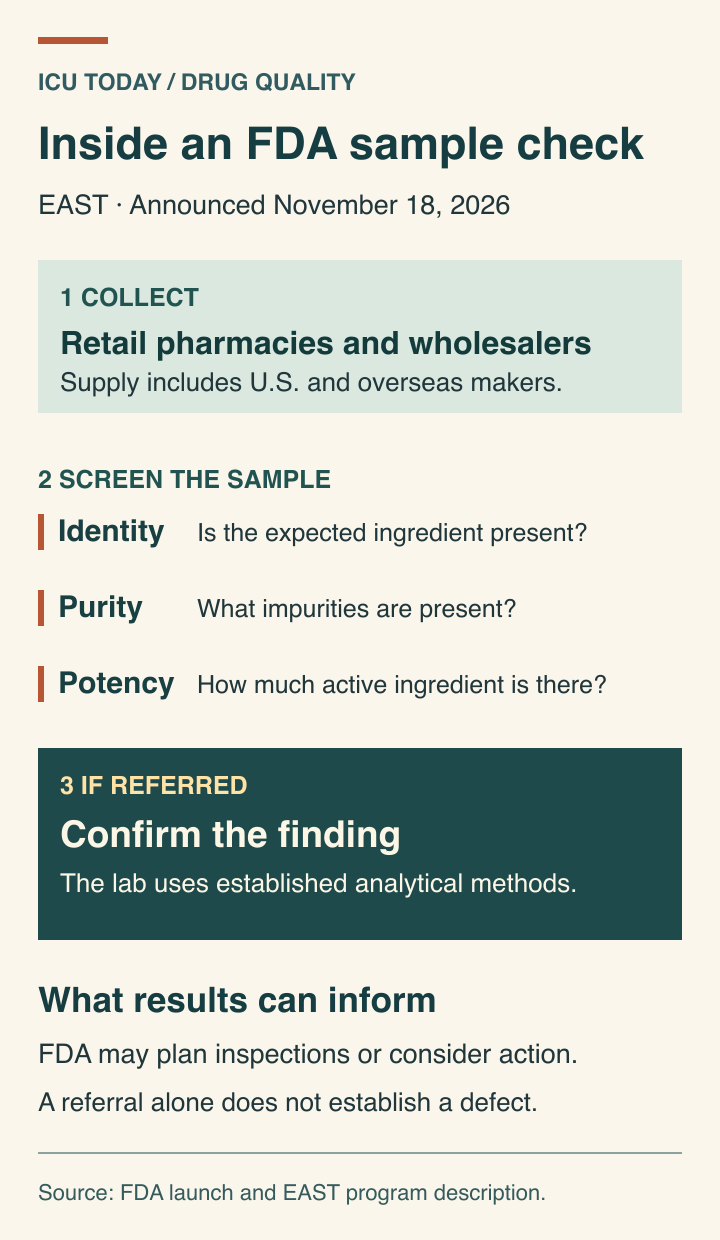
Where the sample comes from. FDA plans to collect medicines at retail pharmacies and wholesale distributors, including drugs from domestic and overseas manufacturers.
Three questions in the lab. Identity checks for the expected active ingredient. Purity examines impurities. Potency measures how much active ingredient is present.
What happens to a referral. Samples referred for further evaluation undergo established confirmatory tests. Results can inform inspections and decisions on regulatory action. The announcement gives no sample count or first results date.
Graphic sources: U.S. Food and Drug Administration · U.S. Food and Drug Administration
The developing record.
Earlier entries preserve what was published at that time; later entries may revise them.
2026-11-20T12:51:17.503Z · FDA described sampling sites, three quality checks and follow-up testing.
FDA will sample medicines at pharmacies and wholesalers to check what reaches patients
The agency plans to screen more products and use confirmatory tests on selected samples. Its launch documents describe how the checks work and leave their reach unquantified.
What happened
The Food and Drug Administration will collect drug samples from retail pharmacies and wholesale distributors under a program it announced November 18. The FDA says sampling at those points will let it examine medicines closer to the point where people receive them. It plans to include drugs made in the United States and abroad and to cover a broader range of manufacturers and kinds of medicine with the resources already available. [U.S. Food and Drug Administration] [U.S. Food and Drug Administration]
Why it matters
The tests ask three different questions about a sample. Identity checks whether the expected active ingredient is present. Purity testing looks for impurities. Potency testing measures how much of the active ingredient the product contains. Under the Enhanced Approach for Sampling and Testing, known as EAST, the agency will combine faster screening with conventional laboratory methods. If a sample is referred for further evaluation, it will undergo confirmatory testing using established methods. A referral alone does not establish that a medicine failed a quality standard. [U.S. Food and Drug Administration]
What remains unknown
The FDA says the results can help it decide where to inspect next and whether a regulatory response is warranted. It plans to report findings through its drug quality sampling program. The November 18 announcement and program description give no sample total, timetable for the first results or estimate of how often testing will uncover a problem. They describe a new way to look for quality issues and identify no medicine for patients to stop taking. [U.S. Food and Drug Administration] [U.S. Food and Drug Administration]
Read the infographic as text
Where the sample comes from. FDA plans to collect medicines at retail pharmacies and wholesale distributors, including drugs from domestic and overseas manufacturers.
Three questions in the lab. Identity checks for the expected active ingredient. Purity examines impurities. Potency measures how much active ingredient is present.
What happens to a referral. Samples referred for further evaluation undergo established confirmatory tests. Results can inform inspections and decisions on regulatory action. The announcement gives no sample count or first results date.
Graphic sources: U.S. Food and Drug Administration · U.S. Food and Drug Administration
Original sources
FDA introduces new approach to drug quality sampling and testing · Issuer: U.S. Food and Drug Administration · Published 2026-11-18
FDA’s Enhanced Approach for Sampling and Testing · Issuer: U.S. Food and Drug Administration · Updated 2026-11-18
Corrections
No corrections recorded.