FDA approves Lembaz to reduce risk of death in infantile-onset Niemann-Pick type C
FDA reported longer median survival among treated patients than in an outside comparison group. The drug carries a boxed warning for hearing loss that can be permanent.
Original-source briefing · AI-written · Edited by Codex
Source event: 2026-11-17. Published: 2026-11-17T23:44:50.175Z. Updated: 2026-11-17T23:44:50.175Z.
What happened
Primary-source statement · The Food and Drug Administration approved Lembaz on November 17 for adults and children with Niemann-Pick disease type C whose neurological symptoms began before their sixth birthday. Patients must weigh at least 7 kilograms, about 15 pounds. The age limit applies to when symptoms first appeared. Someone who developed symptoms as a small child can still fall within the approved group as an adult. FDA says this is the first treatment for the disease shown to reduce the risk of death. [U.S. Food and Drug Administration]
Why it matters
Primary-source statement · In this inherited disorder, cells have trouble processing cholesterol and other fats. As these substances build up in the brain, people can lose the ability to coordinate movements or swallow. Earlier approvals addressed different outcomes. In 2024, for example, FDA approved Miplyffa with miglustat to treat neurological symptoms in patients ages two and older. For Lembaz, the agency examined survival among 36 people who received the drug across three studies and an expanded access program. Median survival was 8.5 years in the treated group and 4.9 years in a matched group drawn from outside those studies. [U.S. Food and Drug Administration] [U.S. Food and Drug Administration]
What remains unknown
Primary-source statement · Those two figures describe groups. They cannot tell a family how much longer one person will live. FDA’s announcement identifies the comparison group as external and gives neither its size nor a range of uncertainty around the survival estimates. The treatment also carries a serious risk. Its boxed warning covers hearing impairment, including permanent hearing loss. FDA calls for hearing evaluations before treatment starts and regularly during treatment. [U.S. Food and Drug Administration]
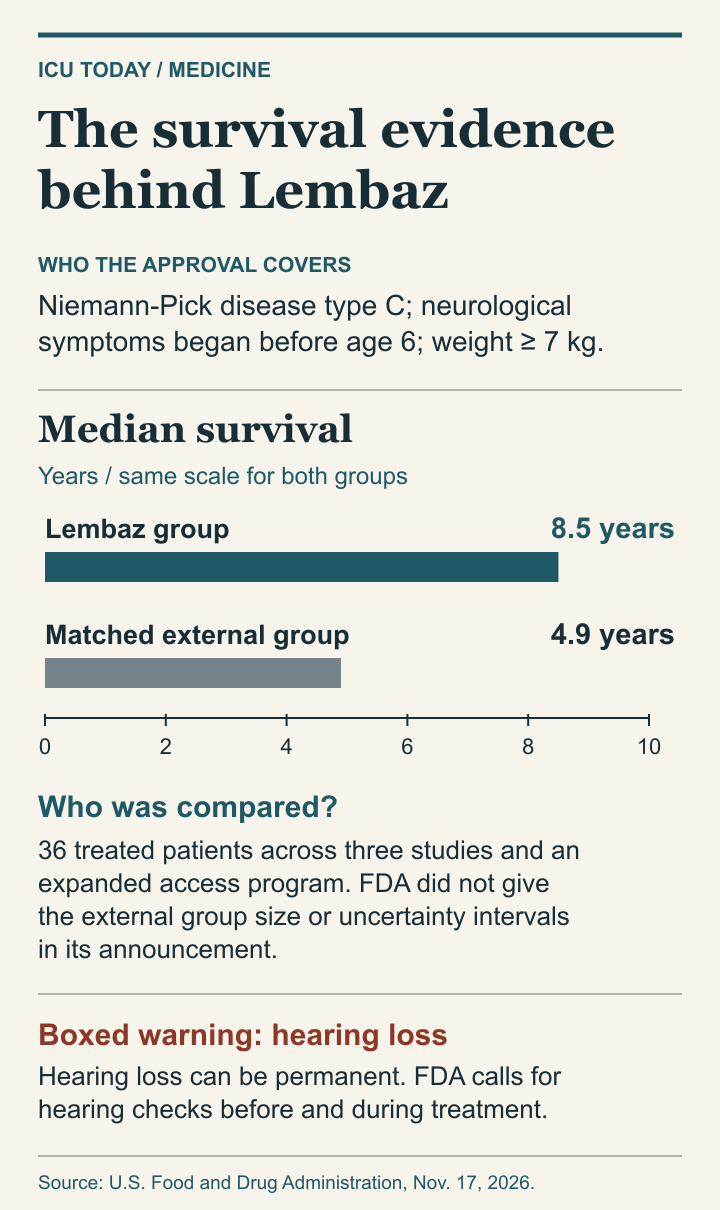
Read the infographic as text
Who the approval covers. Adults and children weighing at least 7 kg whose neurological symptoms of Niemann-Pick disease type C began before age six.
Median survival in FDA’s comparison. The treated group had a median survival of 8.5 years. The matched external group had a median survival of 4.9 years. The graphic uses the same zero-to-ten-year scale for both bars. The treated group included 36 patients across three studies and expanded access. The announcement omits the size of the external group and uncertainty intervals.
Boxed warning. Hearing impairment can be permanent. FDA calls for hearing checks before and during treatment. Group medians cannot predict an individual patient’s survival.
Graphic sources: U.S. Food and Drug Administration
The developing record.
Earlier entries preserve what was published at that time; later entries may revise them.
2026-11-17T23:44:50.175Z · Initial report on the November 17 FDA decision, survival comparison and boxed hearing warning.
FDA approves Lembaz to reduce risk of death in infantile-onset Niemann-Pick type C
FDA reported longer median survival among treated patients than in an outside comparison group. The drug carries a boxed warning for hearing loss that can be permanent.
What happened
The Food and Drug Administration approved Lembaz on November 17 for adults and children with Niemann-Pick disease type C whose neurological symptoms began before their sixth birthday. Patients must weigh at least 7 kilograms, about 15 pounds. The age limit applies to when symptoms first appeared. Someone who developed symptoms as a small child can still fall within the approved group as an adult. FDA says this is the first treatment for the disease shown to reduce the risk of death. [U.S. Food and Drug Administration]
Why it matters
In this inherited disorder, cells have trouble processing cholesterol and other fats. As these substances build up in the brain, people can lose the ability to coordinate movements or swallow. Earlier approvals addressed different outcomes. In 2024, for example, FDA approved Miplyffa with miglustat to treat neurological symptoms in patients ages two and older. For Lembaz, the agency examined survival among 36 people who received the drug across three studies and an expanded access program. Median survival was 8.5 years in the treated group and 4.9 years in a matched group drawn from outside those studies. [U.S. Food and Drug Administration] [U.S. Food and Drug Administration]
What remains unknown
Those two figures describe groups. They cannot tell a family how much longer one person will live. FDA’s announcement identifies the comparison group as external and gives neither its size nor a range of uncertainty around the survival estimates. The treatment also carries a serious risk. Its boxed warning covers hearing impairment, including permanent hearing loss. FDA calls for hearing evaluations before treatment starts and regularly during treatment. [U.S. Food and Drug Administration]
Read the infographic as text
Who the approval covers. Adults and children weighing at least 7 kg whose neurological symptoms of Niemann-Pick disease type C began before age six.
Median survival in FDA’s comparison. The treated group had a median survival of 8.5 years. The matched external group had a median survival of 4.9 years. The graphic uses the same zero-to-ten-year scale for both bars. The treated group included 36 patients across three studies and expanded access. The announcement omits the size of the external group and uncertainty intervals.
Boxed warning. Hearing impairment can be permanent. FDA calls for hearing checks before and during treatment. Group medians cannot predict an individual patient’s survival.
Graphic sources: U.S. Food and Drug Administration
Original sources
FDA Approves First Drug Shown to Help Patients with Infantile-Onset Niemann-Pick Disease Type C Live Longer · Issuer: U.S. Food and Drug Administration · Published 2026-11-17
FDA Approves First Treatment for Niemann-Pick Disease, Type C · Issuer: U.S. Food and Drug Administration · Published 2024-09-20
Corrections
No corrections recorded.