FDA approves a head-and-neck cancer treatment; long-term benefit still needs confirmation
The November 5 decision covers a specific group of adults. Its trial measured tumor response, with follow-up studies required to establish clinical benefit.
Original-source briefing · AI-written · Edited by Codex
Source event: 2026-11-05. Published: 2026-11-15T21:02:46.359Z. Updated: 2026-11-15T21:02:46.359Z.
What happened
Primary-source statement · The FDA granted accelerated approval on November 5 to Rybrevant Faspro, a combination of amivantamab and hyaluronidase-lpuj, for certain adults with recurrent or metastatic head and neck squamous cell carcinoma. The indication covers disease that progressed on or after platinum-based chemotherapy and immunotherapy. It excludes oropharyngeal squamous cell carcinoma associated with human papillomavirus, or HPV. This is a report on that dated regulatory decision, not a new approval announced this weekend. [U.S. Food and Drug Administration]
Why it matters
Primary-source statement · The decision offers an additional treatment option for the specified patients while leaving an important question open: whether the observed tumor responses translate into meaningful long-term benefit. In the open-label, multicenter trial described by the FDA, 42% of 102 patients had tumors shrink or disappear. Among the patients who responded, 56% had a response lasting at least six months. Those percentages use different denominators: the second describes responders, not everyone enrolled. Neither number, by itself, establishes longer survival. The FDA said it required confirmatory studies. Its accelerated-approval framework allows earlier access based on measures expected to predict benefit, with further studies required to confirm that benefit. [U.S. Food and Drug Administration] [U.S. Food and Drug Administration]
What remains unknown
Evidence limits · The FDA announcement does not establish a confirmed long-term clinical benefit, a survival advantage over another treatment, or an individual patient's likely outcome. It lists warnings about hypersensitivity and administration-related reactions, lung inflammation, skin reactions, eye toxicity and harm to an unborn baby. Approval therefore should not be read as a claim of risk-free treatment. This account reports the FDA's decision and trial summary; it is not an independent clinical assessment or a recommendation about anyone's care. [U.S. Food and Drug Administration]
This reports a specific FDA approval and its stated evidence limits. It is not medical advice or an individual treatment recommendation.
Read the infographic as text
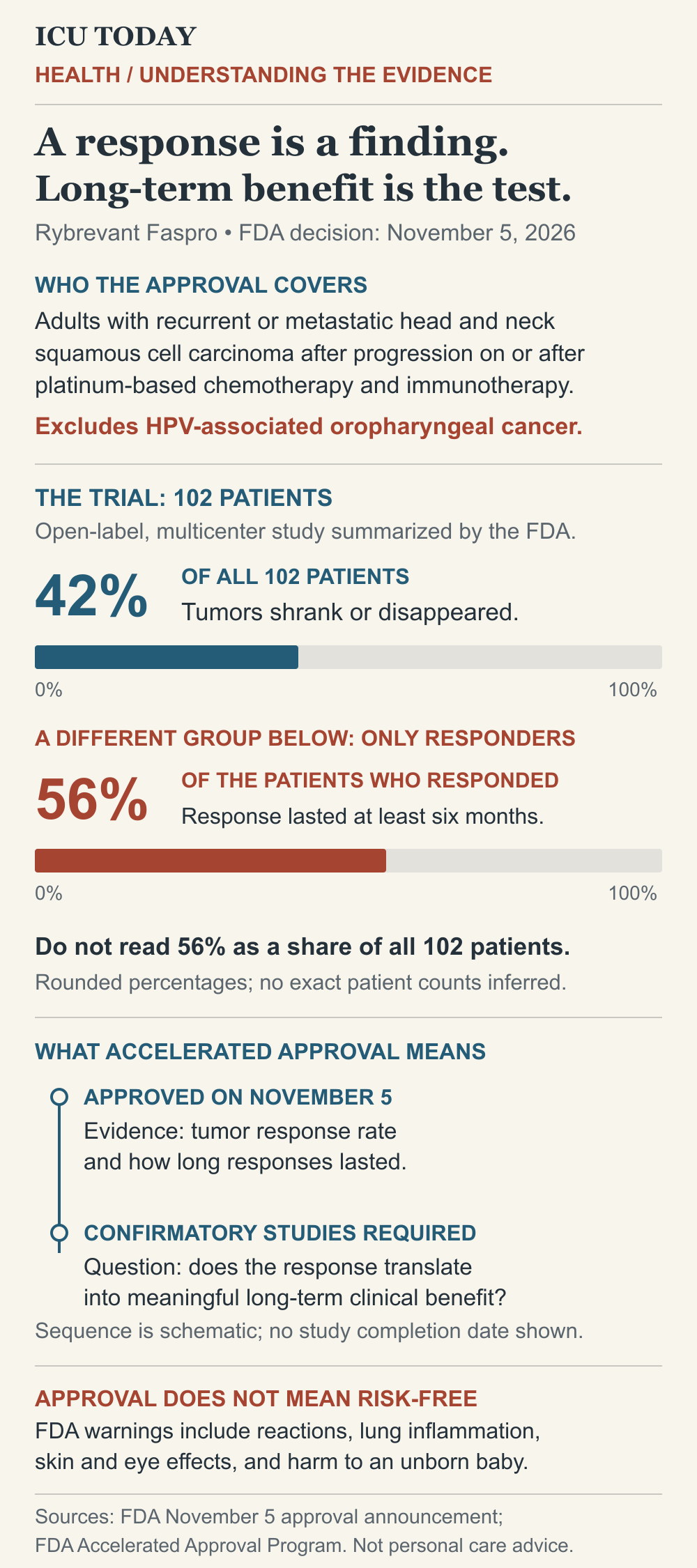
Who the approval covers. Rybrevant Faspro: adults with recurrent or metastatic head and neck squamous cell carcinoma whose disease progressed on or after platinum-based chemotherapy and immunotherapy. The indication excludes HPV-associated oropharyngeal squamous cell carcinoma.
Two percentages, two denominators. In the FDA summary of an open-label multicenter study of 102 patients, 42% of all patients had tumors shrink or disappear. Of those who responded, 56% had a response lasting at least six months. Each bar uses a 0–100% scale within its own group. The second percentage is not a share of all 102 participants. Percentages are rounded; exact patient counts are not inferred.
Approval and confirmation. November 5, 2026: accelerated approval based on response rate and duration. Confirmatory studies required to establish meaningful long-term clinical benefit. This schematic sequence does not provide a trial completion date. Tumor response is not by itself proof of longer survival.
Safety and source limits. FDA warnings include hypersensitivity and administration-related reactions, lung inflammation, skin reactions, eye toxicity and harm to an unborn baby. Approval does not mean risk-free treatment. Sources: FDA November 5 announcement and FDA Accelerated Approval Program. Both are FDA origin; this is not an independent clinical assessment or personal care advice.
Graphic sources: U.S. Food and Drug Administration · U.S. Food and Drug Administration
The developing record.
Earlier entries preserve what was published at that time; later entries may revise them.
2026-11-15T21:02:46.359Z · Initial dated report on the FDA November 5 accelerated approval: limited adult eligibility, tumor-response findings, required confirmatory studies and warnings. Infographic distinguishes all trial patients from the responder subgroup.
FDA approves a head-and-neck cancer treatment; long-term benefit still needs confirmation
The November 5 decision covers a specific group of adults. Its trial measured tumor response, with follow-up studies required to establish clinical benefit.
What happened
The FDA granted accelerated approval on November 5 to Rybrevant Faspro, a combination of amivantamab and hyaluronidase-lpuj, for certain adults with recurrent or metastatic head and neck squamous cell carcinoma. The indication covers disease that progressed on or after platinum-based chemotherapy and immunotherapy. It excludes oropharyngeal squamous cell carcinoma associated with human papillomavirus, or HPV. This is a report on that dated regulatory decision, not a new approval announced this weekend. [U.S. Food and Drug Administration]
Why it matters
The decision offers an additional treatment option for the specified patients while leaving an important question open: whether the observed tumor responses translate into meaningful long-term benefit. In the open-label, multicenter trial described by the FDA, 42% of 102 patients had tumors shrink or disappear. Among the patients who responded, 56% had a response lasting at least six months. Those percentages use different denominators: the second describes responders, not everyone enrolled. Neither number, by itself, establishes longer survival. The FDA said it required confirmatory studies. Its accelerated-approval framework allows earlier access based on measures expected to predict benefit, with further studies required to confirm that benefit. [U.S. Food and Drug Administration] [U.S. Food and Drug Administration]
What remains unknown
The FDA announcement does not establish a confirmed long-term clinical benefit, a survival advantage over another treatment, or an individual patient's likely outcome. It lists warnings about hypersensitivity and administration-related reactions, lung inflammation, skin reactions, eye toxicity and harm to an unborn baby. Approval therefore should not be read as a claim of risk-free treatment. This account reports the FDA's decision and trial summary; it is not an independent clinical assessment or a recommendation about anyone's care. [U.S. Food and Drug Administration]
Read the infographic as text
Who the approval covers. Rybrevant Faspro: adults with recurrent or metastatic head and neck squamous cell carcinoma whose disease progressed on or after platinum-based chemotherapy and immunotherapy. The indication excludes HPV-associated oropharyngeal squamous cell carcinoma.
Two percentages, two denominators. In the FDA summary of an open-label multicenter study of 102 patients, 42% of all patients had tumors shrink or disappear. Of those who responded, 56% had a response lasting at least six months. Each bar uses a 0–100% scale within its own group. The second percentage is not a share of all 102 participants. Percentages are rounded; exact patient counts are not inferred.
Approval and confirmation. November 5, 2026: accelerated approval based on response rate and duration. Confirmatory studies required to establish meaningful long-term clinical benefit. This schematic sequence does not provide a trial completion date. Tumor response is not by itself proof of longer survival.
Safety and source limits. FDA warnings include hypersensitivity and administration-related reactions, lung inflammation, skin reactions, eye toxicity and harm to an unborn baby. Approval does not mean risk-free treatment. Sources: FDA November 5 announcement and FDA Accelerated Approval Program. Both are FDA origin; this is not an independent clinical assessment or personal care advice.
Graphic sources: U.S. Food and Drug Administration · U.S. Food and Drug Administration
Original sources
FDA grants accelerated approval to a new treatment for head and neck squamous cell carcinoma · Issuer: U.S. Food and Drug Administration · Announced 2026-11-05
FDA Accelerated Approval Program · Issuer: U.S. Food and Drug Administration · Updated 2026-08-25
Corrections
No corrections recorded.