FDA requires GLP-1 warnings for a rare eye condition
The November 9 safety notice describes a potential risk of optic-nerve injury. Its trial findings and observational comparisons need to be read separately.
Original-source briefing · AI-written · Edited by Codex
Source event: 2026-11-09. Published: 2026-11-14T15:28:00.630Z. Updated: 2026-11-14T15:28:00.630Z.
What happened
Primary-source statement · The Food and Drug Administration is requiring updated warnings for GLP-1 medications about a potential increased risk of a rare eye condition that can cause permanent vision loss. Its November 9 notice directs application holders to add the risk to the Warnings and Precautions section of labeling. The condition, non-arteritic anterior ischemic optic neuropathy, or NAION, involves reduced blood flow to the front of the optic nerve. FDA describes sudden, painless loss or reduction of vision in one eye. Its drug list includes Ozempic, Wegovy, Mounjaro and Zepbound, among others. [U.S. Food and Drug Administration]
Why it matters
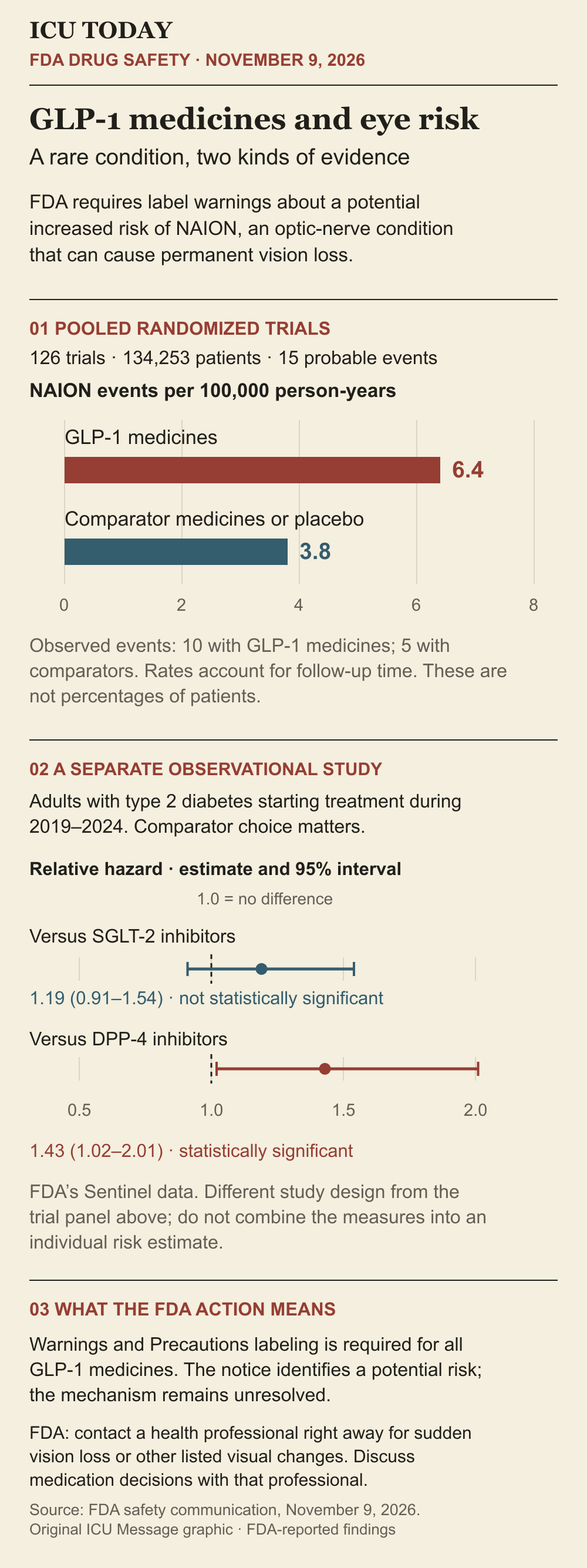
Primary-source statement · FDA reports that the medicines are widely used for type 2 diabetes and weight management, with additional approved uses for certain drugs. The agency pooled 126 randomized trials involving 134,253 patients. It identified 15 probable NAION events: 10 among GLP-1 users and five among comparator patients. After accounting for follow-up time, the reported rates were 6.4 and 3.8 events per 100,000 person-years, respectively. These are time-adjusted event rates, not percentages of patients. The comparison group included placebo and other glucose-lowering medicines. [U.S. Food and Drug Administration]
What the other evidence showed
Primary-source statement · FDA also examined insurance-based observational data for adults with type 2 diabetes who started treatment during 2019–2024. Results differed by comparison medicine: the increase was not statistically significant against SGLT-2 inhibitors, but was significant against DPP-4 inhibitors. The graphic shows both estimates and their confidence intervals. These observational comparisons use different populations and methods from the pooled trials; their results should not be combined into one personal-risk figure. [U.S. Food and Drug Administration]
What FDA tells patients
Primary-source statement · The agency advises contacting a health care professional right away for sudden vision loss or other listed visual changes. People who have had NAION should discuss continuing or stopping their medication with that professional. This report describes FDA's assessment and guidance; it is not an independent review of patient records or an individualized treatment recommendation. [U.S. Food and Drug Administration]
What remains unknown
Primary-source statement · FDA says its animal-data review did not identify a mechanism explaining how GLP-1 use could increase the risk. Reports submitted after marketing were difficult to interpret because NAION risk factors overlap with conditions common among users. The notice identifies a potential risk; it does not establish the cause of an individual person's vision loss or rank the medicines by eye risk. [U.S. Food and Drug Administration]
This report describes an FDA safety communication, not individualized medical advice. FDA advises contacting a health care professional right away for sudden vision loss or other listed visual changes and discussing medication decisions with that professional.
Read the infographic as text
Pooled randomized trials. FDA pooled 126 trials involving 134,253 patients. It identified 15 probable NAION events: 10 with GLP-1 medicines and five with comparators. The rates were 6.4 versus 3.8 events per 100,000 person-years. Bars use a shared zero-based 0–8 scale. Comparators included placebo and other glucose-lowering drugs. These are rates over follow-up time, not percentages of patients.
Separate observational comparisons. FDA’s Sentinel study examined adults with type 2 diabetes starting treatment during 2019–2024. Compared with SGLT-2 inhibitors, the hazard ratio was 1.19, with a 95% confidence interval of 0.91–1.54; the increase was not statistically significant. Compared with DPP-4 inhibitors, the hazard ratio was 1.43, with an interval of 1.02–2.01; the increase was statistically significant. The dashed line at 1.0 represents no difference. These observational measures are separate from the trial rates and do not establish an individual’s risk.
Labeling and patient guidance. The November 9, 2026 notice requires information about potential NAION risk in the Warnings and Precautions section for all GLP-1 medicines. FDA’s animal-data review did not identify a mechanism. FDA advises contacting a health professional right away for sudden vision loss or other listed visual changes, and discussing medication decisions with that professional.
Graphic sources: U.S. Food and Drug Administration
The developing record.
Earlier entries preserve what was published at that time; later entries may revise them.
2026-11-14T15:28:00.630Z · Initial report on FDA’s November9 GLP-1 eye-risk labeling requirement, its trial and observational evidence, limits and patient guidance.
FDA requires GLP-1 warnings for a rare eye condition
The November 9 safety notice describes a potential risk of optic-nerve injury. Its trial findings and observational comparisons need to be read separately.
What happened
The Food and Drug Administration is requiring updated warnings for GLP-1 medications about a potential increased risk of a rare eye condition that can cause permanent vision loss. Its November 9 notice directs application holders to add the risk to the Warnings and Precautions section of labeling. The condition, non-arteritic anterior ischemic optic neuropathy, or NAION, involves reduced blood flow to the front of the optic nerve. FDA describes sudden, painless loss or reduction of vision in one eye. Its drug list includes Ozempic, Wegovy, Mounjaro and Zepbound, among others. [U.S. Food and Drug Administration]
Why it matters
FDA reports that the medicines are widely used for type 2 diabetes and weight management, with additional approved uses for certain drugs. The agency pooled 126 randomized trials involving 134,253 patients. It identified 15 probable NAION events: 10 among GLP-1 users and five among comparator patients. After accounting for follow-up time, the reported rates were 6.4 and 3.8 events per 100,000 person-years, respectively. These are time-adjusted event rates, not percentages of patients. The comparison group included placebo and other glucose-lowering medicines. [U.S. Food and Drug Administration]
What the other evidence showed
FDA also examined insurance-based observational data for adults with type 2 diabetes who started treatment during 2019–2024. Results differed by comparison medicine: the increase was not statistically significant against SGLT-2 inhibitors, but was significant against DPP-4 inhibitors. The graphic shows both estimates and their confidence intervals. These observational comparisons use different populations and methods from the pooled trials; their results should not be combined into one personal-risk figure. [U.S. Food and Drug Administration]
What FDA tells patients
The agency advises contacting a health care professional right away for sudden vision loss or other listed visual changes. People who have had NAION should discuss continuing or stopping their medication with that professional. This report describes FDA's assessment and guidance; it is not an independent review of patient records or an individualized treatment recommendation. [U.S. Food and Drug Administration]
What remains unknown
FDA says its animal-data review did not identify a mechanism explaining how GLP-1 use could increase the risk. Reports submitted after marketing were difficult to interpret because NAION risk factors overlap with conditions common among users. The notice identifies a potential risk; it does not establish the cause of an individual person's vision loss or rank the medicines by eye risk. [U.S. Food and Drug Administration]
Read the infographic as text
Pooled randomized trials. FDA pooled 126 trials involving 134,253 patients. It identified 15 probable NAION events: 10 with GLP-1 medicines and five with comparators. The rates were 6.4 versus 3.8 events per 100,000 person-years. Bars use a shared zero-based 0–8 scale. Comparators included placebo and other glucose-lowering drugs. These are rates over follow-up time, not percentages of patients.
Separate observational comparisons. FDA’s Sentinel study examined adults with type 2 diabetes starting treatment during 2019–2024. Compared with SGLT-2 inhibitors, the hazard ratio was 1.19, with a 95% confidence interval of 0.91–1.54; the increase was not statistically significant. Compared with DPP-4 inhibitors, the hazard ratio was 1.43, with an interval of 1.02–2.01; the increase was statistically significant. The dashed line at 1.0 represents no difference. These observational measures are separate from the trial rates and do not establish an individual’s risk.
Labeling and patient guidance. The November 9, 2026 notice requires information about potential NAION risk in the Warnings and Precautions section for all GLP-1 medicines. FDA’s animal-data review did not identify a mechanism. FDA advises contacting a health professional right away for sudden vision loss or other listed visual changes, and discussing medication decisions with that professional.
Graphic sources: U.S. Food and Drug Administration
Original sources
FDA Drug Safety Communication: GLP-1 labeling changes and potential NAION risk · Issuer: U.S. Food and Drug Administration · Published 2026-11-09
Corrections
No corrections recorded.