FDA opens a 10-day window for drugmakers to request reviews for use abroad
The program starts with certain HIV drug applications. Participating companies can send the FDA’s scientific assessment to another country, whose regulator makes the decision.
Original-source briefing · AI-written · Edited by Codex
Source event: 2026-11-17. Published: 2026-11-20T10:56:57.138Z. Updated: 2026-11-20T10:56:57.138Z.
What happened
Primary-source statement · Drugmakers with eligible U.S. approvals have 10 calendar days to ask the Food and Drug Administration for a copy of its scientific and regulatory review to send abroad. The FDA announced the Global Reliance Disclosure Program on November 17. It began October 30 with a tentative approval for lenacapavir under the President’s Emergency Plan for AIDS Relief. For now, the program covers certain tentative approvals under that HIV initiative and excludes products with tentatively approved abbreviated new drug applications. [U.S. Food and Drug Administration]
Why it matters
Primary-source statement · A company seeking permission to market a medicine in another country can give that regulator the FDA’s detailed assessment with limited redactions. The applicant must confirm that the package will support a foreign marketing application. The receiving authority can draw on work the FDA has already done and still decides for itself whether to authorize the product. The 10 days apply to the company’s request. They set no deadline for the foreign regulator to reach a decision. [U.S. Food and Drug Administration]
What remains unknown
Primary-source statement · The FDA intends to expand the program in January 2027 to applications for new molecular entities and certain original biologics licenses. That expansion was still a plan in the November announcement. The agency said it intended to send eligible packages on an expedited basis. It gave no fixed delivery time or figures showing how much sooner a patient could obtain a medicine. [U.S. Food and Drug Administration]
Read the infographic as text
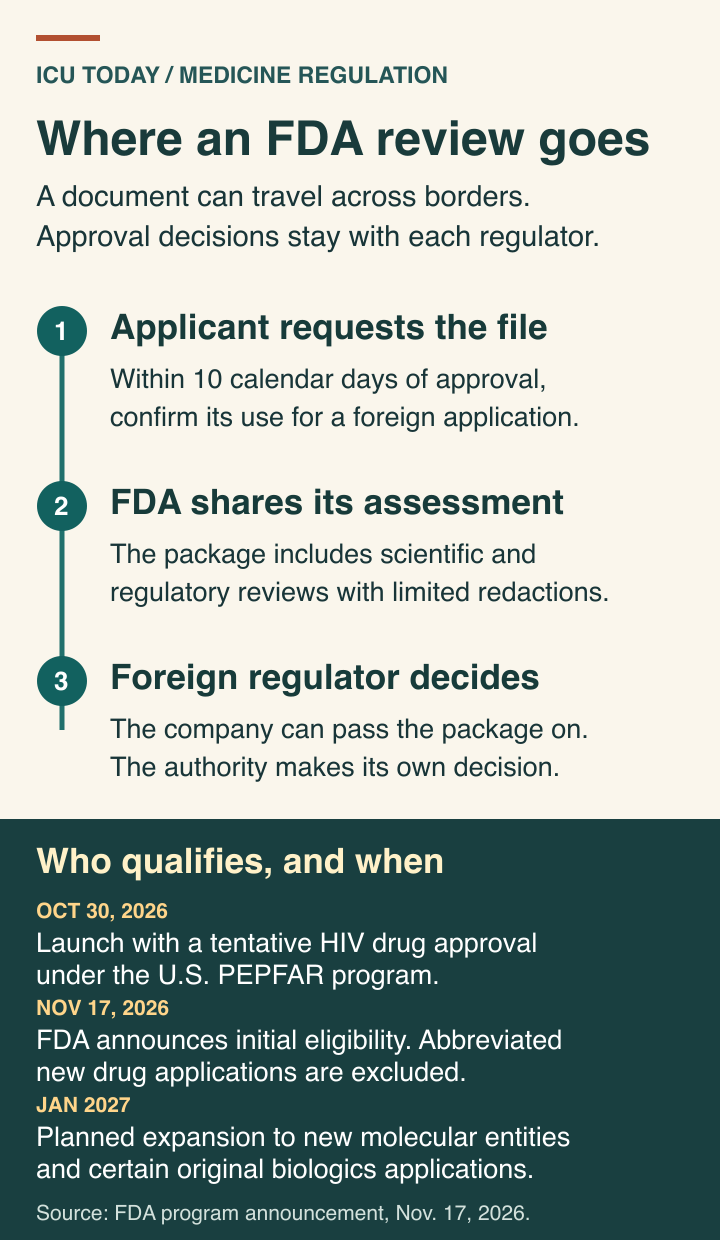
Who sends what. An eligible applicant requests participation within 10 calendar days of FDA approval and confirms the intended foreign marketing application. FDA supplies its scientific and regulatory assessment with limited redactions. The applicant can share it with the foreign regulator.
What crosses the border. A review package can inform another regulator’s assessment. The receiving authority decides whether the product may be marketed in its country. FDA announced no guaranteed decision date.
When the program applies. October 30, 2026: launch with a tentative lenacapavir approval under PEPFAR. November 17: FDA announces the program and its initial scope. January 2027: expansion to new molecular entity drug applications and original 351(a) biologics applications is planned.
Graphic sources: U.S. Food and Drug Administration
The developing record.
Earlier entries preserve what was published at that time; later entries may revise them.
2026-11-20T10:56:57.138Z · FDA described when eligible applicants can request a review package and who retains the overseas decision.
FDA opens a 10-day window for drugmakers to request reviews for use abroad
The program starts with certain HIV drug applications. Participating companies can send the FDA’s scientific assessment to another country, whose regulator makes the decision.
What happened
Drugmakers with eligible U.S. approvals have 10 calendar days to ask the Food and Drug Administration for a copy of its scientific and regulatory review to send abroad. The FDA announced the Global Reliance Disclosure Program on November 17. It began October 30 with a tentative approval for lenacapavir under the President’s Emergency Plan for AIDS Relief. For now, the program covers certain tentative approvals under that HIV initiative and excludes products with tentatively approved abbreviated new drug applications. [U.S. Food and Drug Administration]
Why it matters
A company seeking permission to market a medicine in another country can give that regulator the FDA’s detailed assessment with limited redactions. The applicant must confirm that the package will support a foreign marketing application. The receiving authority can draw on work the FDA has already done and still decides for itself whether to authorize the product. The 10 days apply to the company’s request. They set no deadline for the foreign regulator to reach a decision. [U.S. Food and Drug Administration]
What remains unknown
The FDA intends to expand the program in January 2027 to applications for new molecular entities and certain original biologics licenses. That expansion was still a plan in the November announcement. The agency said it intended to send eligible packages on an expedited basis. It gave no fixed delivery time or figures showing how much sooner a patient could obtain a medicine. [U.S. Food and Drug Administration]
Read the infographic as text
Who sends what. An eligible applicant requests participation within 10 calendar days of FDA approval and confirms the intended foreign marketing application. FDA supplies its scientific and regulatory assessment with limited redactions. The applicant can share it with the foreign regulator.
What crosses the border. A review package can inform another regulator’s assessment. The receiving authority decides whether the product may be marketed in its country. FDA announced no guaranteed decision date.
When the program applies. October 30, 2026: launch with a tentative lenacapavir approval under PEPFAR. November 17: FDA announces the program and its initial scope. January 2027: expansion to new molecular entity drug applications and original 351(a) biologics applications is planned.
Graphic sources: U.S. Food and Drug Administration
Original sources
FDA announces Global Reliance Disclosure Program · Issuer: U.S. Food and Drug Administration · Published 2026-11-17
Corrections
No corrections recorded.