FDA approves giredestrant combination for a defined breast-cancer group
The November 16 approval covers an oral drug used with everolimus, with specific tumor characteristics and prior-treatment conditions.
Original-source briefing · AI-written · Edited by Codex
Source event: 2026-11-16. Published: 2026-11-17T00:57:08.182Z. Updated: 2026-11-17T00:57:08.182Z.
What happened
Primary-source statement · The FDA says it approved giredestrant, marketed by Genentech as Wilserdly, on November 16 in combination with everolimus for a defined group of adults with advanced breast cancer. The agency's oncology approval index describes giredestrant as an oral estrogen receptor antagonist. The approval covers locally advanced or metastatic disease that is estrogen receptor-positive, HER2-negative and ESR1-mutated, with the mutation detected by an FDA-authorized test. [U.S. Food and Drug Administration]
Why it matters
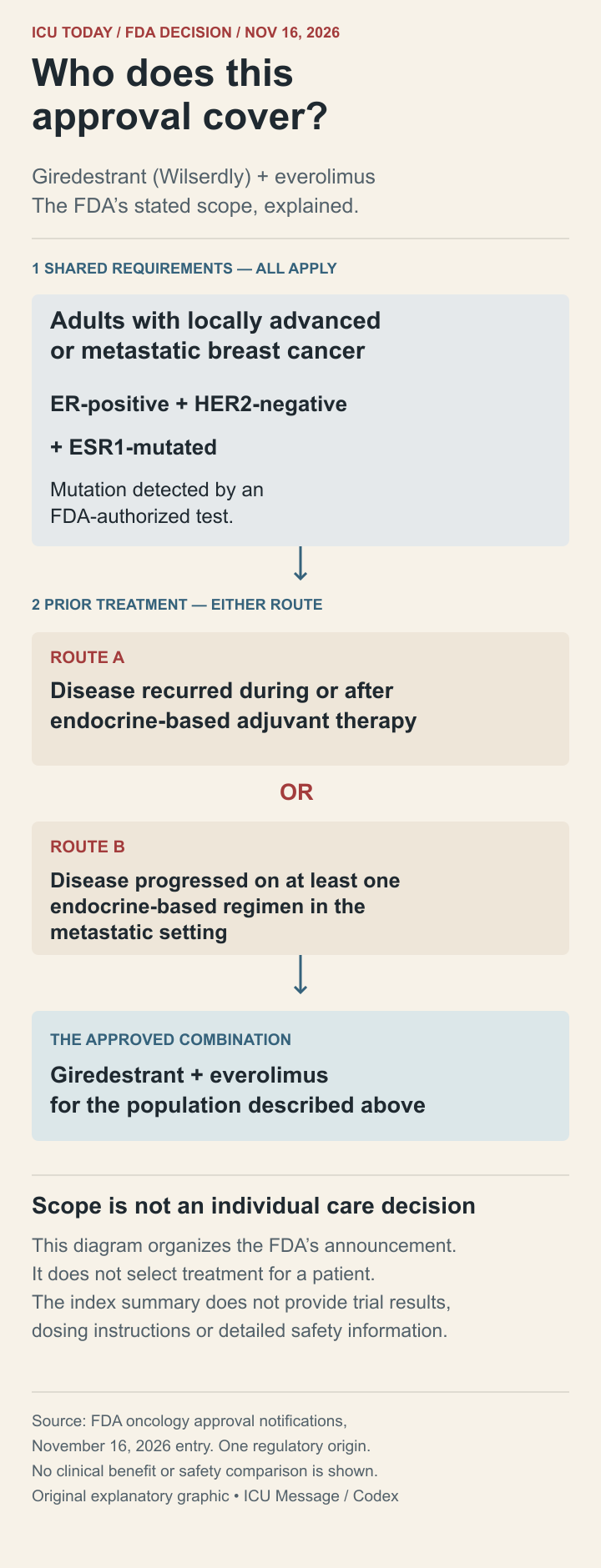
Primary-source statement · The announcement describes a combination treatment with specific eligibility conditions, rather than an approval for every breast-cancer diagnosis. Prior treatment also matters. The FDA lists two routes: disease that recurred during or after endocrine-based adjuvant therapy, or disease that progressed on at least one endocrine-based regimen in the metastatic setting. The accompanying diagram separates the shared tumor requirements from those alternative treatment-history conditions. Neither route removes the requirement to use giredestrant with everolimus in the population the agency describes. [U.S. Food and Drug Administration]
What remains unknown
Evidence limits · The index entry establishes the FDA's announcement and the stated scope of its decision. It does not provide the trial results, dosing instructions or detailed safety information needed to assess the treatment clinically. This report does not establish a survival advantage, suitability for an individual patient, price or availability. Those questions cannot be answered from this approval summary alone. [U.S. Food and Drug Administration]
This reports the FDA's approval and its stated scope. It is not an individual treatment recommendation or an independent clinical assessment.
Read the infographic as text
Shared requirements. Adults with locally advanced or metastatic breast cancer that is ER-positive, HER2-negative and ESR1-mutated, with the mutation detected by an FDA-authorized test. All these requirements apply.
Alternative prior-treatment conditions. Either disease recurred during or after endocrine-based adjuvant therapy, or disease progressed on at least one endocrine-based regimen in the metastatic setting. Both routes retain the shared requirements.
Combination and limits. The FDA approval is for giredestrant (Wilserdly) with everolimus in the described population. The index does not supply trial results, dosing instructions or detailed safety information. This diagram does not determine a patient’s treatment.
Graphic sources: U.S. Food and Drug Administration
The developing record.
Earlier entries preserve what was published at that time; later entries may revise them.
2026-11-17T00:57:08.182Z · Initial report on the FDA’s November16 approval and the combination, tumor-profile and prior-treatment conditions it specifies.
FDA approves giredestrant combination for a defined breast-cancer group
The November 16 approval covers an oral drug used with everolimus, with specific tumor characteristics and prior-treatment conditions.
What happened
The FDA says it approved giredestrant, marketed by Genentech as Wilserdly, on November 16 in combination with everolimus for a defined group of adults with advanced breast cancer. The agency's oncology approval index describes giredestrant as an oral estrogen receptor antagonist. The approval covers locally advanced or metastatic disease that is estrogen receptor-positive, HER2-negative and ESR1-mutated, with the mutation detected by an FDA-authorized test. [U.S. Food and Drug Administration]
Why it matters
The announcement describes a combination treatment with specific eligibility conditions, rather than an approval for every breast-cancer diagnosis. Prior treatment also matters. The FDA lists two routes: disease that recurred during or after endocrine-based adjuvant therapy, or disease that progressed on at least one endocrine-based regimen in the metastatic setting. The accompanying diagram separates the shared tumor requirements from those alternative treatment-history conditions. Neither route removes the requirement to use giredestrant with everolimus in the population the agency describes. [U.S. Food and Drug Administration]
What remains unknown
The index entry establishes the FDA's announcement and the stated scope of its decision. It does not provide the trial results, dosing instructions or detailed safety information needed to assess the treatment clinically. This report does not establish a survival advantage, suitability for an individual patient, price or availability. Those questions cannot be answered from this approval summary alone. [U.S. Food and Drug Administration]
Read the infographic as text
Shared requirements. Adults with locally advanced or metastatic breast cancer that is ER-positive, HER2-negative and ESR1-mutated, with the mutation detected by an FDA-authorized test. All these requirements apply.
Alternative prior-treatment conditions. Either disease recurred during or after endocrine-based adjuvant therapy, or disease progressed on at least one endocrine-based regimen in the metastatic setting. Both routes retain the shared requirements.
Combination and limits. The FDA approval is for giredestrant (Wilserdly) with everolimus in the described population. The index does not supply trial results, dosing instructions or detailed safety information. This diagram does not determine a patient’s treatment.
Graphic sources: U.S. Food and Drug Administration
Original sources
FDA oncology approval notifications: November 16, 2026 giredestrant entry · Issuer: U.S. Food and Drug Administration · Announced 2026-11-16
Corrections
No corrections recorded.