FDA expands breast cancer drug approval to treatment after surgery
In a 4,170-person trial, about 28 more people per 1,000 were alive without invasive breast cancer at three years with giredestrant than with standard hormone therapy. Follow-up on overall survival continues.
Original-source briefing · AI-written · Edited by Codex
Source event: 2026-11-23. Published: 2026-11-24T03:47:18.430Z. Updated: 2026-11-24T03:47:18.430Z.
What happened
Primary-source statement · The U.S. Food and Drug Administration approved giredestrant, sold as Wilserdly, on November 23 as a standalone treatment after breast cancer surgery. The approval covers adults with stage I, II or III disease whose tumors are estrogen receptor–positive and HER2-negative and whose risk of recurrence is intermediate or high. A week earlier, the FDA approved the same drug in combination with everolimus for a different group of people with advanced or metastatic disease. [U.S. Food and Drug Administration]
Why it matters
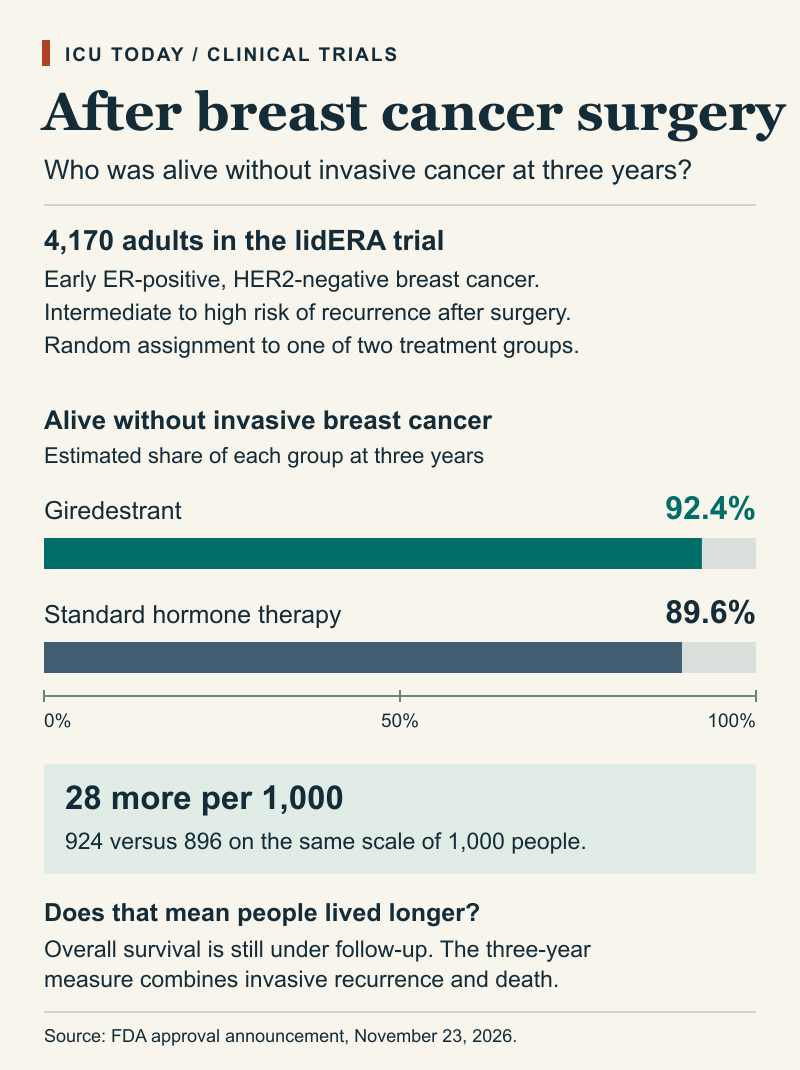
Primary-source statement · Even after surgery, invasive breast cancer can return. The FDA based its decision on lidERA, a trial that randomly assigned 4,170 adults to giredestrant or standard hormone therapy. At three years, the FDA reported that 92.4% of the giredestrant group were alive without invasive breast cancer, compared with 89.6% of those receiving standard therapy. On a common scale of 1,000 people, that is an estimated 924 versus 896, a difference of 28. These figures describe study groups. They cannot predict what will happen to an individual. [U.S. Food and Drug Administration]
What remains unknown
Primary-source statement · Whether people who took giredestrant live longer overall remains an open question. The three-year measure counted both invasive recurrence and death, so it cannot tell readers how much of the difference came from either outcome alone. The FDA said follow-up continues and the manufacturer has agreed to submit the survival results. Among the common side effects the agency reported were muscle and joint pain, hot flashes and tiredness. [U.S. Food and Drug Administration]
The FDA decision applies to a defined group after surgery. The trial figures describe groups of patients and cannot determine an individual treatment choice.
Read the infographic as text
Who entered the trial. The trial randomly assigned 4,170 adults with estrogen receptor–positive, HER2-negative early breast cancer and intermediate to high recurrence risk to giredestrant or standard hormone therapy.
At three years. The FDA reported that 92.4% in the giredestrant group and 89.6% in the comparison group were alive without invasive breast cancer. The absolute difference is 2.8 percentage points, equivalent to 28 per 1,000.
What still needs follow-up. The endpoint combines recurrence and death. These results do not establish whether people live longer overall.
Graphic sources: U.S. Food and Drug Administration
The developing record.
Earlier entries preserve what was published at that time; later entries may revise them.
2026-11-24T03:47:18.430Z · FDA approved giredestrant alone following surgery for an early-stage breast cancer population.
FDA expands breast cancer drug approval to treatment after surgery
In a 4,170-person trial, about 28 more people per 1,000 were alive without invasive breast cancer at three years with giredestrant than with standard hormone therapy. Follow-up on overall survival continues.
What happened
The U.S. Food and Drug Administration approved giredestrant, sold as Wilserdly, on November 23 as a standalone treatment after breast cancer surgery. The approval covers adults with stage I, II or III disease whose tumors are estrogen receptor–positive and HER2-negative and whose risk of recurrence is intermediate or high. A week earlier, the FDA approved the same drug in combination with everolimus for a different group of people with advanced or metastatic disease. [U.S. Food and Drug Administration]
Why it matters
Even after surgery, invasive breast cancer can return. The FDA based its decision on lidERA, a trial that randomly assigned 4,170 adults to giredestrant or standard hormone therapy. At three years, the FDA reported that 92.4% of the giredestrant group were alive without invasive breast cancer, compared with 89.6% of those receiving standard therapy. On a common scale of 1,000 people, that is an estimated 924 versus 896, a difference of 28. These figures describe study groups. They cannot predict what will happen to an individual. [U.S. Food and Drug Administration]
What remains unknown
Whether people who took giredestrant live longer overall remains an open question. The three-year measure counted both invasive recurrence and death, so it cannot tell readers how much of the difference came from either outcome alone. The FDA said follow-up continues and the manufacturer has agreed to submit the survival results. Among the common side effects the agency reported were muscle and joint pain, hot flashes and tiredness. [U.S. Food and Drug Administration]
Read the infographic as text
Who entered the trial. The trial randomly assigned 4,170 adults with estrogen receptor–positive, HER2-negative early breast cancer and intermediate to high recurrence risk to giredestrant or standard hormone therapy.
At three years. The FDA reported that 92.4% in the giredestrant group and 89.6% in the comparison group were alive without invasive breast cancer. The absolute difference is 2.8 percentage points, equivalent to 28 per 1,000.
What still needs follow-up. The endpoint combines recurrence and death. These results do not establish whether people live longer overall.
Graphic sources: U.S. Food and Drug Administration
Original sources
FDA Approves First New Hormone Therapy for Early-Stage Breast Cancer in More Than 20 Years · Issuer: U.S. Food and Drug Administration · Published 2026-11-23
Corrections
No corrections recorded.