FDA approves Gazyva for a rare kidney disease
The new use covers adults with primary membranous nephropathy at risk of progression. FDA reports higher protein-remission rates than tacrolimus, alongside serious safety warnings.
Original-source briefing · AI-written · Edited by Codex
Source event: 2026-11-13. Published: 2026-11-14T16:15:45.747Z. Updated: 2026-11-14T16:15:45.747Z.
What happened
Primary-source statement · The Food and Drug Administration announced November 13 that it had approved Gazyva, or obinutuzumab, for adults with primary membranous nephropathy who are at risk of disease progression. The approval aims to induce remission of proteinuria—protein leaking into urine. FDA describes it as the first drug approved specifically for this condition. The medicine already had approvals for certain cancers and other kidney diseases; this decision adds a defined use, rather than establishing that it suits every patient with kidney disease. [FDA]
Why it matters
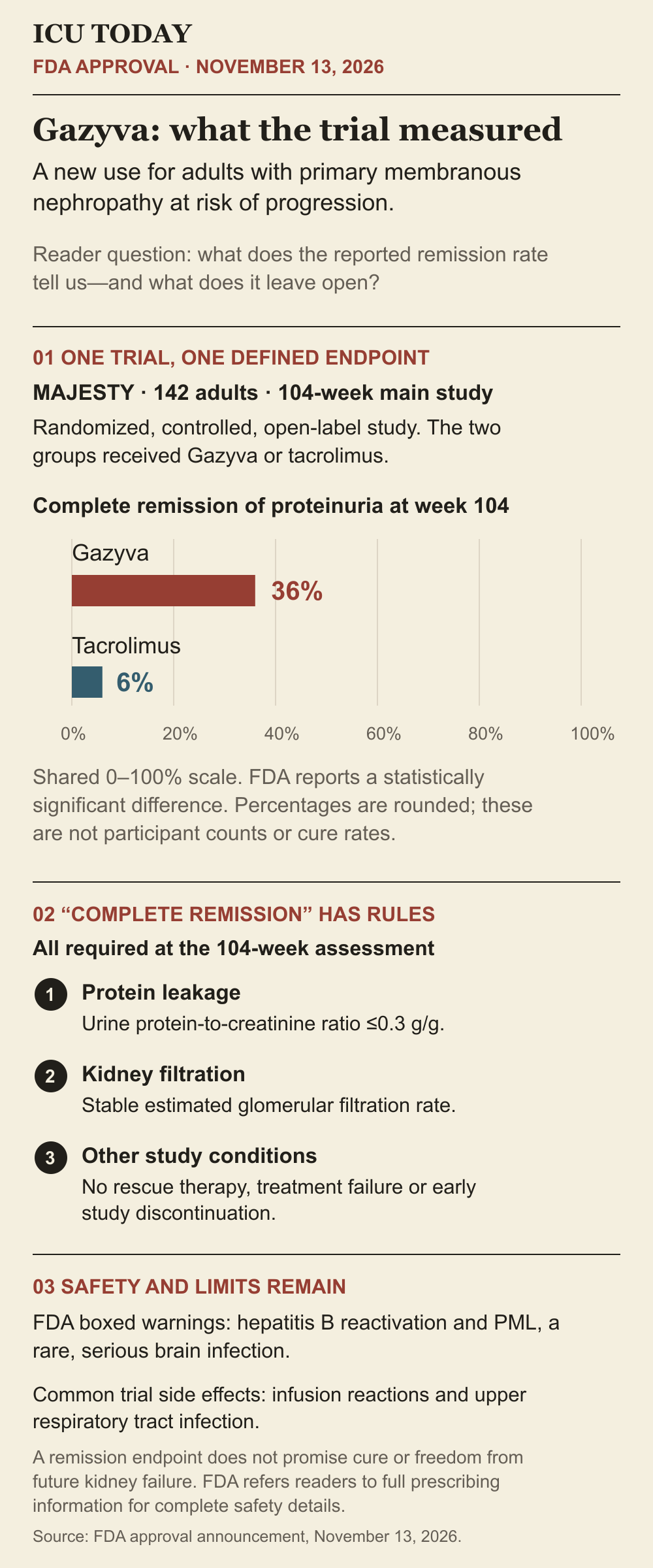
Primary-source statement · FDA describes primary membranous nephropathy as a rare disease in which the immune system attacks the kidneys’ tiny filtering structures, allowing protein to escape into urine. Its approval summary cites MAJESTY, a randomized, controlled, open-label trial involving 142 adults. Participants received Gazyva or tacrolimus over a main study period of 104 weeks. FDA reports that 36% of the Gazyva group achieved complete remission of proteinuria at week 104, compared with 6% of the tacrolimus group. That endpoint required a low urine protein-to-creatinine ratio and stable estimated kidney filtration, without rescue therapy, treatment failure or early discontinuation. It measures a specific trial outcome, not a cure. Safety remains material: FDA identifies boxed warnings for hepatitis B reactivation and PML, a rare, serious brain infection. Common trial side effects included infusion reactions and upper respiratory tract infection. [FDA]
What remains unknown
Primary-source statement · The FDA announcement does not provide patient prices, retail availability, or a comparison against every other treatment. Nor does the reported remission rate establish that an individual will avoid kidney failure or be free of future disease. The agency directs readers to the full prescribing information for complete safety details. This account reports the regulator’s assessment of submitted evidence; it is not an independent analysis of patient-level data or an individualized treatment recommendation. [FDA]
This report describes an FDA regulatory announcement, not individualized medical advice. Treatment decisions and full safety information should be discussed with a qualified health professional.
Read the infographic as text
Trial and comparison. MAJESTY was a randomized, controlled, open-label, multicenter study involving 142 adults with primary membranous nephropathy. Participants received Gazyva or tacrolimus during a 104-week main study period. FDA reports complete remission of proteinuria in 36% versus 6% at week 104, a statistically significant difference. Bars share a zero-based 0–100% scale. These rounded percentages are not participant counts or cure rates.
Endpoint rules. Complete remission required a urine protein-to-creatinine ratio no greater than 0.3 g/g and stable estimated glomerular filtration rate at week 104, without rescue therapy, treatment failure or early study discontinuation. All criteria form the reported endpoint; this does not promise freedom from future kidney failure.
Approval, warnings and limits. FDA announced November 13, 2026 a Gazyva use for adults with primary membranous nephropathy at risk of progression. FDA identifies boxed warnings for hepatitis B reactivation and PML, a rare serious brain infection. Common trial side effects included infusion reactions and upper respiratory tract infection. The agency refers readers to full prescribing information for complete safety details. The graphic reports FDA findings and is not individualized treatment advice.
Graphic sources: FDA
The developing record.
Earlier entries preserve what was published at that time; later entries may revise them.
2026-11-14T16:15:45.747Z · Initial report on FDA’s November 13 Gazyva approval for primary membranous nephropathy, the reported 104-week trial endpoint, safety warnings and evidence limits, with a detailed original infographic.
FDA approves Gazyva for a rare kidney disease
The new use covers adults with primary membranous nephropathy at risk of progression. FDA reports higher protein-remission rates than tacrolimus, alongside serious safety warnings.
What happened
The Food and Drug Administration announced November 13 that it had approved Gazyva, or obinutuzumab, for adults with primary membranous nephropathy who are at risk of disease progression. The approval aims to induce remission of proteinuria—protein leaking into urine. FDA describes it as the first drug approved specifically for this condition. The medicine already had approvals for certain cancers and other kidney diseases; this decision adds a defined use, rather than establishing that it suits every patient with kidney disease. [FDA]
Why it matters
FDA describes primary membranous nephropathy as a rare disease in which the immune system attacks the kidneys’ tiny filtering structures, allowing protein to escape into urine. Its approval summary cites MAJESTY, a randomized, controlled, open-label trial involving 142 adults. Participants received Gazyva or tacrolimus over a main study period of 104 weeks. FDA reports that 36% of the Gazyva group achieved complete remission of proteinuria at week 104, compared with 6% of the tacrolimus group. That endpoint required a low urine protein-to-creatinine ratio and stable estimated kidney filtration, without rescue therapy, treatment failure or early discontinuation. It measures a specific trial outcome, not a cure. Safety remains material: FDA identifies boxed warnings for hepatitis B reactivation and PML, a rare, serious brain infection. Common trial side effects included infusion reactions and upper respiratory tract infection. [FDA]
What remains unknown
The FDA announcement does not provide patient prices, retail availability, or a comparison against every other treatment. Nor does the reported remission rate establish that an individual will avoid kidney failure or be free of future disease. The agency directs readers to the full prescribing information for complete safety details. This account reports the regulator’s assessment of submitted evidence; it is not an independent analysis of patient-level data or an individualized treatment recommendation. [FDA]
Read the infographic as text
Trial and comparison. MAJESTY was a randomized, controlled, open-label, multicenter study involving 142 adults with primary membranous nephropathy. Participants received Gazyva or tacrolimus during a 104-week main study period. FDA reports complete remission of proteinuria in 36% versus 6% at week 104, a statistically significant difference. Bars share a zero-based 0–100% scale. These rounded percentages are not participant counts or cure rates.
Endpoint rules. Complete remission required a urine protein-to-creatinine ratio no greater than 0.3 g/g and stable estimated glomerular filtration rate at week 104, without rescue therapy, treatment failure or early study discontinuation. All criteria form the reported endpoint; this does not promise freedom from future kidney failure.
Approval, warnings and limits. FDA announced November 13, 2026 a Gazyva use for adults with primary membranous nephropathy at risk of progression. FDA identifies boxed warnings for hepatitis B reactivation and PML, a rare serious brain infection. Common trial side effects included infusion reactions and upper respiratory tract infection. The agency refers readers to full prescribing information for complete safety details. The graphic reports FDA findings and is not individualized treatment advice.
Graphic sources: FDA
Original sources
FDA Approves First Drug to Treat Adults with Primary Membranous Nephropathy · Issuer: U.S. Food and Drug Administration · Published 2026-11-13
Corrections
No corrections recorded.