FDA approves another drug regimen around bladder-cancer surgery
The November 13 decision covers adults ineligible for or declining cisplatin chemotherapy. The FDA’s trial summary compares the new regimen with surgery alone, leaving comparisons with other drug regimens unresolved.
Original-source briefing · AI-written · Edited by Codex
Source event: 2026-11-13. Published: 2026-11-13T20:46:21.638Z. Updated: 2026-11-13T20:46:21.638Z.
What happened
Primary-source statement · The Food and Drug Administration approved durvalumab, sold as Imfinzi, with enfortumab vedotin-ejfv on November 13 for a defined group of adults with muscle-invasive bladder cancer: those ineligible for, or who have refused, cisplatin-based chemotherapy. The authorized sequence uses both drugs before radical cystectomy, followed by durvalumab alone after surgery. It is an approval for treatment around an operation, rather than a replacement for the operation. [U.S. Food and Drug Administration]
What the trial compared
Primary-source statement · The FDA based its efficacy assessment on VOLGA, a randomized, open-label trial of 695 patients who were candidates for radical cystectomy. Participants were allocated among three groups: the newly approved regimen, surgery alone, or another investigational combination. The 695 figure covers the whole three-group trial; it is not the number receiving the approved regimen. The agency’s reported efficacy comparison here is against surgery alone. [U.S. Food and Drug Administration]
Why it matters
Primary-source statement · The FDA reports statistically significant improvements in event-free survival and overall survival. The reported hazard ratios were 0.51 and 0.58, respectively. Median event-free survival was not reached in the drug-regimen group, versus 12.1 months in the surgery-alone group; median overall survival was not reached in either. Those results describe the trial comparison. They do not provide a promised survival time for an individual patient. [U.S. Food and Drug Administration]
The earlier approval has a different scope
Primary-source statement · In July, the FDA had expanded approval of a different regimen: either of two pembrolizumab formulations with enfortumab vedotin-ejfv around cystectomy. That decision extended eligibility from cisplatin-ineligible patients to all adults with muscle-invasive disease who were candidates for the operation. Its supporting trial enrolled 808 cisplatin-eligible patients and compared the regimen with gemcitabine and cisplatin before surgery. The two announcements describe different populations and comparison treatments, not a direct contest between the approved regimens. [U.S. Food and Drug Administration] [U.S. Food and Drug Administration]
Safety remains part of the decision
Primary-source statement · The November notice flags durvalumab warnings involving immune-mediated reactions, infusion reactions, transplant complications and harm to a developing fetus. The July notice also lists enfortumab warnings, including skin reactions, high blood sugar, lung inflammation, peripheral neuropathy and eye disorders. Reporting the efficacy results without those safety boundaries would leave out a material part of the FDA’s account. [U.S. Food and Drug Administration] [U.S. Food and Drug Administration]
What remains unknown
Evidence limits · These two FDA summaries do not establish which regimen is preferable for a particular patient, nor do they report a head-to-head comparison. They also do not establish local availability, insurance coverage or out-of-pocket costs. The accompanying infographic keeps the patient groups, treatment sequence and trial comparisons separate; its hazard ratios are not absolute survival percentages. [U.S. Food and Drug Administration] [U.S. Food and Drug Administration]
This is reporting on FDA approval notices and their stated evidence, not an individual treatment recommendation. The notices do not replace prescribing information or a patient’s clinical assessment.
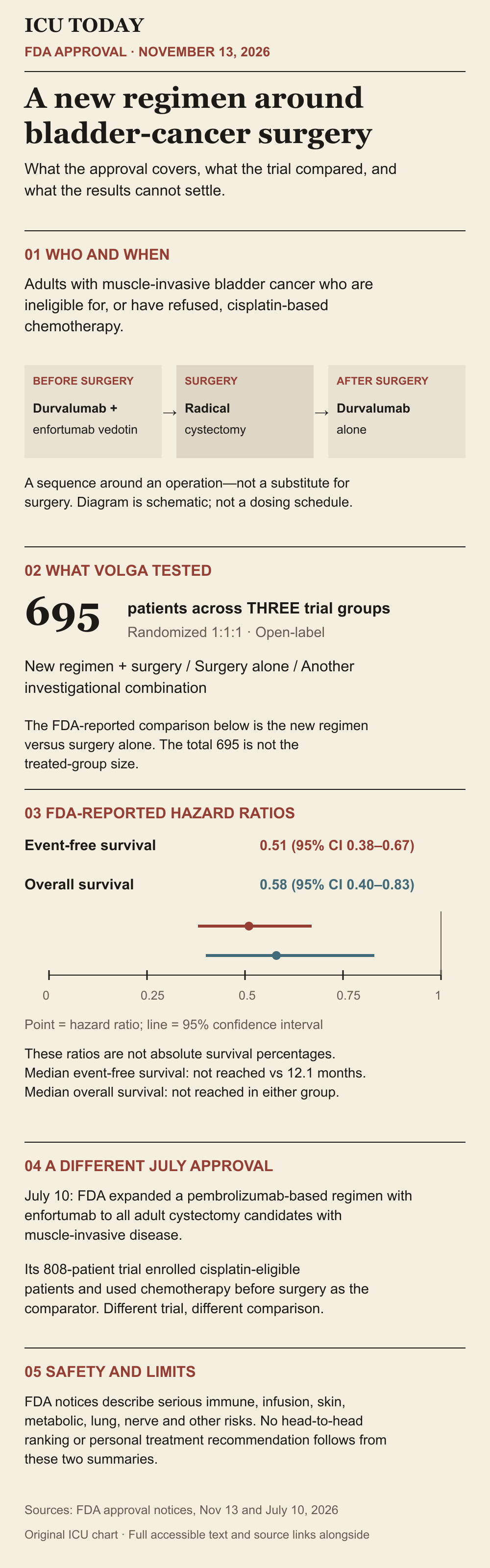
Read the infographic as text
Who and when. The November 13 FDA approval covers adults with muscle-invasive bladder cancer who are ineligible for, or have refused, cisplatin-based chemotherapy. The sequence is durvalumab plus enfortumab vedotin-ejfv before radical cystectomy, then durvalumab alone after surgery. This is a schematic treatment sequence, not a dosing schedule or a substitute for surgery.
What VOLGA tested. VOLGA randomized 695 patients across three groups in a 1:1:1 allocation: the new regimen with surgery, surgery alone, or another investigational combination. It was an open-label trial. The 695 total is not the size of the group receiving the approved regimen. The FDA-reported efficacy comparison shown here is against surgery alone.
FDA-reported results. Event-free survival: hazard ratio 0.51, 95% confidence interval 0.38 to 0.67. Overall survival: hazard ratio 0.58, 95% confidence interval 0.40 to 0.83. Points show the ratios and horizontal lines show their confidence intervals on a common linear axis from 0 to 1. These are not absolute survival percentages. Median event-free survival was not reached with the new regimen and was 12.1 months with surgery alone. Median overall survival was not reached in either group.
A different July approval. On July 10, the FDA expanded a pembrolizumab-based regimen with enfortumab vedotin-ejfv to all adults with muscle-invasive bladder cancer who were candidates for cystectomy. That supporting trial enrolled 808 cisplatin-eligible patients and compared treatment around surgery with gemcitabine and cisplatin before surgery. It was a different trial with a different comparator, not a head-to-head ranking of the two approved regimens.
Safety and limits. The FDA notices describe immune-mediated reactions, infusion reactions, transplant complications, embryo-fetal harm and other risks; the enfortumab warning list also includes skin reactions, high blood sugar, lung inflammation, peripheral neuropathy, eye disorders and infusion-site extravasation. These summaries do not determine a personal treatment choice, local availability, insurance coverage or out-of-pocket costs. Sources are the FDA notices dated November 13 and July 10, 2026; both share one FDA origin.
Graphic sources: U.S. Food and Drug Administration · U.S. Food and Drug Administration
The developing record.
Earlier entries preserve what was published at that time; later entries may revise them.
2026-11-13T20:46:21.638Z · Initial report on the FDA November13 bladder-cancer approval, trial comparison, earlier approval, safety scope and original detailed infographic.
FDA approves another drug regimen around bladder-cancer surgery
The November 13 decision covers adults ineligible for or declining cisplatin chemotherapy. The FDA’s trial summary compares the new regimen with surgery alone, leaving comparisons with other drug regimens unresolved.
What happened
The Food and Drug Administration approved durvalumab, sold as Imfinzi, with enfortumab vedotin-ejfv on November 13 for a defined group of adults with muscle-invasive bladder cancer: those ineligible for, or who have refused, cisplatin-based chemotherapy. The authorized sequence uses both drugs before radical cystectomy, followed by durvalumab alone after surgery. It is an approval for treatment around an operation, rather than a replacement for the operation. [U.S. Food and Drug Administration]
What the trial compared
The FDA based its efficacy assessment on VOLGA, a randomized, open-label trial of 695 patients who were candidates for radical cystectomy. Participants were allocated among three groups: the newly approved regimen, surgery alone, or another investigational combination. The 695 figure covers the whole three-group trial; it is not the number receiving the approved regimen. The agency’s reported efficacy comparison here is against surgery alone. [U.S. Food and Drug Administration]
Why it matters
The FDA reports statistically significant improvements in event-free survival and overall survival. The reported hazard ratios were 0.51 and 0.58, respectively. Median event-free survival was not reached in the drug-regimen group, versus 12.1 months in the surgery-alone group; median overall survival was not reached in either. Those results describe the trial comparison. They do not provide a promised survival time for an individual patient. [U.S. Food and Drug Administration]
The earlier approval has a different scope
In July, the FDA had expanded approval of a different regimen: either of two pembrolizumab formulations with enfortumab vedotin-ejfv around cystectomy. That decision extended eligibility from cisplatin-ineligible patients to all adults with muscle-invasive disease who were candidates for the operation. Its supporting trial enrolled 808 cisplatin-eligible patients and compared the regimen with gemcitabine and cisplatin before surgery. The two announcements describe different populations and comparison treatments, not a direct contest between the approved regimens. [U.S. Food and Drug Administration] [U.S. Food and Drug Administration]
Safety remains part of the decision
The November notice flags durvalumab warnings involving immune-mediated reactions, infusion reactions, transplant complications and harm to a developing fetus. The July notice also lists enfortumab warnings, including skin reactions, high blood sugar, lung inflammation, peripheral neuropathy and eye disorders. Reporting the efficacy results without those safety boundaries would leave out a material part of the FDA’s account. [U.S. Food and Drug Administration] [U.S. Food and Drug Administration]
What remains unknown
These two FDA summaries do not establish which regimen is preferable for a particular patient, nor do they report a head-to-head comparison. They also do not establish local availability, insurance coverage or out-of-pocket costs. The accompanying infographic keeps the patient groups, treatment sequence and trial comparisons separate; its hazard ratios are not absolute survival percentages. [U.S. Food and Drug Administration] [U.S. Food and Drug Administration]
Read the infographic as text
Who and when. The November 13 FDA approval covers adults with muscle-invasive bladder cancer who are ineligible for, or have refused, cisplatin-based chemotherapy. The sequence is durvalumab plus enfortumab vedotin-ejfv before radical cystectomy, then durvalumab alone after surgery. This is a schematic treatment sequence, not a dosing schedule or a substitute for surgery.
What VOLGA tested. VOLGA randomized 695 patients across three groups in a 1:1:1 allocation: the new regimen with surgery, surgery alone, or another investigational combination. It was an open-label trial. The 695 total is not the size of the group receiving the approved regimen. The FDA-reported efficacy comparison shown here is against surgery alone.
FDA-reported results. Event-free survival: hazard ratio 0.51, 95% confidence interval 0.38 to 0.67. Overall survival: hazard ratio 0.58, 95% confidence interval 0.40 to 0.83. Points show the ratios and horizontal lines show their confidence intervals on a common linear axis from 0 to 1. These are not absolute survival percentages. Median event-free survival was not reached with the new regimen and was 12.1 months with surgery alone. Median overall survival was not reached in either group.
A different July approval. On July 10, the FDA expanded a pembrolizumab-based regimen with enfortumab vedotin-ejfv to all adults with muscle-invasive bladder cancer who were candidates for cystectomy. That supporting trial enrolled 808 cisplatin-eligible patients and compared treatment around surgery with gemcitabine and cisplatin before surgery. It was a different trial with a different comparator, not a head-to-head ranking of the two approved regimens.
Safety and limits. The FDA notices describe immune-mediated reactions, infusion reactions, transplant complications, embryo-fetal harm and other risks; the enfortumab warning list also includes skin reactions, high blood sugar, lung inflammation, peripheral neuropathy, eye disorders and infusion-site extravasation. These summaries do not determine a personal treatment choice, local availability, insurance coverage or out-of-pocket costs. Sources are the FDA notices dated November 13 and July 10, 2026; both share one FDA origin.
Graphic sources: U.S. Food and Drug Administration · U.S. Food and Drug Administration
Original sources
FDA approves durvalumab with enfortumab vedotin-ejfv for muscle invasive bladder cancer · Issuer: U.S. Food and Drug Administration · Published 2026-11-13
FDA approves pembrolizumab or pembrolizumab and berahyaluronidase alfa-pmph each with enfortumab vedotin-ejfv for muscle invasive bladder cancer · Issuer: U.S. Food and Drug Administration · Published 2026-07-10
Corrections
No corrections recorded.