FDA puts cell and gene therapy potency checks across the manufacturing process
Final guidance replaces a 2011 document and explains how manufacturers can build potency assurance into development, production and testing.
Original-source briefing · AI-written · Edited by Codex
Source event: 2026-11-02. Published: 2026-11-16T05:15:18.760Z. Updated: 2026-11-16T05:15:18.760Z.
What happened
Primary-source statement · The Food and Drug Administration issued final guidance on November 2 describing how cell and gene therapy manufacturers can protect a product’s potency throughout development and manufacturing. The document replaces guidance from January 2011. It recommends combining process design, production controls, control of materials, testing during manufacturing and tests used to decide whether a batch can be released. Potency concerns a product’s capacity to produce its intended therapeutic effect. FDA presents the guidance as recommendations reflecting its current thinking; it says the broader approach does not increase sponsor requirements. [U.S. Food and Drug Administration] [U.S. Food and Drug Administration]
Why it matters
Primary-source statement · For these products, FDA says potency testing can be difficult and must account for differences among therapies. Its approach looks beyond a final laboratory result to the conditions that can affect what a batch contains and how it functions. Materials should meet appropriate specifications, manufacturing steps should control relevant risks, and testing should be suitable for the particular product. The guidance covers investigational and licensed therapies, with an assurance strategy that develops as manufacturers gain knowledge and experience. FDA also addresses challenges involving short shelf lives and patient-specific products. [U.S. Food and Drug Administration] [U.S. Food and Drug Administration]
What remains unknown
Evidence limits · This manufacturing guidance does not approve a particular therapy or establish that a treatment will benefit an individual patient. The reviewed documents do not provide measured results showing how the final guidance has changed manufacturing performance or patient outcomes. They describe FDA’s approach and recommendations, alongside existing legal requirements; the guidance itself is nonbinding. A public webinar planned for December 10 is a future discussion, not a completed assessment of its effects. [U.S. Food and Drug Administration] [U.S. Food and Drug Administration]
Read the infographic as text
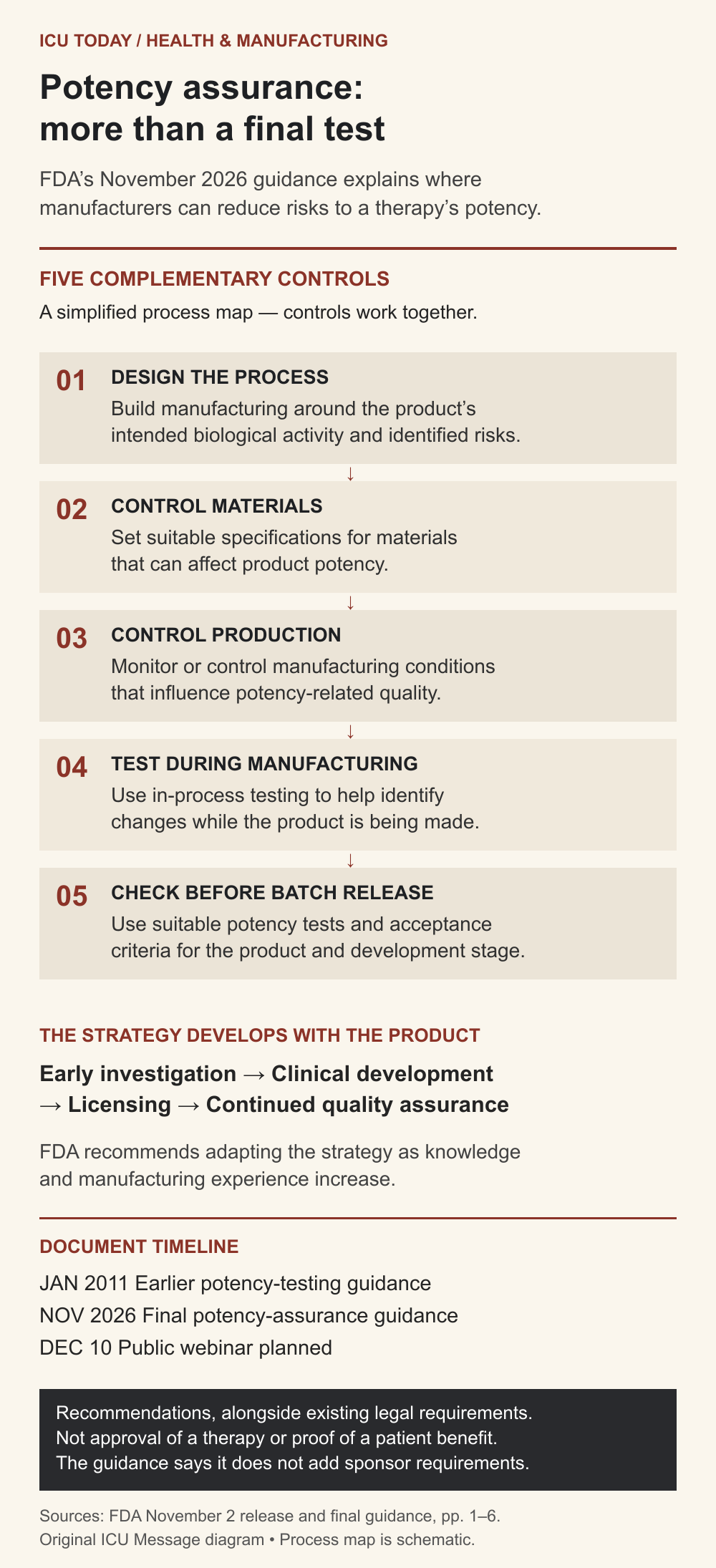
Five complementary controls. Design the manufacturing process around potency risks; control materials through suitable specifications; control production conditions; test during manufacturing; and use suitable potency tests and acceptance criteria before releasing a batch. These controls work together, rather than forming a universal prescription for every therapy.
Across the product lifecycle. Early investigation, clinical development, licensing and continued quality assurance. FDA recommends adapting the strategy as product knowledge and manufacturing experience increase.
Document timeline and limits. January 2011: earlier potency-testing guidance. November 2026: final potency-assurance guidance. December 10: public webinar planned. The guidance contains nonbinding recommendations alongside existing requirements and says it does not increase sponsor requirements. It does not approve a particular therapy or prove benefit to an individual patient.
Graphic sources: U.S. Food and Drug Administration · U.S. Food and Drug Administration
The developing record.
Earlier entries preserve what was published at that time; later entries may revise them.
2026-11-16T05:15:18.760Z · Initial report on FDA’s November 2 potency-assurance guidance, with an explanatory manufacturing-controls graphic.
FDA puts cell and gene therapy potency checks across the manufacturing process
Final guidance replaces a 2011 document and explains how manufacturers can build potency assurance into development, production and testing.
What happened
The Food and Drug Administration issued final guidance on November 2 describing how cell and gene therapy manufacturers can protect a product’s potency throughout development and manufacturing. The document replaces guidance from January 2011. It recommends combining process design, production controls, control of materials, testing during manufacturing and tests used to decide whether a batch can be released. Potency concerns a product’s capacity to produce its intended therapeutic effect. FDA presents the guidance as recommendations reflecting its current thinking; it says the broader approach does not increase sponsor requirements. [U.S. Food and Drug Administration] [U.S. Food and Drug Administration]
Why it matters
For these products, FDA says potency testing can be difficult and must account for differences among therapies. Its approach looks beyond a final laboratory result to the conditions that can affect what a batch contains and how it functions. Materials should meet appropriate specifications, manufacturing steps should control relevant risks, and testing should be suitable for the particular product. The guidance covers investigational and licensed therapies, with an assurance strategy that develops as manufacturers gain knowledge and experience. FDA also addresses challenges involving short shelf lives and patient-specific products. [U.S. Food and Drug Administration] [U.S. Food and Drug Administration]
What remains unknown
This manufacturing guidance does not approve a particular therapy or establish that a treatment will benefit an individual patient. The reviewed documents do not provide measured results showing how the final guidance has changed manufacturing performance or patient outcomes. They describe FDA’s approach and recommendations, alongside existing legal requirements; the guidance itself is nonbinding. A public webinar planned for December 10 is a future discussion, not a completed assessment of its effects. [U.S. Food and Drug Administration] [U.S. Food and Drug Administration]
Read the infographic as text
Five complementary controls. Design the manufacturing process around potency risks; control materials through suitable specifications; control production conditions; test during manufacturing; and use suitable potency tests and acceptance criteria before releasing a batch. These controls work together, rather than forming a universal prescription for every therapy.
Across the product lifecycle. Early investigation, clinical development, licensing and continued quality assurance. FDA recommends adapting the strategy as product knowledge and manufacturing experience increase.
Document timeline and limits. January 2011: earlier potency-testing guidance. November 2026: final potency-assurance guidance. December 10: public webinar planned. The guidance contains nonbinding recommendations alongside existing requirements and says it does not increase sponsor requirements. It does not approve a particular therapy or prove benefit to an individual patient.
Graphic sources: U.S. Food and Drug Administration · U.S. Food and Drug Administration
Original sources
FDA Provides Clarity to Support Cell and Gene Therapy Development and Quality, November 2, 2026 · Issuer: U.S. Food and Drug Administration · Published 2026-11-02
FDA final guidance: Potency Assurance for Cellular and Gene Therapy Products, November 2026 · Issuer: U.S. Food and Drug Administration · Announced 2026-11-02
Corrections
No corrections recorded.