FBI warns ARTEX is accelerating cyberattacks
The bureau’s November 13 alert brings together reports of AI-assisted intrusions. Attempted access, confirmed compromise and attackers’ own claims are different measures.
Original-source briefing · AI-written · Edited by Codex
Source event: 2026-11-13. Published: 2026-11-14T17:40:43.516Z. Updated: 2026-11-14T17:40:43.516Z.
What happened
Primary-source statement · The FBI issued a public warning on Friday, November 13, about criminals using ARTEX, an AI-powered penetration-testing framework, to automate cyberattacks across financial services, government, technology and other industries. Its FLASH alert says malicious use dates to at least August. The software turns an operator’s instructions into tasks for specialized agents connected to outside AI models. The warning concerns abuse of a security-testing tool; it does not establish that everyone running ARTEX is an attacker. [Federal Bureau of Investigation]
Why it matters
Primary-source statement · Microsoft’s October 21 investigation, cited by the FBI, illustrates the risk to organizations that trust third-party cloud applications. Microsoft says the Storm-0940 group attempted sign-ins to more than 2,250 tenants—separate organizational environments—following the ConnectWise Cloud Backup compromise. That figure measures attempted reach, not confirmed breaches. Microsoft reported privileged cloud access in some attacks, while saying most targeting was unsuccessful. In a separate November 13 report, Amazon described agent records collected by its decoy systems between October 3 and November 5. Those records described credential theft and attempts to bypass cryptocurrency exchanges’ identity checks using deepfakes. Amazon assessed ARTEX involvement with moderate confidence. It said it did not observe the described activity as it happened and could not verify the outcomes the agents claimed. The FBI recommends reviewing exposed applications and trusted vendor connections, limiting cloud-administration access, and watching for unusual credential additions and privileged application activity. Its guidance also calls for preserving sign-in and audit evidence. The bureau cautions that a listed network address can later belong to an innocent service; an indicator alone does not establish compromise. [Microsoft Security Blog] [AWS Security Blog] [Federal Bureau of Investigation]
What remains unknown
Evidence limits · These documents do not provide a verified worldwide victim total. The FBI’s synthesis and Microsoft’s underlying report are not independent confirmations of the same numbers. Amazon’s captured agent accounts are another evidence type, not proof that every described operation succeeded. Neither attack speed nor widespread targeting establishes that defenses always failed. [Federal Bureau of Investigation] [Microsoft Security Blog] [AWS Security Blog]
Read the infographic as text
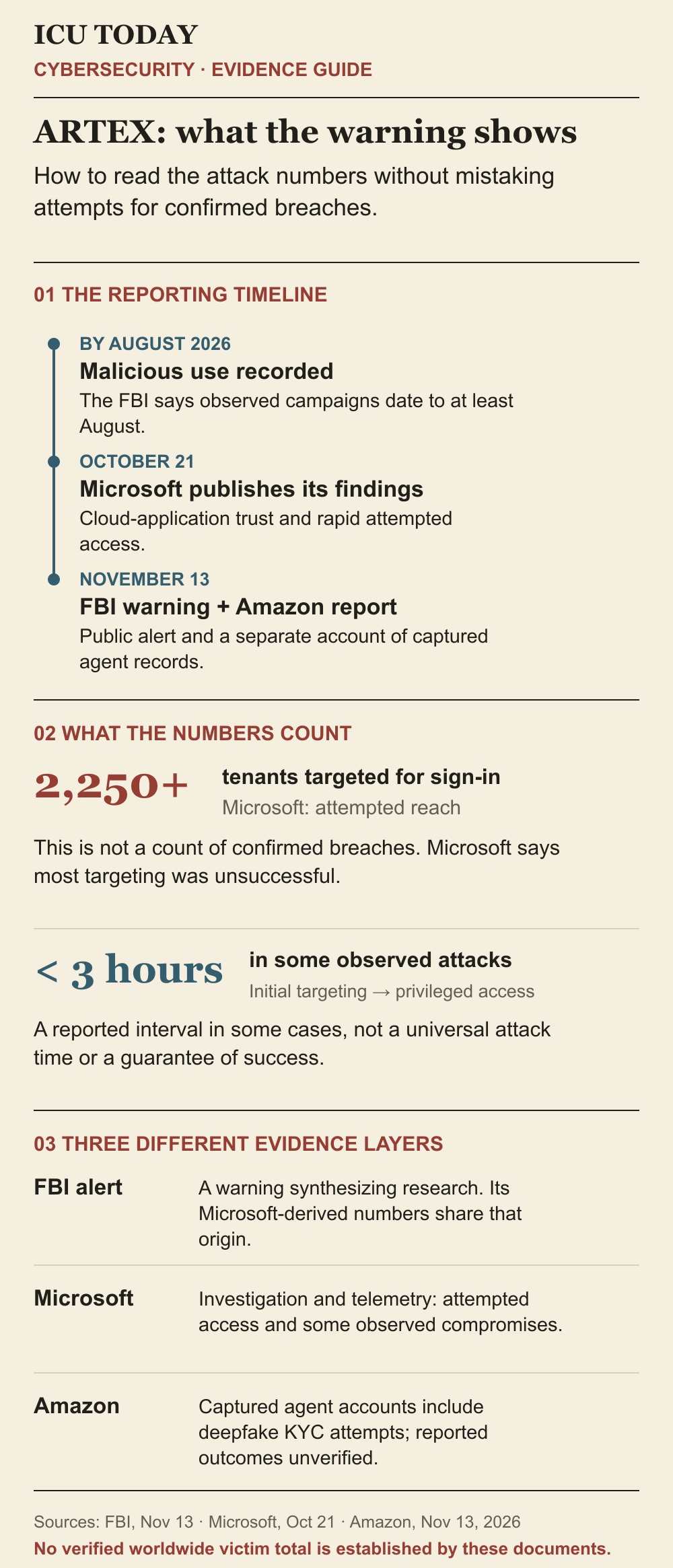
Reporting timeline. The FBI says malicious ARTEX use dates to at least August 2026. Microsoft published its investigation October 21. The FBI warning and Amazon’s separate report were published November 13, 2026.
What the figures count. Microsoft reported attempted sign-ins to more than 2,250 organizational tenants. This is not a count of confirmed breaches; most targeting was unsuccessful. Some observed attacks progressed from initial targeting to privileged access in under three hours. That interval is not a universal attack time or guarantee of success.
Three evidence layers. The FBI alert synthesizes research; its Microsoft-derived numbers share that origin. Microsoft reports investigation and telemetry covering attempted access and some observed compromises. Amazon’s captured agent accounts include deepfake identity-check attempts; it could not verify the outcomes those agents reported. These documents do not establish a verified worldwide victim total.
Graphic sources: Federal Bureau of Investigation · Microsoft Security Blog · AWS Security Blog
The developing record.
Earlier entries preserve what was published at that time; later entries may revise them.
2026-11-14T17:40:43.516Z · Initial report on the FBI’s November 13 ARTEX alert, distinguishing attempted tenant access, observed compromises and unverified agent accounts.
FBI warns ARTEX is accelerating cyberattacks
The bureau’s November 13 alert brings together reports of AI-assisted intrusions. Attempted access, confirmed compromise and attackers’ own claims are different measures.
What happened
The FBI issued a public warning on Friday, November 13, about criminals using ARTEX, an AI-powered penetration-testing framework, to automate cyberattacks across financial services, government, technology and other industries. Its FLASH alert says malicious use dates to at least August. The software turns an operator’s instructions into tasks for specialized agents connected to outside AI models. The warning concerns abuse of a security-testing tool; it does not establish that everyone running ARTEX is an attacker. [Federal Bureau of Investigation]
Why it matters
Microsoft’s October 21 investigation, cited by the FBI, illustrates the risk to organizations that trust third-party cloud applications. Microsoft says the Storm-0940 group attempted sign-ins to more than 2,250 tenants—separate organizational environments—following the ConnectWise Cloud Backup compromise. That figure measures attempted reach, not confirmed breaches. Microsoft reported privileged cloud access in some attacks, while saying most targeting was unsuccessful. In a separate November 13 report, Amazon described agent records collected by its decoy systems between October 3 and November 5. Those records described credential theft and attempts to bypass cryptocurrency exchanges’ identity checks using deepfakes. Amazon assessed ARTEX involvement with moderate confidence. It said it did not observe the described activity as it happened and could not verify the outcomes the agents claimed. The FBI recommends reviewing exposed applications and trusted vendor connections, limiting cloud-administration access, and watching for unusual credential additions and privileged application activity. Its guidance also calls for preserving sign-in and audit evidence. The bureau cautions that a listed network address can later belong to an innocent service; an indicator alone does not establish compromise. [Microsoft Security Blog] [AWS Security Blog] [Federal Bureau of Investigation]
What remains unknown
These documents do not provide a verified worldwide victim total. The FBI’s synthesis and Microsoft’s underlying report are not independent confirmations of the same numbers. Amazon’s captured agent accounts are another evidence type, not proof that every described operation succeeded. Neither attack speed nor widespread targeting establishes that defenses always failed. [Federal Bureau of Investigation] [Microsoft Security Blog] [AWS Security Blog]
Read the infographic as text
Reporting timeline. The FBI says malicious ARTEX use dates to at least August 2026. Microsoft published its investigation October 21. The FBI warning and Amazon’s separate report were published November 13, 2026.
What the figures count. Microsoft reported attempted sign-ins to more than 2,250 organizational tenants. This is not a count of confirmed breaches; most targeting was unsuccessful. Some observed attacks progressed from initial targeting to privileged access in under three hours. That interval is not a universal attack time or guarantee of success.
Three evidence layers. The FBI alert synthesizes research; its Microsoft-derived numbers share that origin. Microsoft reports investigation and telemetry covering attempted access and some observed compromises. Amazon’s captured agent accounts include deepfake identity-check attempts; it could not verify the outcomes those agents reported. These documents do not establish a verified worldwide victim total.
Graphic sources: Federal Bureau of Investigation · Microsoft Security Blog · AWS Security Blog
Original sources
Threat Overview of ARTEX Autonomous Penetration Testing Framework — FLASH-20261113-001 · Issuer: Federal Bureau of Investigation · Published 2026-11-13
AI-driven, large-scale nation-state campaign using ARTEX enables supply chain compromise · Issuer: Microsoft Threat Intelligence · Published 2026-10-21
Amazon Threat Intelligence observes threat actors running cybercrime campaigns with ARTEX AI agents · Issuer: Amazon Threat Intelligence · Published 2026-11-13
Corrections
No corrections recorded.