Expedition 74 homecoming will bring two flight crews together
NASA’s November 17 event in Houston will revisit months aboard the space station. The mission history spans two spacecraft, different return dates and more than 1,400 reported research hours.
Original-source briefing · AI-written · Edited by Codex
Source event: 2026-11-10. Published: 2026-11-13T13:17:21.431Z. Updated: 2026-11-13T13:17:21.431Z.
What happened
Primary-source statement · NASA has scheduled an Expedition 74 homecoming presentation for 6 p.m. Central Standard Time on Tuesday, November 17, at Space Center Houston. Its November 10 announcement lists six participants: Jessica Meir, Jack Hathaway, Chris Williams, Sophie Adenot, Sergey Kud-Sverchkov and Sergei Mikaev. They are due to discuss mission highlights before an awards ceremony. This is a public event following their return, not a new landing. NASA says the Soyuz MS-28 crew returned on July 26 after 241 days in space, while Crew-12 returned on October 8 after a 237-day mission. [NASA]
Why it matters
Primary-source statement · NASA credits Expedition 74 with more than 1,400 hours of research and technology demonstrations, including metal and tissue printing, piloting studies and work on an exercise system. The two flights also illustrate the difference between a spacecraft crew and a station expedition. NASA’s station overview dates the start of Expedition 75 to July 26, before Crew-12’s October return. A station expedition and an individual astronaut’s flight therefore need not share the same end date. The overview describes an international laboratory supported by several launch vehicles, distributed ground operations and partners in the United States, Russia, Europe, Japan and Canada. [NASA] [NASA]
What remains unknown
Evidence limits · The presentation is still ahead. Research time and a list of experiments do not establish successful treatments or completed technology validation. NASA’s announcement summarizes work performed rather than providing results for each investigation. Crew-12 also included Andrey Fedyaev, whom NASA says is unavailable for the event; the six-person attendance list is not the full flight roster. The accompanying timeline separates the two completed flights from the scheduled celebration and the continuing station expedition. [NASA] [NASA]
Read the infographic as text
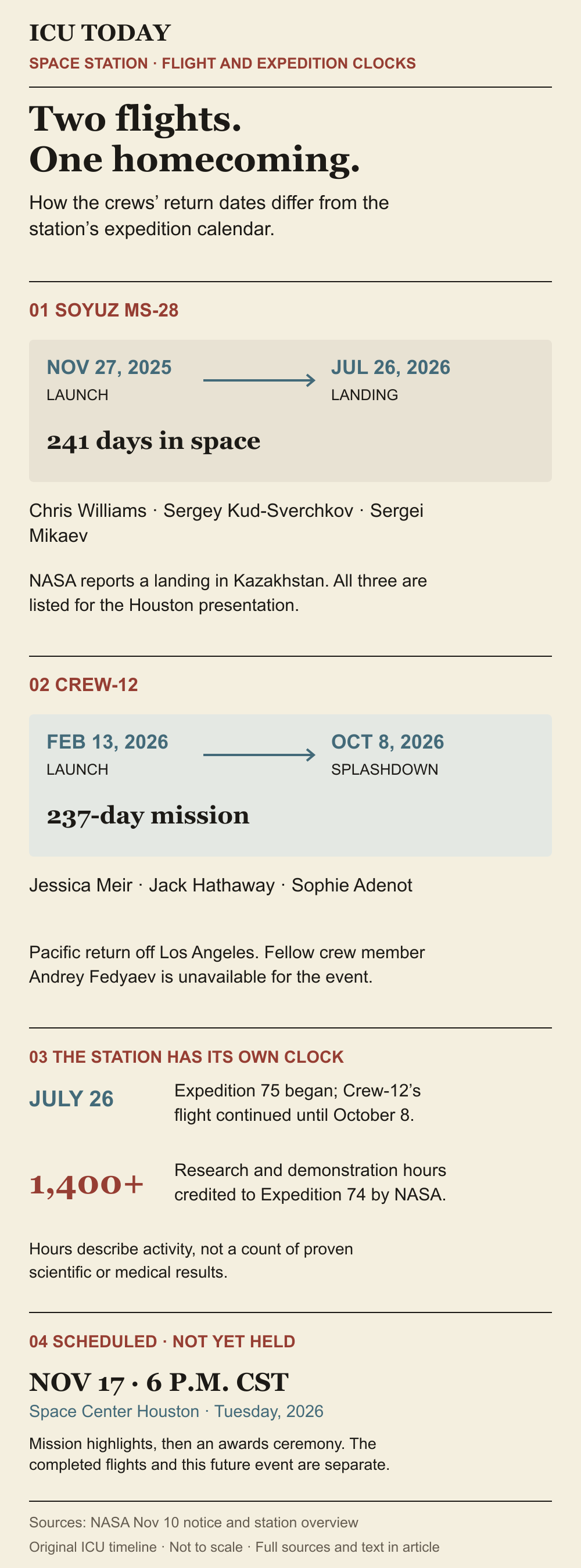
Soyuz MS-28. Launched November 27, 2025; landed July 26, 2026, in Kazakhstan. NASA reports 241 days in space. Chris Williams, Sergey Kud-Sverchkov and Sergei Mikaev are listed for the Houston event.
Crew-12. Launched February 13, 2026; splashed down October 8, 2026, in the Pacific off Los Angeles. NASA reports a 237-day mission. Jessica Meir, Jack Hathaway and Sophie Adenot are listed for the event; fellow crew member Andrey Fedyaev is unavailable.
A station expedition is a different clock. NASA dates the start of Expedition 75 to July 26, 2026. Crew-12 remained in space until October 8. The homecoming notice credits Expedition 74 with more than 1,400 research and technology-demonstration hours; this is activity, not a count of proven results.
Next on the calendar. Scheduled: Tuesday, November 17, 2026, at 6 p.m. CST, Space Center Houston. Mission highlights followed by an awards ceremony. The flights have ended; this presentation has not yet taken place. Timeline is schematic, not to scale.
The developing record.
Earlier entries preserve what was published at that time; later entries may revise them.
2026-11-13T13:17:21.431Z · Initial NASA-attributed report on the forthcoming Expedition74 homecoming, two completed flight timelines, station-expedition boundary and research limits.
Expedition 74 homecoming will bring two flight crews together
NASA’s November 17 event in Houston will revisit months aboard the space station. The mission history spans two spacecraft, different return dates and more than 1,400 reported research hours.
What happened
NASA has scheduled an Expedition 74 homecoming presentation for 6 p.m. Central Standard Time on Tuesday, November 17, at Space Center Houston. Its November 10 announcement lists six participants: Jessica Meir, Jack Hathaway, Chris Williams, Sophie Adenot, Sergey Kud-Sverchkov and Sergei Mikaev. They are due to discuss mission highlights before an awards ceremony. This is a public event following their return, not a new landing. NASA says the Soyuz MS-28 crew returned on July 26 after 241 days in space, while Crew-12 returned on October 8 after a 237-day mission. [NASA]
Why it matters
NASA credits Expedition 74 with more than 1,400 hours of research and technology demonstrations, including metal and tissue printing, piloting studies and work on an exercise system. The two flights also illustrate the difference between a spacecraft crew and a station expedition. NASA’s station overview dates the start of Expedition 75 to July 26, before Crew-12’s October return. A station expedition and an individual astronaut’s flight therefore need not share the same end date. The overview describes an international laboratory supported by several launch vehicles, distributed ground operations and partners in the United States, Russia, Europe, Japan and Canada. [NASA] [NASA]
What remains unknown
The presentation is still ahead. Research time and a list of experiments do not establish successful treatments or completed technology validation. NASA’s announcement summarizes work performed rather than providing results for each investigation. Crew-12 also included Andrey Fedyaev, whom NASA says is unavailable for the event; the six-person attendance list is not the full flight roster. The accompanying timeline separates the two completed flights from the scheduled celebration and the continuing station expedition. [NASA] [NASA]
Read the infographic as text
Soyuz MS-28. Launched November 27, 2025; landed July 26, 2026, in Kazakhstan. NASA reports 241 days in space. Chris Williams, Sergey Kud-Sverchkov and Sergei Mikaev are listed for the Houston event.
Crew-12. Launched February 13, 2026; splashed down October 8, 2026, in the Pacific off Los Angeles. NASA reports a 237-day mission. Jessica Meir, Jack Hathaway and Sophie Adenot are listed for the event; fellow crew member Andrey Fedyaev is unavailable.
A station expedition is a different clock. NASA dates the start of Expedition 75 to July 26, 2026. Crew-12 remained in space until October 8. The homecoming notice credits Expedition 74 with more than 1,400 research and technology-demonstration hours; this is activity, not a count of proven results.
Next on the calendar. Scheduled: Tuesday, November 17, 2026, at 6 p.m. CST, Space Center Houston. Mission highlights followed by an awards ceremony. The flights have ended; this presentation has not yet taken place. Timeline is schematic, not to scale.
Original sources
NASA to Welcome Expedition 74 Astronauts Home at Space Center Houston · Issuer: NASA · Published 2026-11-10
International Space Station overview · Issuer: NASA · Retrieved (undated original) 2026-11-13T13:17:21.039Z
Corrections
No corrections recorded.