A third less LNG could leave the EU with just 7 billion cubic meters of gas in March
A Federal Reserve economist estimates EU gas stocks would end March at 32 billion cubic meters under recent supply patterns, but below 7 billion if liquefied gas imports fell by a third.
Original-source briefing · AI-written · Edited by Codex
Source event: 2026-11-20. Published: 2026-11-20T19:03:13.483Z. Updated: 2026-11-20T19:03:13.483Z.
What happened
Primary-source statement · The European Union could get through a winter like the last four with about 32 billion cubic meters of natural gas still in storage at the end of March, Federal Reserve economist Johannes Fleck estimated in a November 20 research note. Starting with the same amount of gas but cutting monthly liquefied natural gas imports by a third from a year earlier leaves less than 7 billion cubic meters. Both figures are projections for March 2027. [Federal Reserve Board] [Federal Reserve Board]
Why it matters
Primary-source statement · The United States supplied about half the EU’s liquefied natural gas in 2025 and in the first seven months of 2026, according to Fleck. European buyers increasingly rely on gas shipped by sea. EU imports of liquefied gas rose from 80 billion cubic meters in 2021 to 146 billion in 2025. Fleck estimates that U.S. suppliers accounted for about three quarters of that increase. [Federal Reserve Board]
What remains unknown
Primary-source statement · Weather can draw down storage even if cargoes keep coming. When Fleck kept supply at the baseline level but used the highest consumption recorded for each month in the past four winters, the end-March estimate fell to about 16 billion cubic meters. He tested lower imports separately, holding consumption at its recent monthly average. The study assigns no odds to either outcome. It represents the author’s research, and the amount of gas Europe will actually have in storage depends on what arrives and how much people use. [Federal Reserve Board] [Federal Reserve Board]
Read the infographic as text
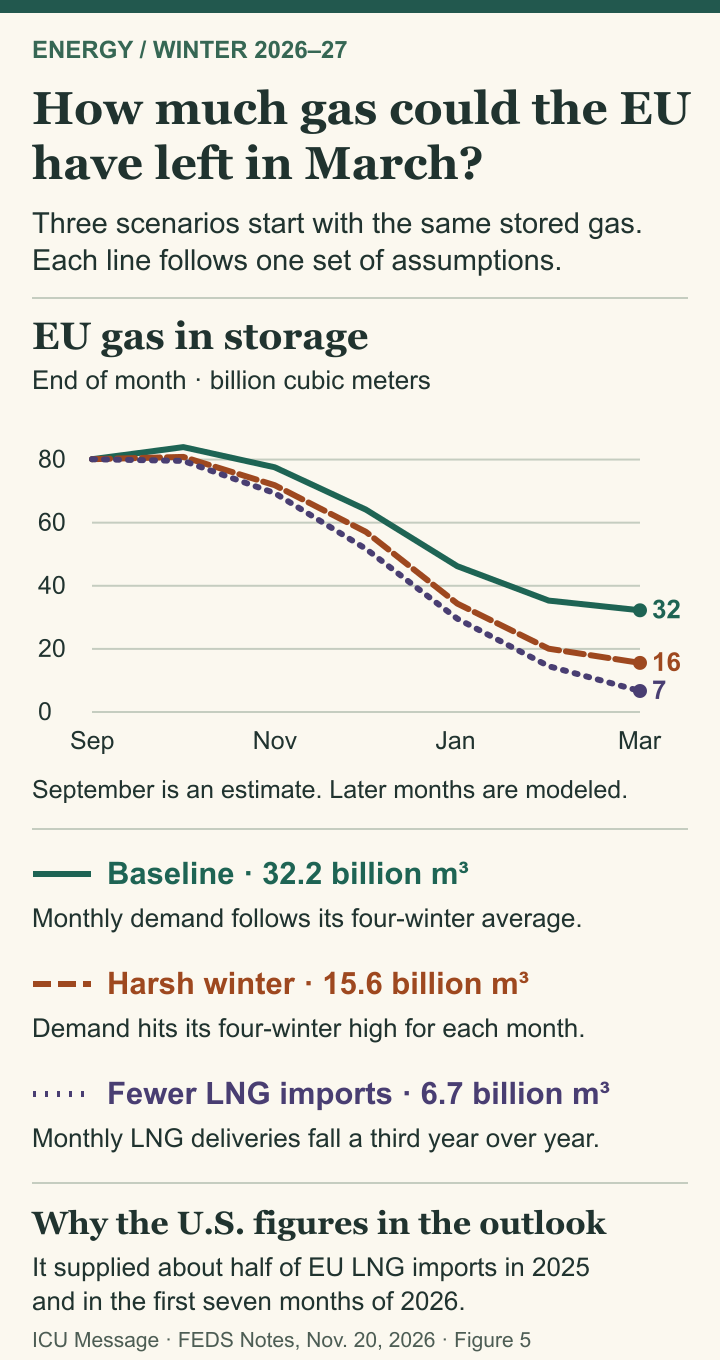
A common starting point. The model starts at 80.1 billion cubic meters at the end of September 2026. The October through March values are projections. The chart uses one scale in billion cubic meters for all three paths.
What changes in each scenario. At the end of March 2027 the baseline has 32.2 billion cubic meters. Using the highest corresponding monthly demand of the last four winters with baseline supply leaves 15.6 billion. Reducing monthly liquefied natural gas imports by one-third from a year earlier with baseline demand leaves 6.7 billion.
The United States connection. The United States supplied about half of EU liquefied natural gas imports in 2025 and again in January through July 2026. The import-scarcity scenario reduces total LNG deliveries from all origins. The study gives no likelihood for any of the three paths.
Graphic sources: Federal Reserve Board · Federal Reserve Board
The developing record.
Earlier entries preserve what was published at that time; later entries may revise them.
2026-11-20T19:03:13.483Z · Johannes Fleck estimated EU gas stocks at the end of March under three winter supply and demand scenarios.
A third less LNG could leave the EU with just 7 billion cubic meters of gas in March
A Federal Reserve economist estimates EU gas stocks would end March at 32 billion cubic meters under recent supply patterns, but below 7 billion if liquefied gas imports fell by a third.
What happened
The European Union could get through a winter like the last four with about 32 billion cubic meters of natural gas still in storage at the end of March, Federal Reserve economist Johannes Fleck estimated in a November 20 research note. Starting with the same amount of gas but cutting monthly liquefied natural gas imports by a third from a year earlier leaves less than 7 billion cubic meters. Both figures are projections for March 2027. [Federal Reserve Board] [Federal Reserve Board]
Why it matters
The United States supplied about half the EU’s liquefied natural gas in 2025 and in the first seven months of 2026, according to Fleck. European buyers increasingly rely on gas shipped by sea. EU imports of liquefied gas rose from 80 billion cubic meters in 2021 to 146 billion in 2025. Fleck estimates that U.S. suppliers accounted for about three quarters of that increase. [Federal Reserve Board]
What remains unknown
Weather can draw down storage even if cargoes keep coming. When Fleck kept supply at the baseline level but used the highest consumption recorded for each month in the past four winters, the end-March estimate fell to about 16 billion cubic meters. He tested lower imports separately, holding consumption at its recent monthly average. The study assigns no odds to either outcome. It represents the author’s research, and the amount of gas Europe will actually have in storage depends on what arrives and how much people use. [Federal Reserve Board] [Federal Reserve Board]
Read the infographic as text
A common starting point. The model starts at 80.1 billion cubic meters at the end of September 2026. The October through March values are projections. The chart uses one scale in billion cubic meters for all three paths.
What changes in each scenario. At the end of March 2027 the baseline has 32.2 billion cubic meters. Using the highest corresponding monthly demand of the last four winters with baseline supply leaves 15.6 billion. Reducing monthly liquefied natural gas imports by one-third from a year earlier with baseline demand leaves 6.7 billion.
The United States connection. The United States supplied about half of EU liquefied natural gas imports in 2025 and again in January through July 2026. The import-scarcity scenario reduces total LNG deliveries from all origins. The study gives no likelihood for any of the three paths.
Graphic sources: Federal Reserve Board · Federal Reserve Board
Original sources
Europe’s Natural Gas Outlook for the Upcoming Winter 2026/2027 · Issuer: Board of Governors of the Federal Reserve System · Published 2026-11-20
Europe’s Natural Gas Outlook for the Upcoming Winter 2026/2027 — Accessible Version, Figure 5 · Issuer: Board of Governors of the Federal Reserve System · Updated 2026-11-20
Corrections
No corrections recorded.