ESCAPADE leaves Earth behind on its long route to Mars
NASA reports that both spacecraft completed their November flybys. Their year-long detour explains how the mission got this far—and why the Mars science is still ahead.
Original-source briefing · AI-written · Edited by Codex
Source event: 2026-11-09. Published: 2026-11-11T21:00:09.756Z. Updated: 2026-11-11T21:00:09.756Z.
What happened
Primary-source statement · NASA says its two ESCAPADE spacecraft have completed the Earth flybys that sent them toward Mars. The first passed Earth on November 7 and the second on November 9, combining the planet’s gravity with sustained engine firings. The agency puts each departure burn at approximately nine minutes. Closest approaches were about 1,000 miles and 650 miles above Earth’s surface, respectively. The maneuvers begin a roughly ten-month interplanetary journey; the spacecraft have not arrived at Mars. [NASA]
A departure a year after launch
Primary-source statement · The mission team’s design history starts with a launch on Blue Origin’s New Glenn on November 13, 2025. A launch date and a departure for Mars are different milestones in this mission. NASA says Earth and Mars were on opposite sides of the Sun at launch. Instead of going directly toward Mars, the probes followed an Earth-proximity route around the Sun–Earth L2 region, about a million miles from Earth. Berkeley describes the route as a kidney-bean-shaped phase lasting roughly a year, ending with a return to Earth for the departure burns. [University of California, Berkeley Space Sciences Laboratory] [NASA]
The earlier course correction
Primary-source statement · The journey also required work before this month’s close approaches. In a January 7 update, NASA reported that one spacecraft completed its second trajectory correction the previous day, after an attempt had been delayed in December 2025. The other spacecraft had completed its first two maneuvers in December as planned. That January maneuver was intended to set up the Earth-proximity portion of the route. The earlier report helps distinguish an intermediate correction from the much later departure maneuver: the probes spent the intervening months following the designed route, rather than already cruising directly toward Mars. [NASA]
Why two spacecraft matter
Primary-source statement · Berkeley’s science team describes a measurement problem behind the twin-spacecraft design. Mars’ upper atmosphere and magnetic environment respond to changing conditions in the solar wind, the stream of material from the Sun. A single spacecraft samples different places at different times. The team says that makes it difficult to separate changes associated with location from changes happening as time passes. Its science objectives therefore call for coordinated observations at multiple locations. These are measurements made in the environment itself: the team says most of the quantities it needs cannot be detected remotely. [University of California, Berkeley Space Sciences Laboratory] [University of California, Berkeley Space Sciences Laboratory]
Why it matters
Primary-source statement · The mission’s stated purpose is to understand how the solar wind interacts with Mars and contributes to atmospheric escape. Berkeley identifies both escaping ions and sputtering among the processes of interest, and connects atmospheric escape to the evolution of rocky planets’ climates. The value of the two-probe design, in the team’s account, is the ability to examine a changing system from more than one place. That is a scientific objective rather than a finding from this week’s flybys. Completing the departure maneuvers advances the mission toward those observations; it does not yet answer how much atmosphere Mars loses under particular conditions. [University of California, Berkeley Space Sciences Laboratory] [University of California, Berkeley Space Sciences Laboratory]
Getting into orbit is another step
Primary-source statement · The mission plan includes further trajectory corrections during the cruise. Berkeley describes the next major destination as a large initial capture orbit around Mars, followed by several months of reducing and coordinating the two spacecraft’s orbits. NASA’s current schedule places the separate orbit-insertion burns on September 7 and September 9, 2027, with each engine firing for about eleven minutes. Those burns are intended to slow the spacecraft enough to enter orbit. Arrival and readiness for the main science campaign are separate milestones, with additional maneuvering between them. [University of California, Berkeley Space Sciences Laboratory] [NASA]
The planned observing sequence
Primary-source statement · NASA expects science operations to start in June 2028. It describes a first formation in which the spacecraft follow one another in the same orbit for six months. A later, five-month campaign would place them in different orbits: one farther from Mars to observe the arriving solar wind, and one closer to study the planet’s response. The sequence is planned, and its dates remain subject to the mission’s progress. [NASA]
What remains unknown
Evidence limits · Successful Earth departure does not guarantee successful Mars orbit insertion or the planned science return. The cited documents describe mission operations and intended measurements; they do not provide the future Mars observations needed to answer the research questions. NASA and Berkeley are members of the same mission, so their accounts share that origin. This report attributes the flight status to NASA and the design and research rationale to the mission team. The accompanying timeline keeps their completed milestones separate from their future targets. [NASA] [University of California, Berkeley Space Sciences Laboratory] [University of California, Berkeley Space Sciences Laboratory]
Mission-team reporting. Completed Earth flybys are separate from planned Mars arrival and science; NASA and Berkeley share mission origin.
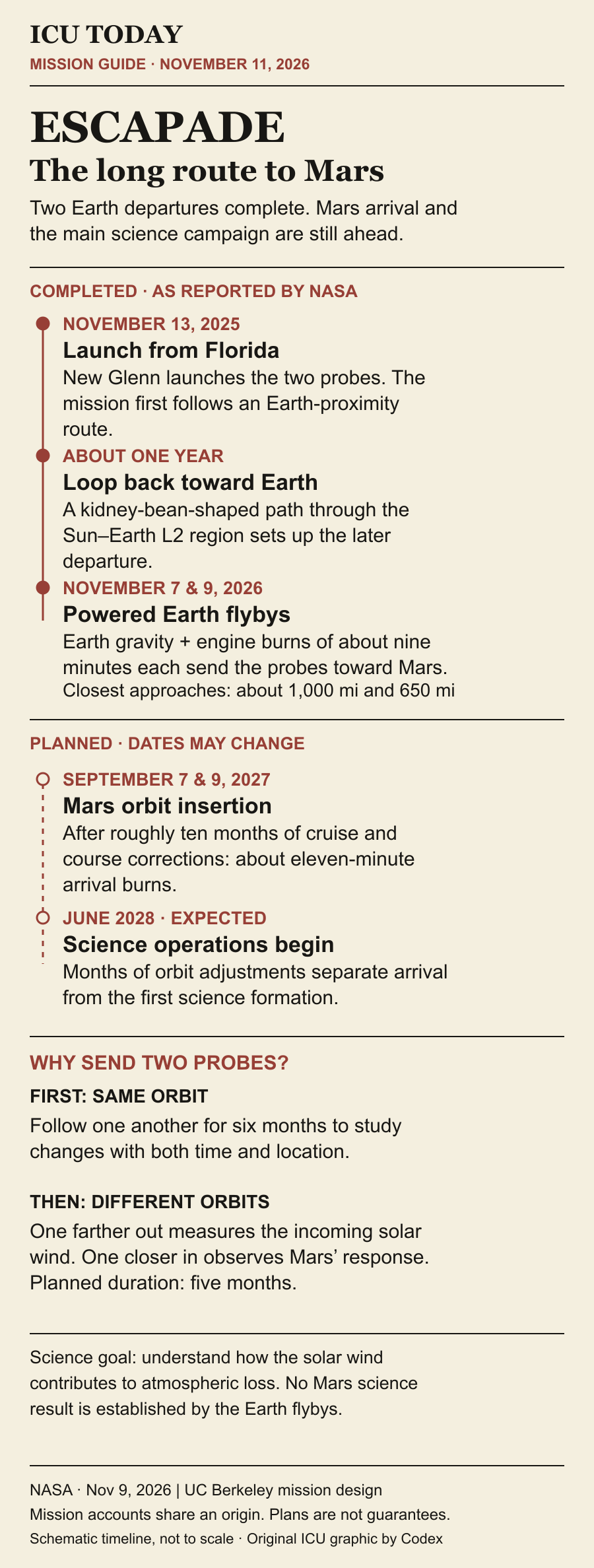
Read the infographic as text
Completed: launch and Earth-proximity phase. November 13, 2025: launch on New Glenn from Florida. Roughly one year on a kidney-bean-shaped path through the Sun–Earth L2 region sets up the return to Earth.
Completed: November 7 and 9, 2026. NASA reports powered Earth flybys with approximately nine-minute engine burns. Closest approaches were about 1,000 miles and 650 miles above Earth, respectively.
Planned: September 7 and 9, 2027. After roughly ten months of cruise and course corrections, approximately eleven-minute burns are planned to place the probes in orbit around Mars.
Expected: June 2028. Science operations are expected after several months of orbit adjustments. First, the spacecraft follow each other in the same orbit for six months. Then one studies incoming solar wind farther out while the other observes Mars’ response closer in, for five months.
Purpose and limits. The objective is to understand how solar wind contributes to atmospheric loss. Earth departures do not establish a Mars science result. NASA and Berkeley share mission origin. Future milestones are plans, not guarantees.
Graphic sources: NASA · University of California, Berkeley Space Sciences Laboratory · University of California, Berkeley Space Sciences Laboratory
The developing record.
Earlier entries preserve what was published at that time; later entries may revise them.
2026-11-11T21:00:09.756Z · Initial extended report: completed Earth flybys, the earlier route and the planned Mars science sequence.
ESCAPADE leaves Earth behind on its long route to Mars
NASA reports that both spacecraft completed their November flybys. Their year-long detour explains how the mission got this far—and why the Mars science is still ahead.
What happened
NASA says its two ESCAPADE spacecraft have completed the Earth flybys that sent them toward Mars. The first passed Earth on November 7 and the second on November 9, combining the planet’s gravity with sustained engine firings. The agency puts each departure burn at approximately nine minutes. Closest approaches were about 1,000 miles and 650 miles above Earth’s surface, respectively. The maneuvers begin a roughly ten-month interplanetary journey; the spacecraft have not arrived at Mars. [NASA]
A departure a year after launch
The mission team’s design history starts with a launch on Blue Origin’s New Glenn on November 13, 2025. A launch date and a departure for Mars are different milestones in this mission. NASA says Earth and Mars were on opposite sides of the Sun at launch. Instead of going directly toward Mars, the probes followed an Earth-proximity route around the Sun–Earth L2 region, about a million miles from Earth. Berkeley describes the route as a kidney-bean-shaped phase lasting roughly a year, ending with a return to Earth for the departure burns. [University of California, Berkeley Space Sciences Laboratory] [NASA]
The earlier course correction
The journey also required work before this month’s close approaches. In a January 7 update, NASA reported that one spacecraft completed its second trajectory correction the previous day, after an attempt had been delayed in December 2025. The other spacecraft had completed its first two maneuvers in December as planned. That January maneuver was intended to set up the Earth-proximity portion of the route. The earlier report helps distinguish an intermediate correction from the much later departure maneuver: the probes spent the intervening months following the designed route, rather than already cruising directly toward Mars. [NASA]
Why two spacecraft matter
Berkeley’s science team describes a measurement problem behind the twin-spacecraft design. Mars’ upper atmosphere and magnetic environment respond to changing conditions in the solar wind, the stream of material from the Sun. A single spacecraft samples different places at different times. The team says that makes it difficult to separate changes associated with location from changes happening as time passes. Its science objectives therefore call for coordinated observations at multiple locations. These are measurements made in the environment itself: the team says most of the quantities it needs cannot be detected remotely. [University of California, Berkeley Space Sciences Laboratory] [University of California, Berkeley Space Sciences Laboratory]
Why it matters
The mission’s stated purpose is to understand how the solar wind interacts with Mars and contributes to atmospheric escape. Berkeley identifies both escaping ions and sputtering among the processes of interest, and connects atmospheric escape to the evolution of rocky planets’ climates. The value of the two-probe design, in the team’s account, is the ability to examine a changing system from more than one place. That is a scientific objective rather than a finding from this week’s flybys. Completing the departure maneuvers advances the mission toward those observations; it does not yet answer how much atmosphere Mars loses under particular conditions. [University of California, Berkeley Space Sciences Laboratory] [University of California, Berkeley Space Sciences Laboratory]
Getting into orbit is another step
The mission plan includes further trajectory corrections during the cruise. Berkeley describes the next major destination as a large initial capture orbit around Mars, followed by several months of reducing and coordinating the two spacecraft’s orbits. NASA’s current schedule places the separate orbit-insertion burns on September 7 and September 9, 2027, with each engine firing for about eleven minutes. Those burns are intended to slow the spacecraft enough to enter orbit. Arrival and readiness for the main science campaign are separate milestones, with additional maneuvering between them. [University of California, Berkeley Space Sciences Laboratory] [NASA]
The planned observing sequence
NASA expects science operations to start in June 2028. It describes a first formation in which the spacecraft follow one another in the same orbit for six months. A later, five-month campaign would place them in different orbits: one farther from Mars to observe the arriving solar wind, and one closer to study the planet’s response. The sequence is planned, and its dates remain subject to the mission’s progress. [NASA]
What remains unknown
Successful Earth departure does not guarantee successful Mars orbit insertion or the planned science return. The cited documents describe mission operations and intended measurements; they do not provide the future Mars observations needed to answer the research questions. NASA and Berkeley are members of the same mission, so their accounts share that origin. This report attributes the flight status to NASA and the design and research rationale to the mission team. The accompanying timeline keeps their completed milestones separate from their future targets. [NASA] [University of California, Berkeley Space Sciences Laboratory] [University of California, Berkeley Space Sciences Laboratory]
Read the infographic as text
Completed: launch and Earth-proximity phase. November 13, 2025: launch on New Glenn from Florida. Roughly one year on a kidney-bean-shaped path through the Sun–Earth L2 region sets up the return to Earth.
Completed: November 7 and 9, 2026. NASA reports powered Earth flybys with approximately nine-minute engine burns. Closest approaches were about 1,000 miles and 650 miles above Earth, respectively.
Planned: September 7 and 9, 2027. After roughly ten months of cruise and course corrections, approximately eleven-minute burns are planned to place the probes in orbit around Mars.
Expected: June 2028. Science operations are expected after several months of orbit adjustments. First, the spacecraft follow each other in the same orbit for six months. Then one studies incoming solar wind farther out while the other observes Mars’ response closer in, for five months.
Purpose and limits. The objective is to understand how solar wind contributes to atmospheric loss. Earth departures do not establish a Mars science result. NASA and Berkeley share mission origin. Future milestones are plans, not guarantees.
Graphic sources: NASA · University of California, Berkeley Space Sciences Laboratory · University of California, Berkeley Space Sciences Laboratory
Original sources
NASA’s ESCAPADE Completes Powered Earth Flybys, Now En Route to Mars · Issuer: NASA · Published 2026-11-09T16:01:47.000Z
NASA’s Second ESCAPADE Spacecraft Completes Trajectory Maneuver · Issuer: NASA · Published 2026-01-07T17:20:41.000Z
ESCAPADE Mission Design · Issuer: University of California, Berkeley Space Sciences Laboratory · Retrieved (undated original) 2026-11-11T20:39:25.803Z
ESCAPADE Science Goals & Objectives · Issuer: University of California, Berkeley Space Sciences Laboratory · Retrieved (undated original) 2026-11-11T20:42:46.176Z
Why ESCAPADE? · Issuer: University of California, Berkeley Space Sciences Laboratory · Retrieved (undated original) 2026-11-11T20:42:47.358Z
Corrections
No corrections recorded.