How Endeavour rode a modified 747 to its museum home
NASA’s new account connects the shuttle’s 2012 California farewell to a planned upright display. Its carrier-aircraft records explain the machinery behind the journey.
Original-source briefing · AI-written · Edited by Codex
Source event: 2026-11-12. Published: 2026-11-13T15:25:24.043Z. Updated: 2026-11-13T15:25:24.043Z.
What happened
Primary-source statement · NASA is revisiting space shuttle Endeavour’s final ferry flight as it announces a new chapter for the retired orbiter. In a November 12 account, the agency says its home at the California Science Center in Los Angeles will reopen the weekend of November 13 with Endeavour upright in launch position. That is the announcement’s schedule, not independently confirmed opening-day status. The flight recalled in the feature happened on September 21, 2012, when Endeavour crossed California mounted on a modified Boeing 747. NASA says the orbiter completed 25 space missions before its museum journey. [NASA]
Why it matters
Primary-source statement · The carrier was specialized transport equipment, not simply an airliner with a shuttle placed on its roof. NASA’s historical fact sheet describes three mounting struts supported by strengthened internal structure. Two extra vertical stabilizers helped directional stability, and most interior furnishings behind the forward doors were removed. Crews also had instruments to monitor the orbiter’s electrical loads. Large gantry-like Mate-Demate Devices lifted orbiters into position and removed them afterward. The aircraft ferried shuttles from landing sites back to Kennedy Space Center and between locations too far apart for ground transport. [NASA]
Planning the California farewell
Primary-source statement · The November account describes coordination with the science center, the Federal Aviation Administration, Los Angeles International Airport and NASA’s Johnson Space Center. Photography was part of the flight planning. NASA’s F/A-18s and an F-15 carried imaging teams, and the agency recounts a proposal for separate photo and video chase aircraft over Los Angeles. Photographer Carla Thomas surveyed the route in a police helicopter; the account identifies the Hollywood hillside’s power lines and radio antennas as obstacles considered during planning. After the ferry flight, Endeavour was removed from the 747 and taken by trailer to the science center. [NASA]
What the older specifications show
Primary-source statement · NASA’s fact sheet lists a typical cruise altitude of 13,000–15,000 feet with an orbiter aboard and a typical range of 1,000 nautical miles with reserves. Those are historical operating specifications, not measurements from the September 2012 farewell. The document says NASA 905 carried out 70 of the program’s 87 operational ferry missions, then delivered Discovery, Enterprise and Endeavour to museums after the orbiters retired. It dates NASA 905’s own retirement to late 2012. [NASA]
What remains unknown
Evidence limits · ICU reviewed two NASA documents from one institutional origin. The new feature provides the opening-weekend expectation, while the older fact sheet supplies carrier history and engineering details. Neither establishes the exhibit’s present visitor-access status, ticket availability or opening hours. This report does not independently reconstruct the flight or certify an aircraft’s performance. The infographic keeps the 2012 transport, historical specifications and announced November 2026 display separate. [NASA] [NASA]
Read the infographic as text
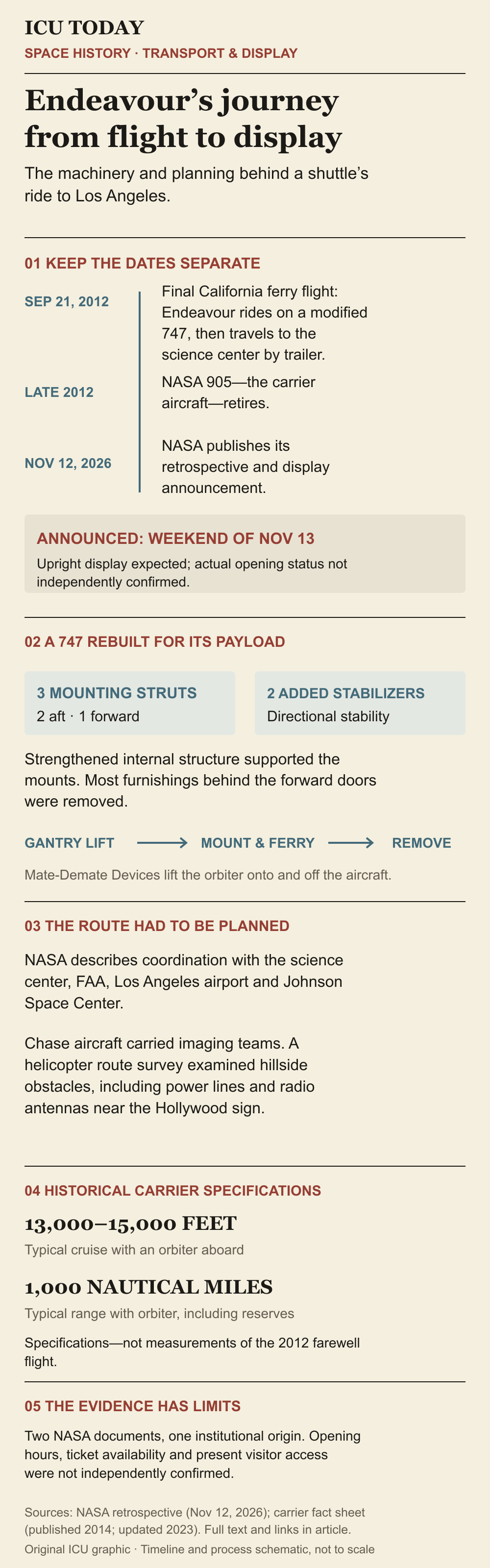
Separate the dates. September 21, 2012: Endeavour’s final ferry flight over California on a modified 747. Afterward, the orbiter was removed and trailered to the California Science Center. Late 2012: NASA 905 retired. November 12, 2026: NASA publishes its retrospective. Weekend of November 13, 2026: expected reopening with Endeavour upright, according to that announcement. Present visitor-access status is not independently confirmed. Timeline is not to scale.
How the carrier supported an orbiter. Three mounting struts—two aft and one forward—connected the orbiter to strengthened internal structure. Two additional vertical stabilizers enhanced directional stability. Most interior furnishings behind the forward doors were removed. Large gantry-like Mate-Demate Devices lifted the orbiter onto and off the aircraft. This is a process schematic, not a technical drawing.
Planning the ferry flight. NASA describes coordination with the California Science Center, FAA, Los Angeles International Airport and Johnson Space Center. Photo and video teams rode in chase aircraft. A police-helicopter route survey helped identify obstacles around the Hollywood hillside, including power lines and radio antennas. The agency’s written recollection is the source; no independent flight reconstruction is claimed.
Historical specifications, with limits. NASA lists typical cruise with an orbiter at 13,000–15,000 feet and typical range at 1,000 nautical miles with reserves. These are historical specifications, not measured values from Endeavour’s farewell. NASA 905 flew 70 of the shuttle program’s 87 operational ferry missions. The museum deliveries came after the operational program; do not add them to that denominator.
What the documents do not establish. No independently confirmed opening-day status, opening hours or ticket availability. The new account has a November 12 publication label and a November 11 last-updated label; neither is a live museum check. The carrier fact sheet carries a September 24, 2014 publication label and July 26, 2023 update label. Source dates and historical event dates are separate. Sources: NASA’s Endeavour retrospective and Shuttle Carrier Aircraft fact sheet.
The developing record.
Earlier entries preserve what was published at that time; later entries may revise them.
2026-11-13T15:25:24.043Z · Initial NASA-attributed report on Endeavour transport history, carrier modifications, flight planning and announced display, with clear dates and source limits.
How Endeavour rode a modified 747 to its museum home
NASA’s new account connects the shuttle’s 2012 California farewell to a planned upright display. Its carrier-aircraft records explain the machinery behind the journey.
What happened
NASA is revisiting space shuttle Endeavour’s final ferry flight as it announces a new chapter for the retired orbiter. In a November 12 account, the agency says its home at the California Science Center in Los Angeles will reopen the weekend of November 13 with Endeavour upright in launch position. That is the announcement’s schedule, not independently confirmed opening-day status. The flight recalled in the feature happened on September 21, 2012, when Endeavour crossed California mounted on a modified Boeing 747. NASA says the orbiter completed 25 space missions before its museum journey. [NASA]
Why it matters
The carrier was specialized transport equipment, not simply an airliner with a shuttle placed on its roof. NASA’s historical fact sheet describes three mounting struts supported by strengthened internal structure. Two extra vertical stabilizers helped directional stability, and most interior furnishings behind the forward doors were removed. Crews also had instruments to monitor the orbiter’s electrical loads. Large gantry-like Mate-Demate Devices lifted orbiters into position and removed them afterward. The aircraft ferried shuttles from landing sites back to Kennedy Space Center and between locations too far apart for ground transport. [NASA]
Planning the California farewell
The November account describes coordination with the science center, the Federal Aviation Administration, Los Angeles International Airport and NASA’s Johnson Space Center. Photography was part of the flight planning. NASA’s F/A-18s and an F-15 carried imaging teams, and the agency recounts a proposal for separate photo and video chase aircraft over Los Angeles. Photographer Carla Thomas surveyed the route in a police helicopter; the account identifies the Hollywood hillside’s power lines and radio antennas as obstacles considered during planning. After the ferry flight, Endeavour was removed from the 747 and taken by trailer to the science center. [NASA]
What the older specifications show
NASA’s fact sheet lists a typical cruise altitude of 13,000–15,000 feet with an orbiter aboard and a typical range of 1,000 nautical miles with reserves. Those are historical operating specifications, not measurements from the September 2012 farewell. The document says NASA 905 carried out 70 of the program’s 87 operational ferry missions, then delivered Discovery, Enterprise and Endeavour to museums after the orbiters retired. It dates NASA 905’s own retirement to late 2012. [NASA]
What remains unknown
ICU reviewed two NASA documents from one institutional origin. The new feature provides the opening-weekend expectation, while the older fact sheet supplies carrier history and engineering details. Neither establishes the exhibit’s present visitor-access status, ticket availability or opening hours. This report does not independently reconstruct the flight or certify an aircraft’s performance. The infographic keeps the 2012 transport, historical specifications and announced November 2026 display separate. [NASA] [NASA]
Read the infographic as text
Separate the dates. September 21, 2012: Endeavour’s final ferry flight over California on a modified 747. Afterward, the orbiter was removed and trailered to the California Science Center. Late 2012: NASA 905 retired. November 12, 2026: NASA publishes its retrospective. Weekend of November 13, 2026: expected reopening with Endeavour upright, according to that announcement. Present visitor-access status is not independently confirmed. Timeline is not to scale.
How the carrier supported an orbiter. Three mounting struts—two aft and one forward—connected the orbiter to strengthened internal structure. Two additional vertical stabilizers enhanced directional stability. Most interior furnishings behind the forward doors were removed. Large gantry-like Mate-Demate Devices lifted the orbiter onto and off the aircraft. This is a process schematic, not a technical drawing.
Planning the ferry flight. NASA describes coordination with the California Science Center, FAA, Los Angeles International Airport and Johnson Space Center. Photo and video teams rode in chase aircraft. A police-helicopter route survey helped identify obstacles around the Hollywood hillside, including power lines and radio antennas. The agency’s written recollection is the source; no independent flight reconstruction is claimed.
Historical specifications, with limits. NASA lists typical cruise with an orbiter at 13,000–15,000 feet and typical range at 1,000 nautical miles with reserves. These are historical specifications, not measured values from Endeavour’s farewell. NASA 905 flew 70 of the shuttle program’s 87 operational ferry missions. The museum deliveries came after the operational program; do not add them to that denominator.
What the documents do not establish. No independently confirmed opening-day status, opening hours or ticket availability. The new account has a November 12 publication label and a November 11 last-updated label; neither is a live museum check. The carrier fact sheet carries a September 24, 2014 publication label and July 26, 2023 update label. Source dates and historical event dates are separate. Sources: NASA’s Endeavour retrospective and Shuttle Carrier Aircraft fact sheet.
Original sources
Through NASA’s Lens: Capturing Space Shuttle Endeavour’s Move to LA · Issuer: NASA · Published 2026-11-12
NASA Armstrong Fact Sheet: Shuttle Carrier Aircraft · Issuer: NASA · Published 2014-09-24
Corrections
No corrections recorded.