California weather delays Dragon’s return of frozen research samples from the space station
NASA and SpaceX called off Wednesday’s departure. A blood vessel made with a 3D printer, frozen tumor samples and a lighting experiment are among the cargo due back on Earth.
Original-source briefing · AI-written · Edited by Codex
Source event: 2026-11-18. Published: 2026-11-18T15:51:30.747Z. Updated: 2026-11-18T15:51:30.747Z.
What happened
Primary-source statement · NASA and SpaceX called off Wednesday’s opportunity to bring a Dragon cargo spacecraft home from the International Space Station. NASA said the weather off California, where teams would recover the capsule from the ocean, was unfavorable. The agency scheduled another weather review for noon Eastern on November 18 and identified Thursday, November 19, as the next opportunity for Dragon to leave the station. [NASA]
Why it matters
Primary-source statement · The return flight carries experiments at different stages of their work. NASA lists a blood vessel built with a 3D printer for researchers studying how blood vessels age. The manifest also includes frozen tumor organoids that researchers treated aboard the station. What comes back is material for scientists to examine. The return advisory gives no findings about how patients would respond to a treatment. One piece of equipment has spent more than three years in orbit. Researchers used a lighting system to study whether it could support astronaut sleep on long missions. NASA describes the total return cargo as thousands of pounds. The figure of more than 6,300 pounds in its October arrival account describes supplies, experiments and equipment delivered to the station on the outbound flight. [NASA]
What remains unknown
Evidence limits · Departure from the station and splashdown off California are separate events. NASA’s next window concerns the first. Its November 18 update gives no revised splashdown time. The earlier landing target was tied to Wednesday’s departure, and the agency has yet to give a new time for the research to reach the recovery team. [NASA] [NASA]
Read the infographic as text
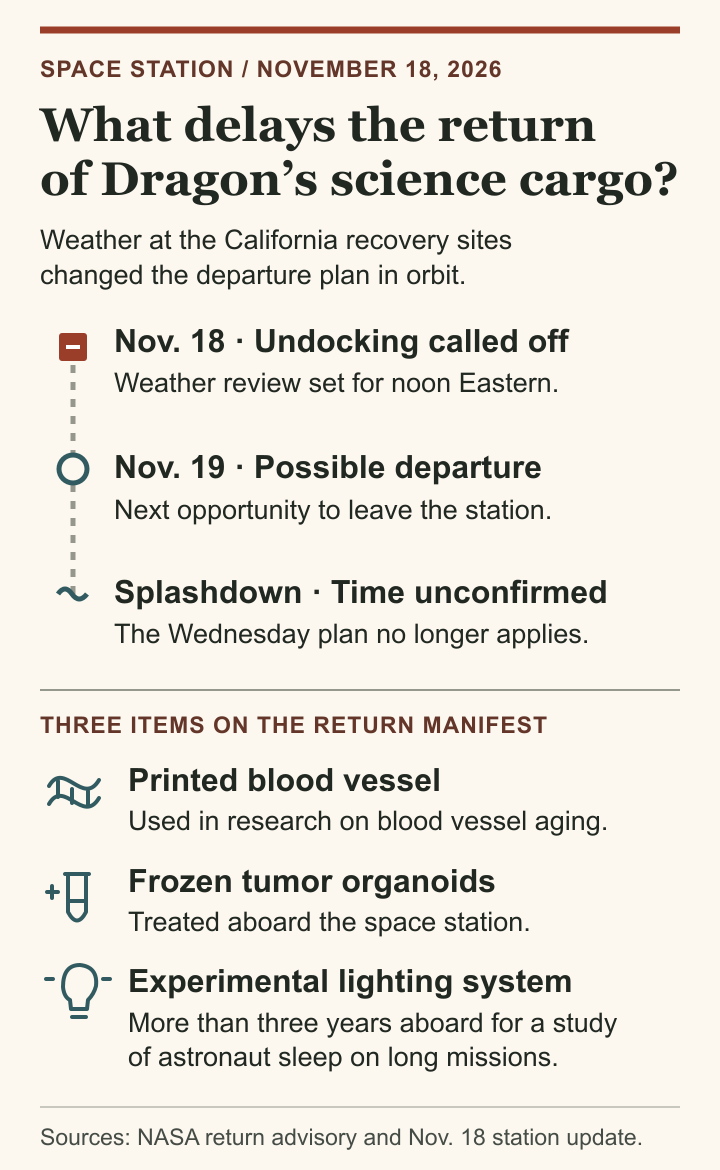
November 18 • Recovery weather. Unfavorable conditions off California led NASA and SpaceX to drop the Wednesday undocking opportunity. The weather review was scheduled for noon EST.
November 19 • Departure window. Thursday is the next possible undocking. A revised splashdown time has yet to be announced.
Research on board. A 3D-printed blood vessel was used to study vascular aging. Frozen tumor organoids were treated aboard the station. A lighting system spent more than three years on orbit for a study of astronaut sleep. These are research purposes, with outcomes unreported in the advisory.
The developing record.
Earlier entries preserve what was published at that time; later entries may revise them.
2026-11-18T15:51:30.747Z · Initial report on NASA’s weather decision, the cargo due back on Earth, and the distinction between the next departure opportunity and an unconfirmed splashdown.
California weather delays Dragon’s return of frozen research samples from the space station
NASA and SpaceX called off Wednesday’s departure. A blood vessel made with a 3D printer, frozen tumor samples and a lighting experiment are among the cargo due back on Earth.
What happened
NASA and SpaceX called off Wednesday’s opportunity to bring a Dragon cargo spacecraft home from the International Space Station. NASA said the weather off California, where teams would recover the capsule from the ocean, was unfavorable. The agency scheduled another weather review for noon Eastern on November 18 and identified Thursday, November 19, as the next opportunity for Dragon to leave the station. [NASA]
Why it matters
The return flight carries experiments at different stages of their work. NASA lists a blood vessel built with a 3D printer for researchers studying how blood vessels age. The manifest also includes frozen tumor organoids that researchers treated aboard the station. What comes back is material for scientists to examine. The return advisory gives no findings about how patients would respond to a treatment. One piece of equipment has spent more than three years in orbit. Researchers used a lighting system to study whether it could support astronaut sleep on long missions. NASA describes the total return cargo as thousands of pounds. The figure of more than 6,300 pounds in its October arrival account describes supplies, experiments and equipment delivered to the station on the outbound flight. [NASA]
What remains unknown
Departure from the station and splashdown off California are separate events. NASA’s next window concerns the first. Its November 18 update gives no revised splashdown time. The earlier landing target was tied to Wednesday’s departure, and the agency has yet to give a new time for the research to reach the recovery team. [NASA] [NASA]
Read the infographic as text
November 18 • Recovery weather. Unfavorable conditions off California led NASA and SpaceX to drop the Wednesday undocking opportunity. The weather review was scheduled for noon EST.
November 19 • Departure window. Thursday is the next possible undocking. A revised splashdown time has yet to be announced.
Research on board. A 3D-printed blood vessel was used to study vascular aging. Frozen tumor organoids were treated aboard the station. A lighting system spent more than three years on orbit for a study of astronaut sleep. These are research purposes, with outcomes unreported in the advisory.
Original sources
NASA, SpaceX Stand Down from Dragon’s Undocking on Wednesday · Issuer: NASA · Published 2026-11-18
NASA to Cover 35th SpaceX Resupply Mission Space Station Departure · Issuer: NASA · Published 2026-11-17
Corrections
No corrections recorded.