Dollar rose against trading-partner currencies in the Fed’s latest weekly figures
The broad dollar index gained 0.8% from November 9 to November 13. The rise was larger against advanced-economy currencies than against emerging-market currencies.
Original-source briefing · AI-written · Edited by Codex
Source event: 2026-11-16. Published: 2026-11-17T10:52:02.266Z. Updated: 2026-11-17T10:52:02.266Z.
What happened
Primary-source statement · The dollar strengthened against a broad group of major U.S. trading-partner currencies from November 9 to November 13, according to Federal Reserve data released November 16. The broad index rose from 121.6623 to 122.6503, a gain of about 0.8% calculated from the published values. The advanced-foreign-economy index gained about 1.4%; the emerging-market index rose about 0.2%. These comparisons run from Monday to Friday, rather than from the previous Friday, and describe last week’s observations—not current market prices. [Federal Reserve Board]
Why it matters
Primary-source statement · The indexes summarize the dollar’s exchange value across groups of trading partners rather than against one currency. Their differing movements show why a broad-dollar headline can hide substantial variation. In the same table, one U.S. dollar bought 159.93 Japanese yen on November 13, compared with 157.99 on November 9. The euro cost $1.1034, down from $1.1204. The euro row uses dollars per euro, while the yen row uses yen per dollar: opposite quotation conventions can describe the same direction of dollar movement. [Federal Reserve Board]
What remains unknown
Primary-source statement · The Fed publishes this weekly series on Mondays at 4:15 p.m., covering the previous business week. Its November 16 table marks November 11 as having no data; that gap is not a zero or an unchanged observation. The release does not establish what caused the movements or where exchange rates will go next. The index level uses January 2006 as 100, so 122.6503 is an index reading, not a dollar price. [Federal Reserve Board] [Federal Reserve Board]
Read the infographic as text
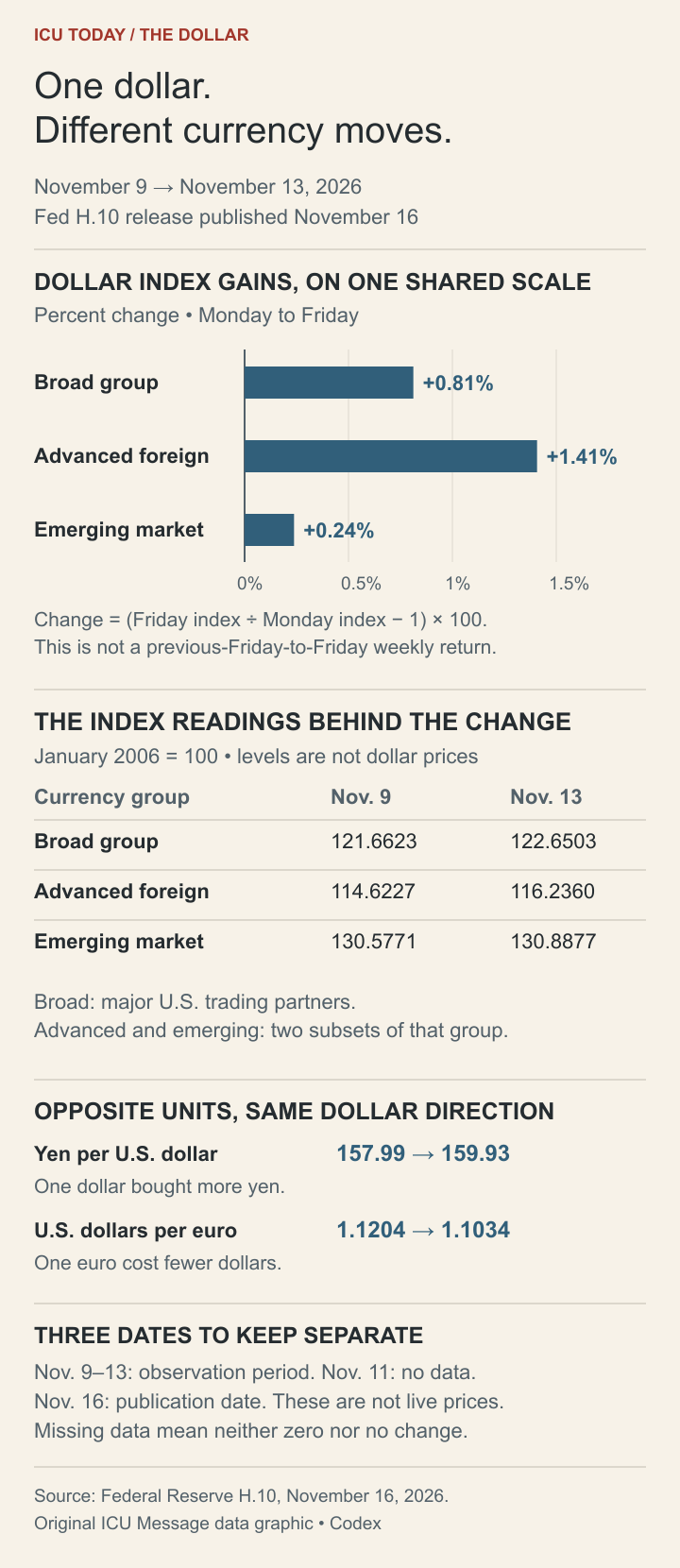
Index gains. Monday November 9 to Friday November 13 changes, calculated as (Friday/Monday −1) ×100: broad 0.8121%, advanced foreign 1.4075%, emerging market 0.2379%. Bars share a linear scale starting at zero. This is not a previous-Friday weekly return.
Index readings. January 2006=100. Broad 121.6623 to 122.6503; advanced foreign 114.6227 to 116.2360; emerging market 130.5771 to 130.8877. The broad group represents major U.S. trading partners; advanced and emerging groups are subsets. Levels are index readings, not currency prices.
Quotation units. Yen per U.S. dollar rose from 157.99 to 159.93; U.S. dollars per euro fell from 1.1204 to 1.1034. One dollar bought more yen and one euro cost fewer dollars. Opposite quotation conventions describe dollar gains in both examples.
Dates and missing data. Observation period November 9–13, 2026; publication November 16. November 11 is ND, meaning no data—not zero or an unchanged reading. The release does not establish causes or future currency movements.
Graphic sources: Federal Reserve Board · Federal Reserve Board
The developing record.
Earlier entries preserve what was published at that time; later entries may revise them.
2026-11-17T10:52:02.266Z · Initial report on the Federal Reserve’s November 16 exchange-rate release, with November9–13 index comparisons.
Dollar rose against trading-partner currencies in the Fed’s latest weekly figures
The broad dollar index gained 0.8% from November 9 to November 13. The rise was larger against advanced-economy currencies than against emerging-market currencies.
What happened
The dollar strengthened against a broad group of major U.S. trading-partner currencies from November 9 to November 13, according to Federal Reserve data released November 16. The broad index rose from 121.6623 to 122.6503, a gain of about 0.8% calculated from the published values. The advanced-foreign-economy index gained about 1.4%; the emerging-market index rose about 0.2%. These comparisons run from Monday to Friday, rather than from the previous Friday, and describe last week’s observations—not current market prices. [Federal Reserve Board]
Why it matters
The indexes summarize the dollar’s exchange value across groups of trading partners rather than against one currency. Their differing movements show why a broad-dollar headline can hide substantial variation. In the same table, one U.S. dollar bought 159.93 Japanese yen on November 13, compared with 157.99 on November 9. The euro cost $1.1034, down from $1.1204. The euro row uses dollars per euro, while the yen row uses yen per dollar: opposite quotation conventions can describe the same direction of dollar movement. [Federal Reserve Board]
What remains unknown
The Fed publishes this weekly series on Mondays at 4:15 p.m., covering the previous business week. Its November 16 table marks November 11 as having no data; that gap is not a zero or an unchanged observation. The release does not establish what caused the movements or where exchange rates will go next. The index level uses January 2006 as 100, so 122.6503 is an index reading, not a dollar price. [Federal Reserve Board] [Federal Reserve Board]
Read the infographic as text
Index gains. Monday November 9 to Friday November 13 changes, calculated as (Friday/Monday −1) ×100: broad 0.8121%, advanced foreign 1.4075%, emerging market 0.2379%. Bars share a linear scale starting at zero. This is not a previous-Friday weekly return.
Index readings. January 2006=100. Broad 121.6623 to 122.6503; advanced foreign 114.6227 to 116.2360; emerging market 130.5771 to 130.8877. The broad group represents major U.S. trading partners; advanced and emerging groups are subsets. Levels are index readings, not currency prices.
Quotation units. Yen per U.S. dollar rose from 157.99 to 159.93; U.S. dollars per euro fell from 1.1204 to 1.1034. One dollar bought more yen and one euro cost fewer dollars. Opposite quotation conventions describe dollar gains in both examples.
Dates and missing data. Observation period November 9–13, 2026; publication November 16. November 11 is ND, meaning no data—not zero or an unchanged reading. The release does not establish causes or future currency movements.
Graphic sources: Federal Reserve Board · Federal Reserve Board
Original sources
Foreign Exchange Rates — H.10: November 9–13, 2026 · Issuer: Board of Governors of the Federal Reserve System · Published 2026-11-16
Foreign Exchange Rates — H.10: release schedule · Issuer: Board of Governors of the Federal Reserve System · Updated 2026-11-16
Corrections
No corrections recorded.