Curiosity catches clouds drifting after sunset on Mars
NASA’s new images show a brief seasonal sight over Gale Crater. An earlier observation explains why two clouds in the same frame can tell different stories.
Original-source briefing · AI-written · Edited by Codex
Source event: 2026-11-20. Published: 2026-11-22T09:00:22.772Z. Updated: 2026-11-22T09:00:22.772Z.
What happened
Primary-source statement · NASA released a view on November 20 of twilight clouds drifting over Gale Crater on Mars. Curiosity caught them with its navigation cameras after sunset on October 31, the rover’s 5,061st Martian day. Timing matters for this observation. NASA says the clouds appear for only a short stretch each Martian fall at the crater, where Curiosity has been exploring for more than 14 Earth years. [NASA]
Why it matters
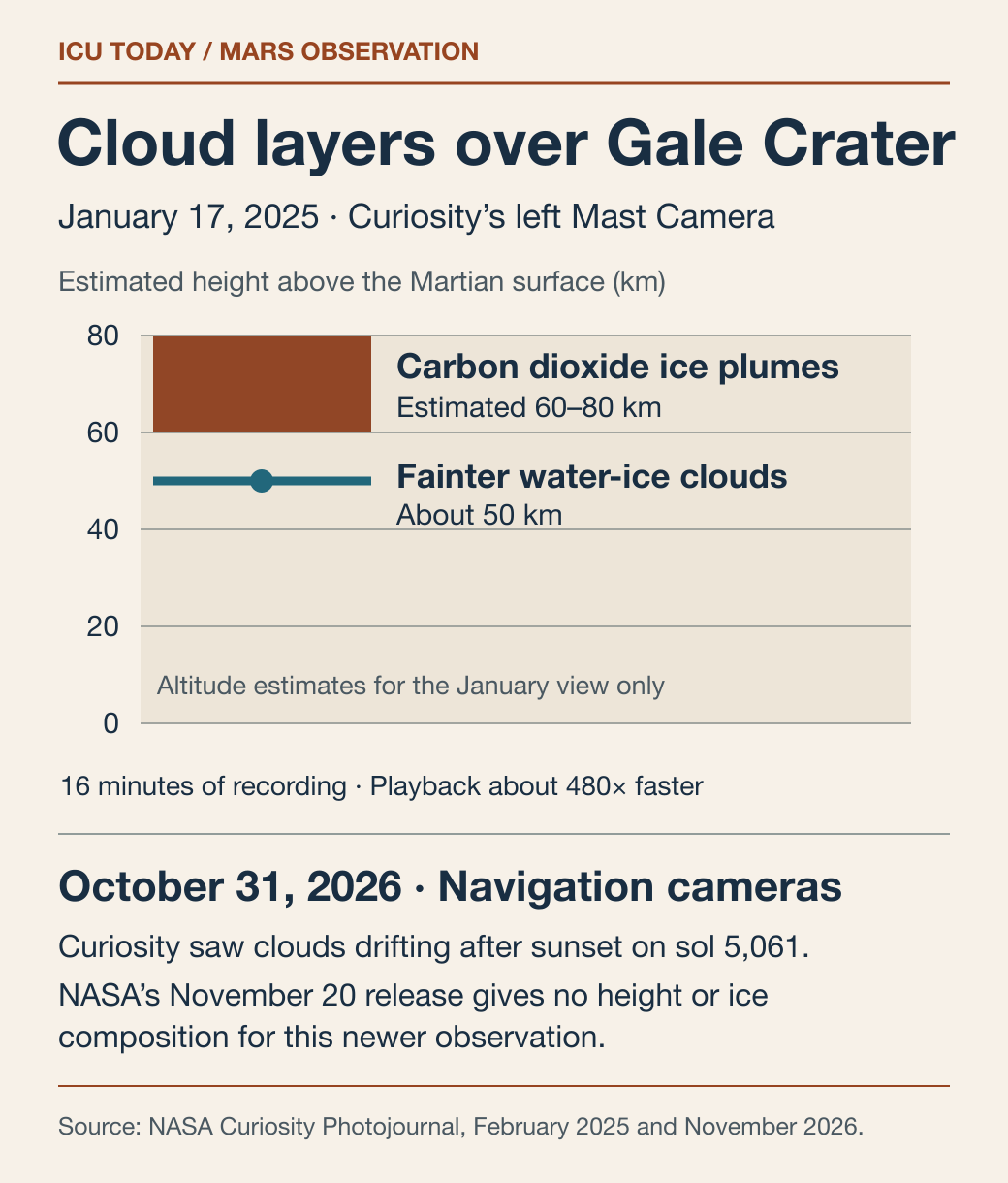
Primary-source statement · One earlier recording shows how much can be happening in a single patch of Martian sky. On January 17, 2025, Curiosity watched with a different instrument, its left Mast Camera. NASA identified the white plumes near the top of that frame as carbon dioxide ice and put them roughly 60 to 80 kilometers above the surface. Lower in the same frame, much fainter clouds of water ice hovered at about 50 kilometers. What looks like a short burst of motion in that earlier video took 16 minutes to record. NASA sped up the footage about 480 times for playback. [NASA] [NASA]
What remains unknown
Primary-source statement · The new release gives the date, place and camera for the October observation. It gives no cloud height, ice composition or wind speed. Those details matter when comparing the two views. The January measurements tell us what the rover saw on that occasion. Whether the clouds drifting past its navigation cameras this October occupied the same layers remains an open question. [NASA] [NASA]
Read the infographic as text
January 17, 2025 · Sol 4,426. Left Mast Camera. Faint water-ice clouds at roughly 50 km. Carbon dioxide ice plumes at an estimated 60–80 km above the Martian surface.
How fast is the January playback?. The earlier recording took 16 minutes. NASA sped it up by about 480 times for playback. That number describes the video playback speed, not the speed of the clouds.
October 31, 2026 · Sol 5,061. Navigation cameras recorded drifting clouds after sunset over Gale Crater. NASA published the images November 20. Cloud height, composition and wind speed were not given.
The developing record.
Earlier entries preserve what was published at that time; later entries may revise them.
2026-11-22T09:00:22.772Z · NASA released Curiosity’s October 31 images of drifting twilight clouds and identified the observing camera and mission day.
Curiosity catches clouds drifting after sunset on Mars
NASA’s new images show a brief seasonal sight over Gale Crater. An earlier observation explains why two clouds in the same frame can tell different stories.
What happened
NASA released a view on November 20 of twilight clouds drifting over Gale Crater on Mars. Curiosity caught them with its navigation cameras after sunset on October 31, the rover’s 5,061st Martian day. Timing matters for this observation. NASA says the clouds appear for only a short stretch each Martian fall at the crater, where Curiosity has been exploring for more than 14 Earth years. [NASA]
Why it matters
One earlier recording shows how much can be happening in a single patch of Martian sky. On January 17, 2025, Curiosity watched with a different instrument, its left Mast Camera. NASA identified the white plumes near the top of that frame as carbon dioxide ice and put them roughly 60 to 80 kilometers above the surface. Lower in the same frame, much fainter clouds of water ice hovered at about 50 kilometers. What looks like a short burst of motion in that earlier video took 16 minutes to record. NASA sped up the footage about 480 times for playback. [NASA] [NASA]
What remains unknown
The new release gives the date, place and camera for the October observation. It gives no cloud height, ice composition or wind speed. Those details matter when comparing the two views. The January measurements tell us what the rover saw on that occasion. Whether the clouds drifting past its navigation cameras this October occupied the same layers remains an open question. [NASA] [NASA]
Read the infographic as text
January 17, 2025 · Sol 4,426. Left Mast Camera. Faint water-ice clouds at roughly 50 km. Carbon dioxide ice plumes at an estimated 60–80 km above the Martian surface.
How fast is the January playback?. The earlier recording took 16 minutes. NASA sped it up by about 480 times for playback. That number describes the video playback speed, not the speed of the clouds.
October 31, 2026 · Sol 5,061. Navigation cameras recorded drifting clouds after sunset over Gale Crater. NASA published the images November 20. Cloud height, composition and wind speed were not given.
Original sources
Curiosity Spots Drifting Twilight Clouds · Issuer: NASA · Published 2026-11-20
Curiosity Views Twilight Clouds · Issuer: NASA · Published 2025-02-11
Corrections
No corrections recorded.