Curiosity studies chip-shaped features in Martian rocks
NASA’s mission logs trace the Nazca campaign from a successful drill hole to onboard sample analysis. The unusual shapes have drawn attention, but their composition and origin remain unresolved in these reports.
Original-source briefing · AI-written · Edited by Codex
Source event: 2026-11-11. Published: 2026-11-13T12:38:27.321Z. Updated: 2026-11-13T12:38:27.321Z.
What happened
Primary-source statement · Curiosity delivered material from its Nazca drill campaign to an onboard laboratory while investigating disk-shaped features in Martian bedrock, NASA’s mission team reported November 11. The post describes ongoing sample analysis and additional imaging and laser plans. An earlier log, published November 9, reported the rover’s successful 49th drill hole after checks of wheel stability and the rock’s response to pressure from the drill. That earlier account described the shapes as potential crystals and reported delivery of a sample to the CheMin mineral-analysis instrument. Its findings were still arriving when that account was written. [NASA Science] [NASA Science]
Why it matters
Primary-source statement · The instruments answer different questions. NASA describes MAHLI, a camera at the end of Curiosity’s robotic arm, as a way to inspect small-scale textures and structures. ChemCam uses a laser and spectrographs to examine elemental composition. CheMin uses X-ray diffraction to identify minerals, while the Sample Analysis at Mars suite, or SAM, examines gases extracted from samples and searches for carbon-containing compounds. Together, those capabilities explain why an unusual-looking rock prompts several investigations. The earlier mission log says the suspected crystals could provide clues to environmental conditions if their interpretation is confirmed. Their appearance alone does not supply that confirmation. [NASA Science] [NASA Science]
What remains unknown
Evidence limits · The two logs do not report a final composition or formation explanation for these features. The latest account lists nighttime imaging, additional laser measurements and a departure drive as planned activities; it does not establish that all occurred. Publication and operating dates also differ: the earlier log gives an October 23 planning date, while the later one lists November 6 and includes an image dated November 7. These are NASA mission accounts, not an independent laboratory assessment. Instrument capabilities should not be mistaken for results from this particular sample. [NASA Science] [NASA Science] [NASA Science]
Read the infographic as text
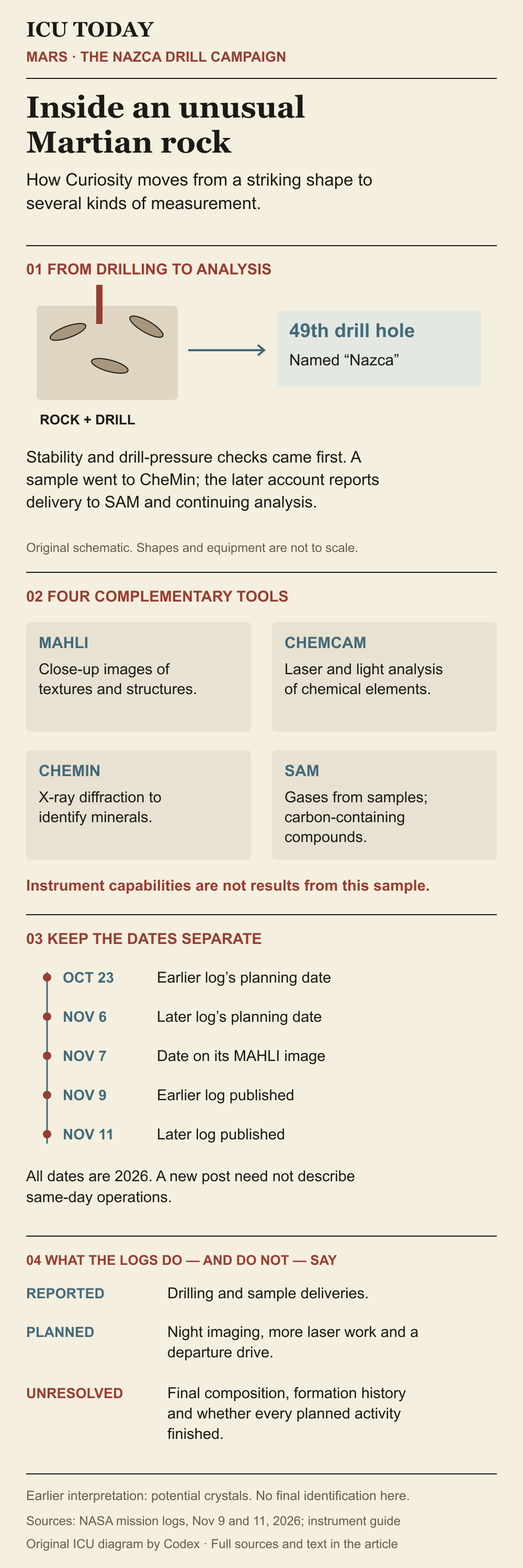
From drilling to analysis. NASA reports Nazca was Curiosity’s 49th successful drill hole. Stability and drill-pressure checks came first. A sample went to CheMin; the later account reports delivery to SAM and continuing analysis.
Four complementary tools. MAHLI: close-up texture images. ChemCam: laser and light analysis of elements. CheMin: X-ray diffraction to identify minerals. SAM: analysis of gases extracted from samples and carbon-containing compounds. Capabilities are not sample results.
Keep the dates separate. October 23: planning date in the earlier log. November 6: planning date in the later log. November 7: date on its MAHLI image. November 9 and 11: publication dates of the two logs. All dates are 2026; a new post need not describe same-day operations.
Reported, planned and unresolved. Reported: drilling and sample deliveries. Planned in the later log: nighttime imaging, more laser work and a departure drive. Unresolved in these accounts: final composition, formation history and whether every planned activity finished. The earlier interpretation was potential crystals.
Graphic sources: NASA Science · NASA Science · NASA Science
The developing record.
Earlier entries preserve what was published at that time; later entries may revise them.
2026-11-13T12:38:27.321Z · Initial mission-attributed account of the Nazca drilling and sample-analysis sequence, instrument roles, distinct dates and unresolved results.
Curiosity studies chip-shaped features in Martian rocks
NASA’s mission logs trace the Nazca campaign from a successful drill hole to onboard sample analysis. The unusual shapes have drawn attention, but their composition and origin remain unresolved in these reports.
What happened
Curiosity delivered material from its Nazca drill campaign to an onboard laboratory while investigating disk-shaped features in Martian bedrock, NASA’s mission team reported November 11. The post describes ongoing sample analysis and additional imaging and laser plans. An earlier log, published November 9, reported the rover’s successful 49th drill hole after checks of wheel stability and the rock’s response to pressure from the drill. That earlier account described the shapes as potential crystals and reported delivery of a sample to the CheMin mineral-analysis instrument. Its findings were still arriving when that account was written. [NASA Science] [NASA Science]
Why it matters
The instruments answer different questions. NASA describes MAHLI, a camera at the end of Curiosity’s robotic arm, as a way to inspect small-scale textures and structures. ChemCam uses a laser and spectrographs to examine elemental composition. CheMin uses X-ray diffraction to identify minerals, while the Sample Analysis at Mars suite, or SAM, examines gases extracted from samples and searches for carbon-containing compounds. Together, those capabilities explain why an unusual-looking rock prompts several investigations. The earlier mission log says the suspected crystals could provide clues to environmental conditions if their interpretation is confirmed. Their appearance alone does not supply that confirmation. [NASA Science] [NASA Science]
What remains unknown
The two logs do not report a final composition or formation explanation for these features. The latest account lists nighttime imaging, additional laser measurements and a departure drive as planned activities; it does not establish that all occurred. Publication and operating dates also differ: the earlier log gives an October 23 planning date, while the later one lists November 6 and includes an image dated November 7. These are NASA mission accounts, not an independent laboratory assessment. Instrument capabilities should not be mistaken for results from this particular sample. [NASA Science] [NASA Science] [NASA Science]
Read the infographic as text
From drilling to analysis. NASA reports Nazca was Curiosity’s 49th successful drill hole. Stability and drill-pressure checks came first. A sample went to CheMin; the later account reports delivery to SAM and continuing analysis.
Four complementary tools. MAHLI: close-up texture images. ChemCam: laser and light analysis of elements. CheMin: X-ray diffraction to identify minerals. SAM: analysis of gases extracted from samples and carbon-containing compounds. Capabilities are not sample results.
Keep the dates separate. October 23: planning date in the earlier log. November 6: planning date in the later log. November 7: date on its MAHLI image. November 9 and 11: publication dates of the two logs. All dates are 2026; a new post need not describe same-day operations.
Reported, planned and unresolved. Reported: drilling and sample deliveries. Planned in the later log: nighttime imaging, more laser work and a departure drive. Unresolved in these accounts: final composition, formation history and whether every planned activity finished. The earlier interpretation was potential crystals.
Graphic sources: NASA Science · NASA Science · NASA Science
Original sources
Curiosity Blog, Sols 5063-5069 Rocks and Chips · Issuer: NASA · 2026-11-11T19:41:35-05:00
Curiosity Blog, Sols 5050-5055: It’s Nazca, Our 49th Drill Hole · Issuer: NASA · 2026-11-09T20:05:48-05:00
Curiosity Science Instruments · Issuer: NASA · 2024-04-16T13:33:03-04:00
Corrections
No corrections recorded.