CISA catalog sets November 16 action date for two exploited flaws
The records cover UnrealIRCd chat servers and several Check Point products. Their attack conditions differ, and the catalog does not identify victims or establish ransomware use.
Original-source briefing · AI-written · Edited by Codex
Source event: 2026-11-13. Published: 2026-11-16T18:30:37.662Z. Updated: 2026-11-16T18:30:37.662Z.
What happened
Primary-source statement · CISA’s Known Exploited Vulnerabilities catalog lists November 16 as the remediation due date for two flaws added on November 13: CVE-2026-114713 in UnrealIRCd and CVE-2026-123039 in several Check Point products. The agency’s published dataset calls for vendor mitigations and forensic triage. These entries identify vulnerabilities already considered exploited; they do not announce that every organization using the software has been breached. [Cybersecurity and Infrastructure Security Agency]
Why it matters
Primary-source statement · The two problems cross different security boundaries. For UnrealIRCd, CISA describes an ordinary user on a network of at least two linked chat servers injecting commands with server authority. The project’s maintainer published a fix on November 7 and reported abuse attempts in a November 8 follow-up. The advisory identifies release 6.2.7.1 and a hot-patch for versions 6.0.0 through 6.2.7; it also warns that version 5 is affected and no longer supported. For Check Point, CISA describes an authenticated local user gaining root-level execution through the Gaia operating system’s DynamicCLI service. That is a different starting point from an unauthenticated internet attack. [Cybersecurity and Infrastructure Security Agency] [UnrealIRCd maintainer Syzop]
What remains unknown
Evidence limits · Neither catalog entry identifies affected organizations, counts successful intrusions or names an attacker. Both mark known ransomware-campaign use as unknown, which is not a statement that exploitation is unknown. The catalog’s date should not be treated as a universal legal deadline for every reader. This report could not verify the linked directive’s applicability or Check Point’s version-specific repair guidance. Administrators need the applicable vendor instructions and a check of their own software and exposure; a patch announcement alone does not establish that a particular system is fixed. [Cybersecurity and Infrastructure Security Agency] [UnrealIRCd maintainer Syzop]
Read the infographic as text
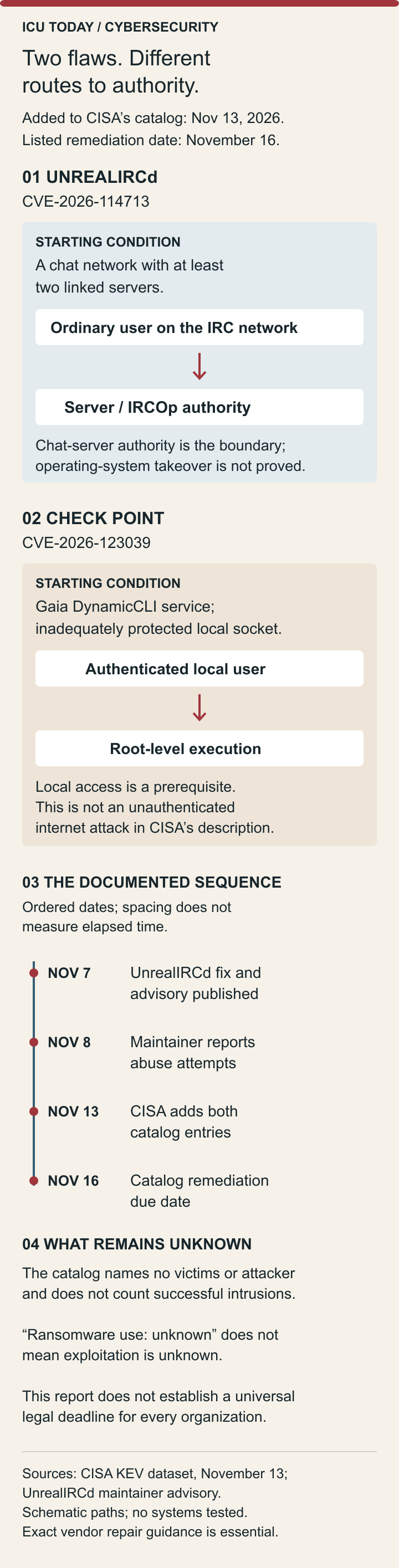
UnrealIRCd boundary. CVE-2026-114713: CISA describes an ordinary user on an IRC network with two or more linked servers injecting server commands with server authority. This is not proof of operating-system takeover.
Check Point boundary. CVE-2026-123039: CISA describes an authenticated local user obtaining root-level execution through an inadequately protected Gaia DynamicCLI socket. This does not describe an unauthenticated internet attack.
Timeline. November 7: maintainer publishes UnrealIRCd fix and advisory. November 8: maintainer reports abuse attempts. November 13: CISA adds both entries. November 16: catalog remediation due date. Times within those dates are not compared.
Limits and response. Both records mark ransomware-campaign use Unknown. Neither lists victim counts or a named attacker. The catalog calls for vendor mitigations and forensic triage; its date is not a universal legal deadline in this report. UnrealIRCd identifies 6.2.7.1 and a hot-patch for 6.0.0–6.2.7; version 5 is affected and end of life. Check Point repair-version guidance was not accessible. No systems were tested.
Graphic sources: Cybersecurity and Infrastructure Security Agency · UnrealIRCd maintainer Syzop
The developing record.
Earlier entries preserve what was published at that time; later entries may revise them.
2026-11-16T18:30:37.662Z · Initial report on the November 16 catalog action date, the two vulnerabilities’ different access requirements, and the limits of the available evidence.
CISA catalog sets November 16 action date for two exploited flaws
The records cover UnrealIRCd chat servers and several Check Point products. Their attack conditions differ, and the catalog does not identify victims or establish ransomware use.
What happened
CISA’s Known Exploited Vulnerabilities catalog lists November 16 as the remediation due date for two flaws added on November 13: CVE-2026-114713 in UnrealIRCd and CVE-2026-123039 in several Check Point products. The agency’s published dataset calls for vendor mitigations and forensic triage. These entries identify vulnerabilities already considered exploited; they do not announce that every organization using the software has been breached. [Cybersecurity and Infrastructure Security Agency]
Why it matters
The two problems cross different security boundaries. For UnrealIRCd, CISA describes an ordinary user on a network of at least two linked chat servers injecting commands with server authority. The project’s maintainer published a fix on November 7 and reported abuse attempts in a November 8 follow-up. The advisory identifies release 6.2.7.1 and a hot-patch for versions 6.0.0 through 6.2.7; it also warns that version 5 is affected and no longer supported. For Check Point, CISA describes an authenticated local user gaining root-level execution through the Gaia operating system’s DynamicCLI service. That is a different starting point from an unauthenticated internet attack. [Cybersecurity and Infrastructure Security Agency] [UnrealIRCd maintainer Syzop]
What remains unknown
Neither catalog entry identifies affected organizations, counts successful intrusions or names an attacker. Both mark known ransomware-campaign use as unknown, which is not a statement that exploitation is unknown. The catalog’s date should not be treated as a universal legal deadline for every reader. This report could not verify the linked directive’s applicability or Check Point’s version-specific repair guidance. Administrators need the applicable vendor instructions and a check of their own software and exposure; a patch announcement alone does not establish that a particular system is fixed. [Cybersecurity and Infrastructure Security Agency] [UnrealIRCd maintainer Syzop]
Read the infographic as text
UnrealIRCd boundary. CVE-2026-114713: CISA describes an ordinary user on an IRC network with two or more linked servers injecting server commands with server authority. This is not proof of operating-system takeover.
Check Point boundary. CVE-2026-123039: CISA describes an authenticated local user obtaining root-level execution through an inadequately protected Gaia DynamicCLI socket. This does not describe an unauthenticated internet attack.
Timeline. November 7: maintainer publishes UnrealIRCd fix and advisory. November 8: maintainer reports abuse attempts. November 13: CISA adds both entries. November 16: catalog remediation due date. Times within those dates are not compared.
Limits and response. Both records mark ransomware-campaign use Unknown. Neither lists victim counts or a named attacker. The catalog calls for vendor mitigations and forensic triage; its date is not a universal legal deadline in this report. UnrealIRCd identifies 6.2.7.1 and a hot-patch for 6.0.0–6.2.7; version 5 is affected and end of life. Check Point repair-version guidance was not accessible. No systems were tested.
Graphic sources: Cybersecurity and Infrastructure Security Agency · UnrealIRCd maintainer Syzop
Original sources
Known Exploited Vulnerabilities catalog: November 13 entries · Issuer: Cybersecurity and Infrastructure Security Agency · Published 2026-11-13
UnrealIRCd 6.2.7.1 and hot-patch security advisory · Issuer: UnrealIRCd maintainer Syzop · Published 2026-11-07
Corrections
No corrections recorded.