NASA’s simulated Mars crew completes 378-day habitat stay
Four volunteers left a Houston habitat on October 31. NASA’s account describes delayed communications, limited supplies and research work, but does not establish readiness for a real Mars mission.
Original-source briefing · AI-written · Edited by Codex
Source event: 2026-10-31. Published: 2026-11-14T03:05:34.980Z. Updated: 2026-11-14T03:05:34.980Z.
What happened
Primary-source statement · Four volunteers have completed NASA’s second yearlong simulated Mars mission in Houston, the agency reports. Ross Elder, Ellen Ellis, James Spicer and Matthew Montgomery left the Mars Dune Alpha habitat at Johnson Space Center on October 31 after what NASA describes as 378 days inside. They entered on October 19, 2025. NASA’s account, carrying a November 9 publication date, describes a ground experiment in living and working with constraints expected on a distant mission. The crew did not travel to Mars. [NASA]
Why it matters
Primary-source statement · NASA says the CHAPEA crew collected health and performance data while managing limited resources and communication delays of up to 22 minutes each way. That delay changes the setting for everyday work: a message cannot be treated as a live conversation with someone outside. At the stated maximum in both directions, a message and an immediate reply would take 44 minutes in transmission alone. That is an illustration of the reported simulation setting, excluding time to consider or prepare a response, not a fixed delay for all Mars communications. [NASA]
The work inside
Primary-source statement · The roughly 1,700-square-foot, 3D-printed habitat combined research with the chores that keep a small crew functioning. NASA describes simulated Marswalks, exercise, crop cultivation and maintenance. Crew members remotely operated a drone and rover to survey terrain and identify or collect rock samples. Biological sample collections supported the health research; tracking consumables, including dish soap and respirator filters, accompanied management of food and water. The crew also established 3D-printing capabilities and ran a seed-germination experiment using a control and simulated Martian soil. These are activities reported by NASA, not independently verified experimental results. [NASA]
What remains unknown
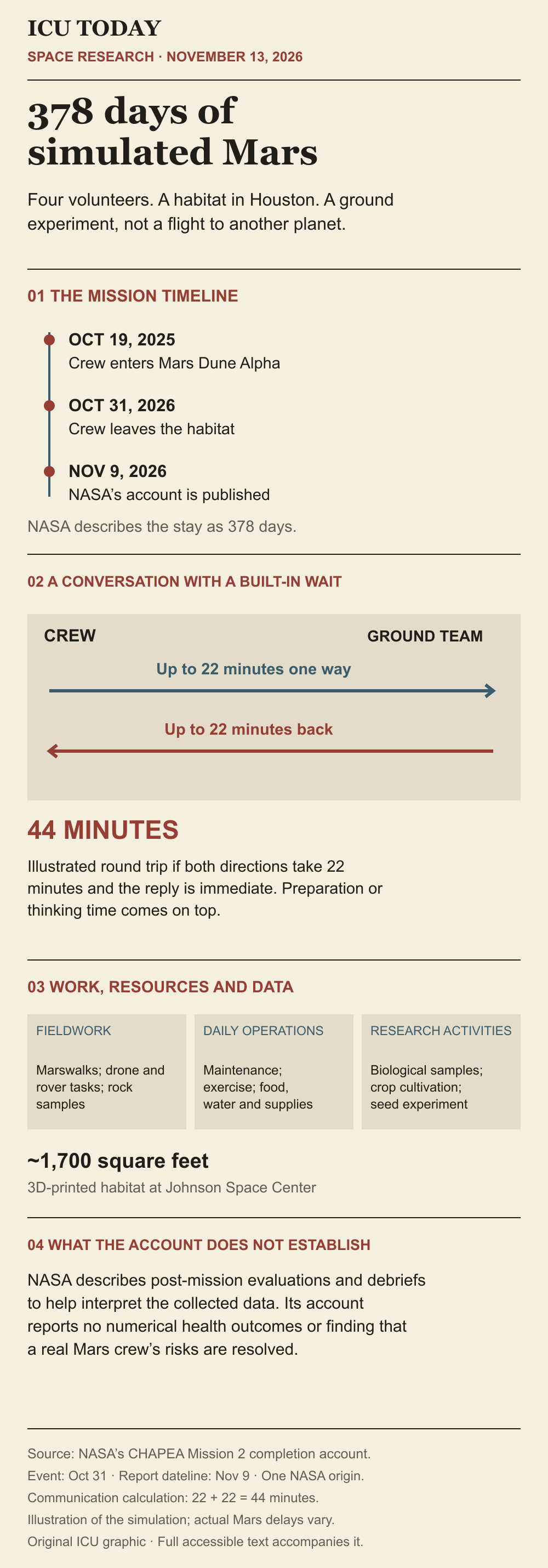
Primary-source statement · NASA’s account describes two weeks of post-mission evaluations and debriefs intended to help researchers interpret the data alongside the crew’s experiences. It does not report numerical health outcomes, effect sizes or a finding that a particular combination of resources is sufficient for a real Mars mission. Completion of the habitat stay is therefore a milestone in collecting evidence, rather than a demonstration that the risks of a crewed Mars journey have been resolved. The accompanying infographic separates the dated mission, simulated communication constraint and research activities from those unanswered questions. [NASA]
Read the infographic as text
Mission timeline. Four volunteers entered Mars Dune Alpha at NASA Johnson Space Center in Houston on October 19, 2025, and exited October 31, 2026. NASA describes 378 days inside. The account carries a November 9, 2026 publication dateline. This was a ground simulation, not a Mars flight.
Communication delays. NASA reports simulated delays of up to 22 minutes each way. If a message and immediate reply each take 22 minutes, the illustrated roundtrip takes 44 minutes in transmission; response preparation takes additional time. Actual Mars delays vary. Calculation: 22 + 22 = 44.
Work and resources. Simulated fieldwork included Marswalks, drone and rover operations and rock samples. Daily operations included maintenance, exercise and management of food, water and supplies. Research activities included biological sample collections, crops and a seed-germination experiment with a control and simulated Martian soil. The 3D-printed habitat is roughly 1,700 square feet.
Limits of the evidence. NASA describes post-mission evaluations and debriefs to interpret the data. The written account does not report numerical health outcomes or a finding that real Mars mission risks have been resolved. One NASA origin; mission completion does not establish scientific effectiveness.
Graphic sources: NASA
The developing record.
Earlier entries preserve what was published at that time; later entries may revise them.
2026-11-14T03:05:34.980Z · Initial report on NASA’s completed CHAPEA Mission 2 ground simulation, its communication constraints and research work, with evidence limits and a detailed timeline infographic.
NASA’s simulated Mars crew completes 378-day habitat stay
Four volunteers left a Houston habitat on October 31. NASA’s account describes delayed communications, limited supplies and research work, but does not establish readiness for a real Mars mission.
What happened
Four volunteers have completed NASA’s second yearlong simulated Mars mission in Houston, the agency reports. Ross Elder, Ellen Ellis, James Spicer and Matthew Montgomery left the Mars Dune Alpha habitat at Johnson Space Center on October 31 after what NASA describes as 378 days inside. They entered on October 19, 2025. NASA’s account, carrying a November 9 publication date, describes a ground experiment in living and working with constraints expected on a distant mission. The crew did not travel to Mars. [NASA]
Why it matters
NASA says the CHAPEA crew collected health and performance data while managing limited resources and communication delays of up to 22 minutes each way. That delay changes the setting for everyday work: a message cannot be treated as a live conversation with someone outside. At the stated maximum in both directions, a message and an immediate reply would take 44 minutes in transmission alone. That is an illustration of the reported simulation setting, excluding time to consider or prepare a response, not a fixed delay for all Mars communications. [NASA]
The work inside
The roughly 1,700-square-foot, 3D-printed habitat combined research with the chores that keep a small crew functioning. NASA describes simulated Marswalks, exercise, crop cultivation and maintenance. Crew members remotely operated a drone and rover to survey terrain and identify or collect rock samples. Biological sample collections supported the health research; tracking consumables, including dish soap and respirator filters, accompanied management of food and water. The crew also established 3D-printing capabilities and ran a seed-germination experiment using a control and simulated Martian soil. These are activities reported by NASA, not independently verified experimental results. [NASA]
What remains unknown
NASA’s account describes two weeks of post-mission evaluations and debriefs intended to help researchers interpret the data alongside the crew’s experiences. It does not report numerical health outcomes, effect sizes or a finding that a particular combination of resources is sufficient for a real Mars mission. Completion of the habitat stay is therefore a milestone in collecting evidence, rather than a demonstration that the risks of a crewed Mars journey have been resolved. The accompanying infographic separates the dated mission, simulated communication constraint and research activities from those unanswered questions. [NASA]
Read the infographic as text
Mission timeline. Four volunteers entered Mars Dune Alpha at NASA Johnson Space Center in Houston on October 19, 2025, and exited October 31, 2026. NASA describes 378 days inside. The account carries a November 9, 2026 publication dateline. This was a ground simulation, not a Mars flight.
Communication delays. NASA reports simulated delays of up to 22 minutes each way. If a message and immediate reply each take 22 minutes, the illustrated roundtrip takes 44 minutes in transmission; response preparation takes additional time. Actual Mars delays vary. Calculation: 22 + 22 = 44.
Work and resources. Simulated fieldwork included Marswalks, drone and rover operations and rock samples. Daily operations included maintenance, exercise and management of food, water and supplies. Research activities included biological sample collections, crops and a seed-germination experiment with a control and simulated Martian soil. The 3D-printed habitat is roughly 1,700 square feet.
Limits of the evidence. NASA describes post-mission evaluations and debriefs to interpret the data. The written account does not report numerical health outcomes or a finding that real Mars mission risks have been resolved. One NASA origin; mission completion does not establish scientific effectiveness.
Graphic sources: NASA
Original sources
CHAPEA Mission 2 Crew Reflects After 378 Days on Simulated Mars · Issuer: NASA · Published 2026-11-09
Corrections
No corrections recorded.