A star’s repeated eruptions point to a hidden compact companion
NASA reports that carefully timed X-ray observations helped explain a star that keeps brightening without destroying itself. Whether its companion is a black hole or a neutron star remains unresolved.
Original-source briefing · AI-written · Edited by Codex
Source event: 2026-11-09. Published: 2026-11-13T18:08:51.156Z. Updated: 2026-11-13T18:08:51.156Z.
What happened
Primary-source statement · A star that repeatedly flares up and survives may be feeding a hidden companion, according to a November 9 NASA account of new Chandra research, updated November 12. The object, AT 2016blu, lies in the spiral galaxy NGC 4559, about 30 million light-years from Earth. NASA reports that the research team identified evidence for either a stellar-mass black hole or a neutron star drawing material from the much larger star. The account describes March 2026 observations; it is not a report of a new eruption observed this week. [NASA]
The pattern that made timing possible
Primary-source statement · NASA says astronomers recorded at least 27 bursts of visible light between 2012 and 2026, separated by roughly 113 days. AT 2016blu belongs to a class of hot, massive, variable stars, and its extreme flashes can resemble a supernova. The crucial difference is survival: the star remains after these eruptions, giving it the description supernova impostor. The agency reports an estimated stellar mass of at least 33 Suns. A repeating pattern gave researchers a way to aim observations at an outburst instead of relying on a chance encounter. [NASA]
What changed in the X-ray view
Primary-source statement · The agency’s account says Chandra measured the system in March 2026 at no less than 100 times its X-ray brightness in observations from 2001 and 2002, before the recorded outbursts began. Optical monitoring helped trigger the new observations through Chandra’s Target of Opportunity program. That monitoring included the Katzman Automatic Imaging Telescope, the Las Cumbres Observatory Global Supernova Project and contributions from more than 30 amateur astronomers through the American Association of Variable Star Observers. These observations form one study’s evidence chain, rather than separate independent confirmations of its interpretation. [NASA]
The proposed engine
Primary-source statement · In the explanation NASA describes, the two objects follow an elongated orbit. When they approach one another, the compact companion captures material ejected by the larger star. Gas moving around that companion becomes hot enough to radiate strongly in X-rays. The team proposes that those X-rays heat surrounding dense gas, which then shines in visible light. This connects two different kinds of observation: the optical flashes that supplied the timing and the high-energy signal used to investigate their power source. [NASA]
Why it matters
Primary-source statement · NASA presents the result as a possible connection between violent stellar eruptions and ultra-luminous X-ray sources, a rare category whose members can include neutron stars or black holes. It describes AT 2016blu as a candidate in that category. The report also says the system may help researchers study brightness changes preceding some supernova explosions. That prospective scientific use does not establish when, or whether, this particular star will explode. [NASA]
What remains unknown
Evidence limits · The companion’s identity is still unresolved between a neutron star and a black hole. The gas-transfer sequence is the team’s explanation of the reported observations, not a directly imaged movie of an orbit. This article draws on NASA’s written study account; the underlying journal paper, raw measurements and independent replication were not reviewed. The infographic separates the dated observations, the proposed mechanism and those remaining limits. [NASA]
Read the infographic as text
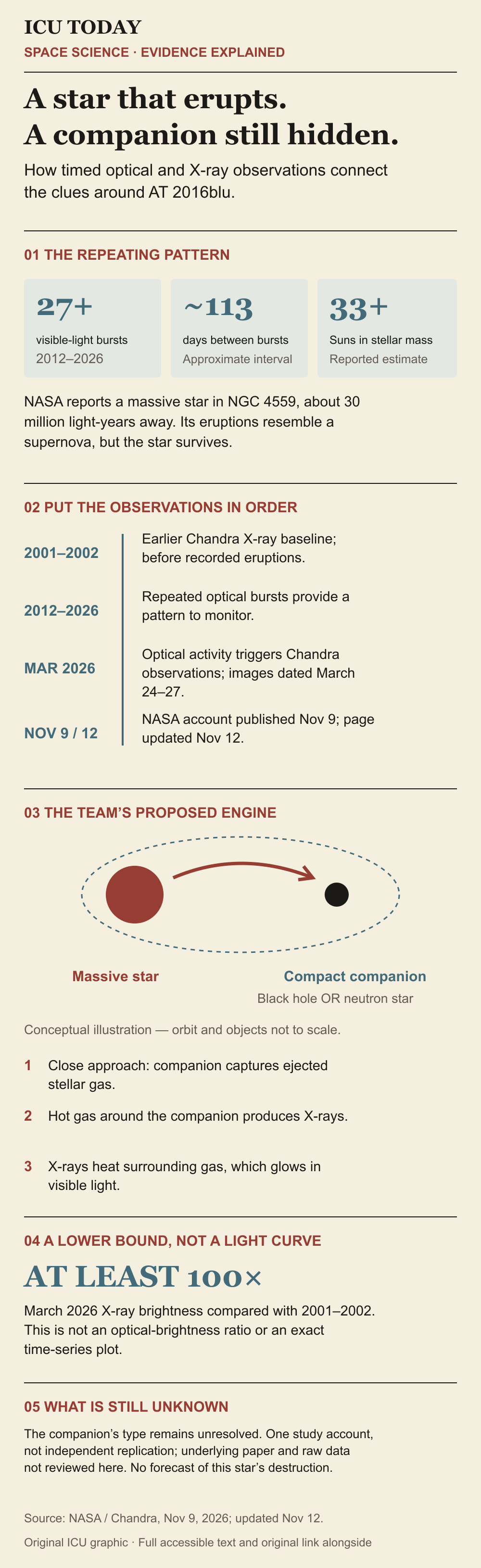
A star that survives its eruptions. AT 2016blu is in NGC 4559, about 30 million light-years away. NASA reports an estimated mass of at least 33 Suns, at least 27 visible-light bursts between 2012 and 2026, and roughly 113 days between bursts. A supernova impostor resembles an explosive brightening but survives these eruptions.
The observation timeline. 2001–2002: earlier Chandra X-ray observations, before the recorded eruptions. 2012–2026: at least 27 optical bursts. Early 2026: optical monitoring triggered a Target of Opportunity request. March 24–27, 2026: the Chandra observations illustrated in NASA’s account; optical examples are dated March 14 and March 25. November 9: NASA published the account. November 12: page updated. These dates describe different events.
The proposed gas-transfer cycle. Schematic, not to scale. In the team’s explanation, a massive star and compact companion approach one another in an elongated orbit. The companion captures material ejected by the star. Hot gas around the companion emits X-rays. The team proposes that X-rays heat surrounding dense gas, producing visible light. The compact companion could be a black hole or a neutron star; neither identity is settled here.
What the brightness comparison says. NASA reports March 2026 X-ray brightness of at least 100 times the 2001–2002 value. This is a lower-bound comparison between those observations, not an exact brightness curve, the star’s optical brightness or its mass. Optical monitoring supplied timing; X-ray observations investigated the energy source.
What remains open. Black hole or neutron star remains unresolved. NASA describes a candidate ultra-luminous X-ray source and a possible connection with violent stellar eruptions. The account does not provide a forecast of this star’s destruction. One research chain is reported; the underlying paper, raw data and independent replication were not reviewed for this article.
Graphic sources: NASA
The developing record.
Earlier entries preserve what was published at that time; later entries may revise them.
2026-11-13T18:08:51.156Z · Initial NASA-attributed account of the repeating stellar outbursts, dated observations, proposed companion mechanism and remaining uncertainty, with a detailed original infographic.
A star’s repeated eruptions point to a hidden compact companion
NASA reports that carefully timed X-ray observations helped explain a star that keeps brightening without destroying itself. Whether its companion is a black hole or a neutron star remains unresolved.
What happened
A star that repeatedly flares up and survives may be feeding a hidden companion, according to a November 9 NASA account of new Chandra research, updated November 12. The object, AT 2016blu, lies in the spiral galaxy NGC 4559, about 30 million light-years from Earth. NASA reports that the research team identified evidence for either a stellar-mass black hole or a neutron star drawing material from the much larger star. The account describes March 2026 observations; it is not a report of a new eruption observed this week. [NASA]
The pattern that made timing possible
NASA says astronomers recorded at least 27 bursts of visible light between 2012 and 2026, separated by roughly 113 days. AT 2016blu belongs to a class of hot, massive, variable stars, and its extreme flashes can resemble a supernova. The crucial difference is survival: the star remains after these eruptions, giving it the description supernova impostor. The agency reports an estimated stellar mass of at least 33 Suns. A repeating pattern gave researchers a way to aim observations at an outburst instead of relying on a chance encounter. [NASA]
What changed in the X-ray view
The agency’s account says Chandra measured the system in March 2026 at no less than 100 times its X-ray brightness in observations from 2001 and 2002, before the recorded outbursts began. Optical monitoring helped trigger the new observations through Chandra’s Target of Opportunity program. That monitoring included the Katzman Automatic Imaging Telescope, the Las Cumbres Observatory Global Supernova Project and contributions from more than 30 amateur astronomers through the American Association of Variable Star Observers. These observations form one study’s evidence chain, rather than separate independent confirmations of its interpretation. [NASA]
The proposed engine
In the explanation NASA describes, the two objects follow an elongated orbit. When they approach one another, the compact companion captures material ejected by the larger star. Gas moving around that companion becomes hot enough to radiate strongly in X-rays. The team proposes that those X-rays heat surrounding dense gas, which then shines in visible light. This connects two different kinds of observation: the optical flashes that supplied the timing and the high-energy signal used to investigate their power source. [NASA]
Why it matters
NASA presents the result as a possible connection between violent stellar eruptions and ultra-luminous X-ray sources, a rare category whose members can include neutron stars or black holes. It describes AT 2016blu as a candidate in that category. The report also says the system may help researchers study brightness changes preceding some supernova explosions. That prospective scientific use does not establish when, or whether, this particular star will explode. [NASA]
What remains unknown
The companion’s identity is still unresolved between a neutron star and a black hole. The gas-transfer sequence is the team’s explanation of the reported observations, not a directly imaged movie of an orbit. This article draws on NASA’s written study account; the underlying journal paper, raw measurements and independent replication were not reviewed. The infographic separates the dated observations, the proposed mechanism and those remaining limits. [NASA]
Read the infographic as text
A star that survives its eruptions. AT 2016blu is in NGC 4559, about 30 million light-years away. NASA reports an estimated mass of at least 33 Suns, at least 27 visible-light bursts between 2012 and 2026, and roughly 113 days between bursts. A supernova impostor resembles an explosive brightening but survives these eruptions.
The observation timeline. 2001–2002: earlier Chandra X-ray observations, before the recorded eruptions. 2012–2026: at least 27 optical bursts. Early 2026: optical monitoring triggered a Target of Opportunity request. March 24–27, 2026: the Chandra observations illustrated in NASA’s account; optical examples are dated March 14 and March 25. November 9: NASA published the account. November 12: page updated. These dates describe different events.
The proposed gas-transfer cycle. Schematic, not to scale. In the team’s explanation, a massive star and compact companion approach one another in an elongated orbit. The companion captures material ejected by the star. Hot gas around the companion emits X-rays. The team proposes that X-rays heat surrounding dense gas, producing visible light. The compact companion could be a black hole or a neutron star; neither identity is settled here.
What the brightness comparison says. NASA reports March 2026 X-ray brightness of at least 100 times the 2001–2002 value. This is a lower-bound comparison between those observations, not an exact brightness curve, the star’s optical brightness or its mass. Optical monitoring supplied timing; X-ray observations investigated the energy source.
What remains open. Black hole or neutron star remains unresolved. NASA describes a candidate ultra-luminous X-ray source and a possible connection with violent stellar eruptions. The account does not provide a forecast of this star’s destruction. One research chain is reported; the underlying paper, raw data and independent replication were not reviewed for this article.
Graphic sources: NASA
Original sources
NASA’s Chandra Finds Source of Star’s Mysterious Outbursts · Issuer: NASA / Chandra X-ray Center · Published 2026-11-09T18:55:50Z
Corrections
No corrections recorded.