Inside the crew-design work on NASA’s Blue Moon lander
A new NASA account explains how handrails, controls, hygiene systems and training shape a spacecraft that astronauts must be able to use. Planned missions remain ahead.
Original-source briefing · AI-written · Edited by Codex
Source event: 2026-11-12. Published: 2026-11-13T16:05:33.160Z. Updated: 2026-11-13T16:05:33.160Z.
What happened
Primary-source statement · NASA’s latest account of Blue Moon development focuses on a practical question: how will astronauts actually use the lander? In a November 12 profile, the agency describes Katie Spicer’s work as its integration lead for Blue Origin’s Blue Moon Mark 2. Based in Johnson Space Center’s Flight Operations Directorate, she evaluates the vehicle’s design and development with NASA and company colleagues. The review extends to the things astronauts will hold, operate and use inside the spacecraft, including whether its controls and confined living spaces work from a crew member’s perspective. [NASA]
Why it matters
Primary-source statement · NASA’s program overview describes early lunar landers as both transportation and living quarters during surface missions. That gives cabin details an operational role. The November profile identifies four areas Spicer examines: how easily astronauts can grip handles and handrails; whether they can operate push-button displays in microgravity; how usable hygiene systems are in the available space; and whether procedures and training support effective use. The agency presents this as examination beyond whether a design meets a stated requirement. It does not report a new completed qualification test. [NASA] [NASA]
Experience behind the review
Primary-source statement · Spicer’s earlier work involved operating Human Research Facility racks on the International Space Station and working with scientists and astronauts on in-flight processes and protocols, NASA says. She became a flight controller in 2018 and later worked as an Operations and Support Officer in Mission Control. The new account connects that experience with her current assessment of the lander’s interfaces. Her flight-controller background is distinct from certification of Blue Moon itself. [NASA]
Where this fits in NASA’s plans
Primary-source statement · NASA’s November 4 program update, reporting an October 23 briefing, places the work within a planned sequence: an Artemis III Earth-orbit test flight in 2027, followed by an Artemis IV lunar-landing mission in 2028. It describes Orion testing rendezvous, docking and operations with lander test vehicles from Blue Origin and SpaceX. The November 12 profile likewise distinguishes a streamlined Blue Moon test article from a fully functional lunar lander under development. These are NASA’s stated plans; they are not evidence that either mission has flown or that a lander is flight-ready. [NASA] [NASA]
What remains unknown
Evidence limits · The reviewed documents do not provide interface-test results, final cabin specifications or a completed Blue Moon flight-readiness approval. All three come from NASA, so they are one institutional account rather than independent confirmation. An older program overview still lists different mission assignments; the chronology here follows the newer, dated November announcement. The infographic separates the crew-design questions, the proposed test sequence and the outcomes these sources do not establish. [NASA] [NASA] [NASA]
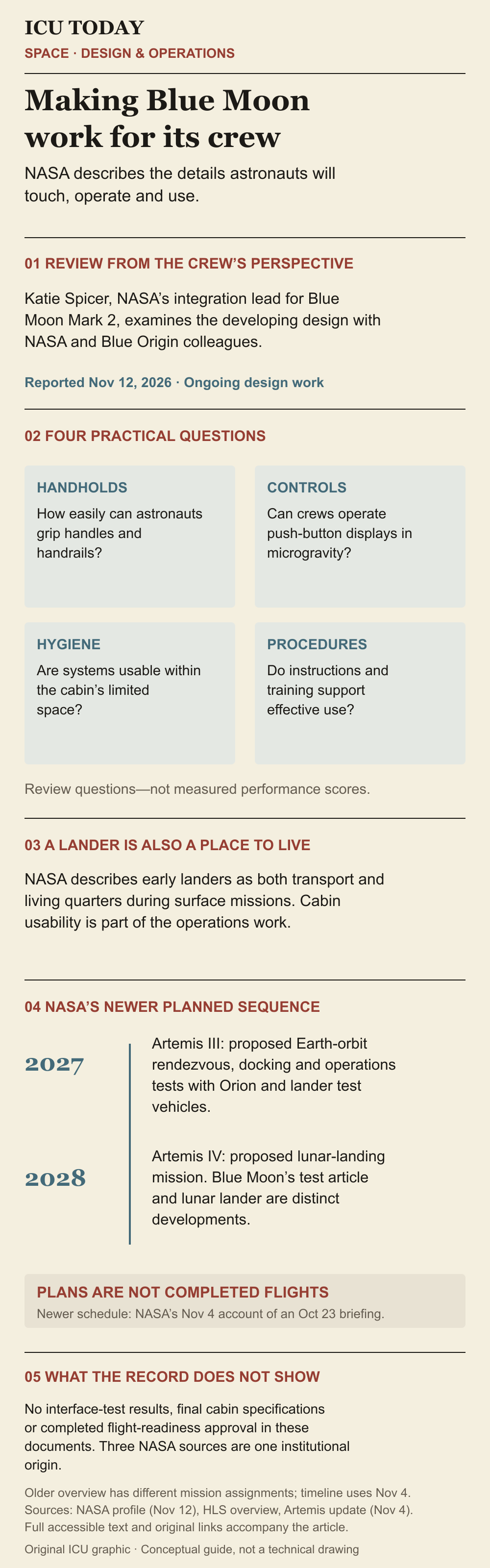
Read the infographic as text
Start with the crew’s tasks. Katie Spicer, NASA’s integration lead for Blue Origin’s Blue Moon Mark 2, evaluates design and development from the crew’s perspective. NASA’s November 12, 2026 account says the work examines what astronauts will touch, operate or use. It describes ongoing design work, not a newly completed qualification test.
Four interface questions. Handles and handrails: how easily can astronauts grip them? Push-button displays: can crews operate them in microgravity? Hygiene systems: are they usable within limited cabin space? Procedures and training: do they support effective system use? These are NASA’s reported review questions, not measured performance scores or approved specifications.
Cabin design and operations belong together. NASA’s general program overview describes landers as transport between lunar orbit and the surface, and as living quarters during early surface missions. Spicer’s previous space-station work included Human Research Facility racks, in-flight protocols and flight control. That background is separate from certification of Blue Moon. The diagram is a conceptual grouping, not an official development sequence or technical drawing.
NASA’s newer planned sequence. October 23, 2026: briefing described in NASA’s November 4 announcement. 2027: planned Artemis III Earth-orbit test of rendezvous, docking and operations involving Orion and Blue Origin and SpaceX lander test vehicles. 2028: planned Artemis IV lunar landing. November 12’s profile distinguishes a streamlined Blue Moon test article from a fully functional lunar lander under development. Dates are plans, not completed events.
What the sources do not establish. No interface-test results, final cabin specifications or completed Blue Moon flight-readiness approval in these reviewed documents. Three NASA documents are one institutional origin, not independent confirmation. An older program overview lists different mission assignments; the timeline uses the newer dated November update. Sources: NASA’s Katie Spicer profile, Human Landing Systems overview, and November 4 Artemis update.
The developing record.
Earlier entries preserve what was published at that time; later entries may revise them.
2026-11-13T16:05:33.160Z · Initial NASA-attributed report on Blue Moon crew interfaces, operational background and planned mission sequence, with a detailed original infographic and explicit evidence limits.
Inside the crew-design work on NASA’s Blue Moon lander
A new NASA account explains how handrails, controls, hygiene systems and training shape a spacecraft that astronauts must be able to use. Planned missions remain ahead.
What happened
NASA’s latest account of Blue Moon development focuses on a practical question: how will astronauts actually use the lander? In a November 12 profile, the agency describes Katie Spicer’s work as its integration lead for Blue Origin’s Blue Moon Mark 2. Based in Johnson Space Center’s Flight Operations Directorate, she evaluates the vehicle’s design and development with NASA and company colleagues. The review extends to the things astronauts will hold, operate and use inside the spacecraft, including whether its controls and confined living spaces work from a crew member’s perspective. [NASA]
Why it matters
NASA’s program overview describes early lunar landers as both transportation and living quarters during surface missions. That gives cabin details an operational role. The November profile identifies four areas Spicer examines: how easily astronauts can grip handles and handrails; whether they can operate push-button displays in microgravity; how usable hygiene systems are in the available space; and whether procedures and training support effective use. The agency presents this as examination beyond whether a design meets a stated requirement. It does not report a new completed qualification test. [NASA] [NASA]
Experience behind the review
Spicer’s earlier work involved operating Human Research Facility racks on the International Space Station and working with scientists and astronauts on in-flight processes and protocols, NASA says. She became a flight controller in 2018 and later worked as an Operations and Support Officer in Mission Control. The new account connects that experience with her current assessment of the lander’s interfaces. Her flight-controller background is distinct from certification of Blue Moon itself. [NASA]
Where this fits in NASA’s plans
NASA’s November 4 program update, reporting an October 23 briefing, places the work within a planned sequence: an Artemis III Earth-orbit test flight in 2027, followed by an Artemis IV lunar-landing mission in 2028. It describes Orion testing rendezvous, docking and operations with lander test vehicles from Blue Origin and SpaceX. The November 12 profile likewise distinguishes a streamlined Blue Moon test article from a fully functional lunar lander under development. These are NASA’s stated plans; they are not evidence that either mission has flown or that a lander is flight-ready. [NASA] [NASA]
What remains unknown
The reviewed documents do not provide interface-test results, final cabin specifications or a completed Blue Moon flight-readiness approval. All three come from NASA, so they are one institutional account rather than independent confirmation. An older program overview still lists different mission assignments; the chronology here follows the newer, dated November announcement. The infographic separates the crew-design questions, the proposed test sequence and the outcomes these sources do not establish. [NASA] [NASA] [NASA]
Read the infographic as text
Start with the crew’s tasks. Katie Spicer, NASA’s integration lead for Blue Origin’s Blue Moon Mark 2, evaluates design and development from the crew’s perspective. NASA’s November 12, 2026 account says the work examines what astronauts will touch, operate or use. It describes ongoing design work, not a newly completed qualification test.
Four interface questions. Handles and handrails: how easily can astronauts grip them? Push-button displays: can crews operate them in microgravity? Hygiene systems: are they usable within limited cabin space? Procedures and training: do they support effective system use? These are NASA’s reported review questions, not measured performance scores or approved specifications.
Cabin design and operations belong together. NASA’s general program overview describes landers as transport between lunar orbit and the surface, and as living quarters during early surface missions. Spicer’s previous space-station work included Human Research Facility racks, in-flight protocols and flight control. That background is separate from certification of Blue Moon. The diagram is a conceptual grouping, not an official development sequence or technical drawing.
NASA’s newer planned sequence. October 23, 2026: briefing described in NASA’s November 4 announcement. 2027: planned Artemis III Earth-orbit test of rendezvous, docking and operations involving Orion and Blue Origin and SpaceX lander test vehicles. 2028: planned Artemis IV lunar landing. November 12’s profile distinguishes a streamlined Blue Moon test article from a fully functional lunar lander under development. Dates are plans, not completed events.
What the sources do not establish. No interface-test results, final cabin specifications or completed Blue Moon flight-readiness approval in these reviewed documents. Three NASA documents are one institutional origin, not independent confirmation. An older program overview lists different mission assignments; the timeline uses the newer dated November update. Sources: NASA’s Katie Spicer profile, Human Landing Systems overview, and November 4 Artemis update.
Original sources
I Am Artemis Katie Spicer · Issuer: NASA · Published 2026-11-12
Human Landing Systems · Issuer: NASA · Updated 2026-10-21
NASA Shares Plans to Accelerate Artemis, Return to Moon · Issuer: NASA · Published 2026-11-04
Corrections
No corrections recorded.