Bank regulators extend review of a more tailored approach to vendor risk
Comments now run through December 16. The proposal would focus oversight on the risks of individual outside-provider relationships, while a separate Federal Reserve guide addresses traditional community banks.
Original-source briefing · AI-written · Edited by Codex
Source event: 2026-11-13. Published: 2026-11-13T22:38:09.876Z. Updated: 2026-11-13T22:38:09.876Z.
What happened
Primary-source statement · Federal banking regulators on November 13 gave the public another month to comment on proposed guidance for managing risks from outside providers. The Federal Reserve, Federal Deposit Insurance Corporation, Office of the Comptroller of the Currency and National Credit Union Administration moved the deadline from November 16 to December 16. The Fed separately extended comments on its companion guide for traditional community banks to the same date. These are two related proposals, with different scopes. [Federal Reserve Board] [Federal Reserve Board] [Federal Reserve Board]
Why it matters
Primary-source statement · In the joint proposal published in September, the agencies say their 2023 guidance was often interpreted too broadly, encouraging process-heavy oversight without enough attention to differences between relationships. Their proposed replacement puts more emphasis on identifying the actual risks and tailoring the effort to their significance. That is the regulators’ explanation for the change, rather than proof that the new approach would improve outcomes. They plan to replace existing guidance when a final version is adopted; the November announcement does not finalize it. [Federal Reserve Board]
Four parts of the proposed framework
Primary-source statement · The joint text sets out four components: identify and assess risks; oversee them in proportion to their significance; make informed decisions about remaining risks and whether to accept them; and establish appropriate governance. It describes risk assessments that consider both the possible magnitude of harm and its likelihood. Its examples distinguish a core service provider touching many bank operations from a facilities-maintenance vendor whose risks may be much narrower. Even similar relationships can carry different risks at different banks. [Federal Reserve Board]
Nonbinding does not erase responsibility
Primary-source statement · The agencies describe the proposed guidance as nonbinding. Its text says departure from the guidance or its examples would not, by itself, justify supervisory action. It also says agencies may act over violations of laws or regulations, unsafe or unsound practices, or other material risks from inadequate management, consistent with applicable standards. The proposal states that using a third party does not diminish a bank’s responsibility to meet its own legal and risk-management obligations. [Federal Reserve Board] [Federal Reserve Board]
A narrower community-bank companion
Primary-source statement · The Fed’s separate proposed guide is intended for Fed-supervised traditional community banking organizations: institutions with less than $30 billion in assets that focus on local communities. It excludes more complex business models or relationships, such as complex bank-fintech partnerships; consumer compliance is outside this guide’s scope. Its four broad topics are operational resilience, system and information security, compliance with rules and regulations, and financial resilience. Those topics address issues such as a provider’s disruption, access to sensitive systems and financial condition, rather than prescribe one identical vendor checklist for every bank. [Federal Reserve Board] [Federal Reserve Board]
What remains unknown
Evidence limits · The notices establish a December 16 comment deadline, not a date when either proposal becomes final. The final wording, timing and practical effects remain unsettled. The Fed is specifically seeking feedback on whether its companion guide offers useful detail without becoming a set of de facto supervisory standards. For now, the concrete change is more time to weigh the proposed approach—not a finding that a particular vendor is safe or that an institution can set aside existing obligations. [Federal Reserve Board] [Federal Reserve Board] [Federal Reserve Board] [Federal Reserve Board]
This is reporting on proposed supervisory guidance and its stated scope, not legal, compliance or investment advice. The documents remain proposals; the comment deadline is not an effective date.
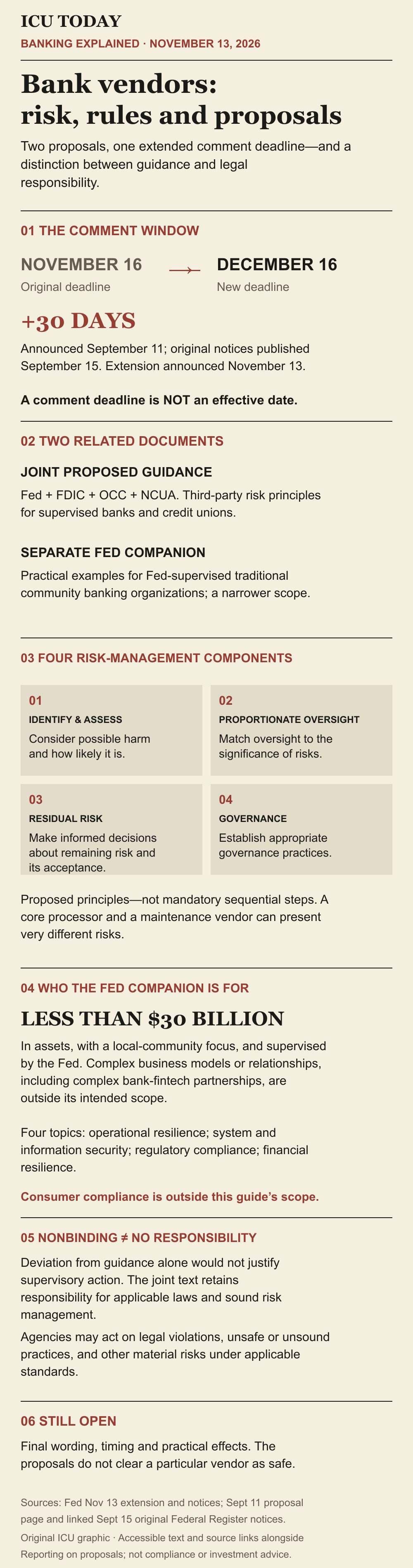
Read the infographic as text
The public-comment timeline. September 11, 2026: agencies announced the proposals. September 15: the original notices appeared in the Federal Register. November 13: agencies announced extensions. November 16 was the original deadline; December 16 is now the deadline for both the joint guidance and the separate Fed community-bank guide. This is an extra 30 days, not a finalization or effective date.
Two documents with different scopes. Joint proposed guidance: Federal Reserve, FDIC, OCC and NCUA; covers third-party risk management for supervised banks and credit unions. Separate Fed companion: practical examples for Fed-supervised traditional community banking organizations. The companion does not cover every institution or business model.
The joint proposal’s four components. 1. Identify and assess risks: consider both the possible magnitude of harm and its likelihood. 2. Oversee risks in proportion to their significance. 3. Make informed decisions about residual risks and risk acceptance. 4. Establish appropriate governance. These are proposed principles, not a mandatory step-by-step sequence. The proposal illustrates that a core-processing relationship can involve broader risks than a facilities-maintenance vendor.
The community-bank companion. Intended for Fed-supervised traditional community banking organizations with less than $30 billion in assets that focus on local communities. More complex business models or relationships, including complex bank-fintech partnerships, are outside its intended scope. Consumer compliance is excluded from this guide’s scope. Its four broad topics: operational resilience; system and information security; compliance with rules and regulations; financial resilience.
What nonbinding means here. The agencies say departure from proposed guidance or its examples alone would not justify supervisory action. The joint text retains responsibility for applicable laws and sound risk management and allows action over legal violations, unsafe or unsound practices and other material risks, consistent with applicable standards. Outsourcing does not remove a bank’s responsibility. No individual vendor receives a safety clearance from these proposals.
What is still open. The final text, finalization timing and practical effects are unsettled. The Fed asks whether its community-bank guide offers useful detail without creating de facto supervisory standards. Sources: Fed November 13 extension announcement and both extension notices; September 11 proposal page and its linked September 15 original Federal Register notices. Joint issuer records are not independent proof of future outcomes. Original reporting graphic, not compliance advice.
Graphic sources: Federal Reserve Board · Federal Reserve Board · Federal Reserve Board · Federal Reserve Board
The developing record.
Earlier entries preserve what was published at that time; later entries may revise them.
2026-11-13T22:38:09.876Z · Initial explanatory report on the November13 comment extension, the proposed risk-based vendor framework and its separate community-bank companion, with an original detailed infographic.
Bank regulators extend review of a more tailored approach to vendor risk
Comments now run through December 16. The proposal would focus oversight on the risks of individual outside-provider relationships, while a separate Federal Reserve guide addresses traditional community banks.
What happened
Federal banking regulators on November 13 gave the public another month to comment on proposed guidance for managing risks from outside providers. The Federal Reserve, Federal Deposit Insurance Corporation, Office of the Comptroller of the Currency and National Credit Union Administration moved the deadline from November 16 to December 16. The Fed separately extended comments on its companion guide for traditional community banks to the same date. These are two related proposals, with different scopes. [Federal Reserve Board] [Federal Reserve Board] [Federal Reserve Board]
Why it matters
In the joint proposal published in September, the agencies say their 2023 guidance was often interpreted too broadly, encouraging process-heavy oversight without enough attention to differences between relationships. Their proposed replacement puts more emphasis on identifying the actual risks and tailoring the effort to their significance. That is the regulators’ explanation for the change, rather than proof that the new approach would improve outcomes. They plan to replace existing guidance when a final version is adopted; the November announcement does not finalize it. [Federal Reserve Board]
Four parts of the proposed framework
The joint text sets out four components: identify and assess risks; oversee them in proportion to their significance; make informed decisions about remaining risks and whether to accept them; and establish appropriate governance. It describes risk assessments that consider both the possible magnitude of harm and its likelihood. Its examples distinguish a core service provider touching many bank operations from a facilities-maintenance vendor whose risks may be much narrower. Even similar relationships can carry different risks at different banks. [Federal Reserve Board]
Nonbinding does not erase responsibility
The agencies describe the proposed guidance as nonbinding. Its text says departure from the guidance or its examples would not, by itself, justify supervisory action. It also says agencies may act over violations of laws or regulations, unsafe or unsound practices, or other material risks from inadequate management, consistent with applicable standards. The proposal states that using a third party does not diminish a bank’s responsibility to meet its own legal and risk-management obligations. [Federal Reserve Board] [Federal Reserve Board]
A narrower community-bank companion
The Fed’s separate proposed guide is intended for Fed-supervised traditional community banking organizations: institutions with less than $30 billion in assets that focus on local communities. It excludes more complex business models or relationships, such as complex bank-fintech partnerships; consumer compliance is outside this guide’s scope. Its four broad topics are operational resilience, system and information security, compliance with rules and regulations, and financial resilience. Those topics address issues such as a provider’s disruption, access to sensitive systems and financial condition, rather than prescribe one identical vendor checklist for every bank. [Federal Reserve Board] [Federal Reserve Board]
What remains unknown
The notices establish a December 16 comment deadline, not a date when either proposal becomes final. The final wording, timing and practical effects remain unsettled. The Fed is specifically seeking feedback on whether its companion guide offers useful detail without becoming a set of de facto supervisory standards. For now, the concrete change is more time to weigh the proposed approach—not a finding that a particular vendor is safe or that an institution can set aside existing obligations. [Federal Reserve Board] [Federal Reserve Board] [Federal Reserve Board] [Federal Reserve Board]
Read the infographic as text
The public-comment timeline. September 11, 2026: agencies announced the proposals. September 15: the original notices appeared in the Federal Register. November 13: agencies announced extensions. November 16 was the original deadline; December 16 is now the deadline for both the joint guidance and the separate Fed community-bank guide. This is an extra 30 days, not a finalization or effective date.
Two documents with different scopes. Joint proposed guidance: Federal Reserve, FDIC, OCC and NCUA; covers third-party risk management for supervised banks and credit unions. Separate Fed companion: practical examples for Fed-supervised traditional community banking organizations. The companion does not cover every institution or business model.
The joint proposal’s four components. 1. Identify and assess risks: consider both the possible magnitude of harm and its likelihood. 2. Oversee risks in proportion to their significance. 3. Make informed decisions about residual risks and risk acceptance. 4. Establish appropriate governance. These are proposed principles, not a mandatory step-by-step sequence. The proposal illustrates that a core-processing relationship can involve broader risks than a facilities-maintenance vendor.
The community-bank companion. Intended for Fed-supervised traditional community banking organizations with less than $30 billion in assets that focus on local communities. More complex business models or relationships, including complex bank-fintech partnerships, are outside its intended scope. Consumer compliance is excluded from this guide’s scope. Its four broad topics: operational resilience; system and information security; compliance with rules and regulations; financial resilience.
What nonbinding means here. The agencies say departure from proposed guidance or its examples alone would not justify supervisory action. The joint text retains responsibility for applicable laws and sound risk management and allows action over legal violations, unsafe or unsound practices and other material risks, consistent with applicable standards. Outsourcing does not remove a bank’s responsibility. No individual vendor receives a safety clearance from these proposals.
What is still open. The final text, finalization timing and practical effects are unsettled. The Fed asks whether its community-bank guide offers useful detail without creating de facto supervisory standards. Sources: Fed November 13 extension announcement and both extension notices; September 11 proposal page and its linked September 15 original Federal Register notices. Joint issuer records are not independent proof of future outcomes. Original reporting graphic, not compliance advice.
Graphic sources: Federal Reserve Board · Federal Reserve Board · Federal Reserve Board · Federal Reserve Board
Original sources
November 13 extension announcement · Issuer: Federal Reserve Board / FDIC / OCC / NCUA · Published 2026-11-13
September proposal and linked original notices · Issuer: Federal Reserve Board / FDIC / OCC / NCUA · Published 2026-09-11
Joint guidance comment-period extension notice · Issuer: Federal Reserve Board / FDIC / OCC / NCUA · Published 2026-11-13
Fed community-bank guide comment-period extension · Issuer: Federal Reserve Board · Published 2026-11-13
Corrections
No corrections recorded.