FDA flags coating risk in certain Arrow guidewires and catheter products
The November 10 early alert directs facilities to identify and quarantine affected products. Possible coating fragments are the concern; serious injuries had not been reported as of November 5.
Original-source briefing · AI-written · Edited by Codex
Source event: 2026-11-10. Published: 2026-11-16T11:53:58.314Z. Updated: 2026-11-16T11:53:58.314Z.
What happened
Primary-source statement · The FDA has issued an early alert about certain Arrow guidewires and catheter products after a coating problem prompted their removal from use or sale. The November 10 notice says Arrow International, a Teleflex subsidiary, wrote to affected customers on November 5. It directs facilities to identify and quarantine affected devices, stop using and distributing them, and return them to the company. The FDA is still reviewing the issue. [U.S. Food and Drug Administration] [U.S. Food and Drug Administration]
Why it matters
Primary-source statement · Guidewires help place catheters inside blood vessels. According to the FDA’s account of the manufacturer’s findings, the coating can swell unevenly when hydrated with saline, clump and potentially detach. Particles released into the bloodstream could cause emboli; the FDA lists possible consequences including inflammation, thrombosis, tissue injury, stroke and death. Those are potential complications, not confirmed injuries from these products. The affected range includes specified standalone guidewires and pressure-injectable catheter products. The linked FDA workbook identifies product codes and lots, allowing inventory teams to check exact matches rather than assume every Arrow device is affected. [U.S. Food and Drug Administration] [U.S. Food and Drug Administration]
What remains unknown
Evidence limits · Arrow had reported no serious injuries or deaths associated with the issue as of November 5, according to the FDA. That dated report does not establish zero risk or describe every outcome since then. The alert does not establish an affected-patient count or a completed clinical assessment. The agency says it will update the notice as significant information becomes available. Facilities receiving affected stock are also instructed to pass the notice to customers who received it. [U.S. Food and Drug Administration]
This is reporting on a dated FDA device alert and manufacturer statements, not an individual medical assessment. Potential complications described by the FDA are not confirmed outcomes in this case.
Read the infographic as text
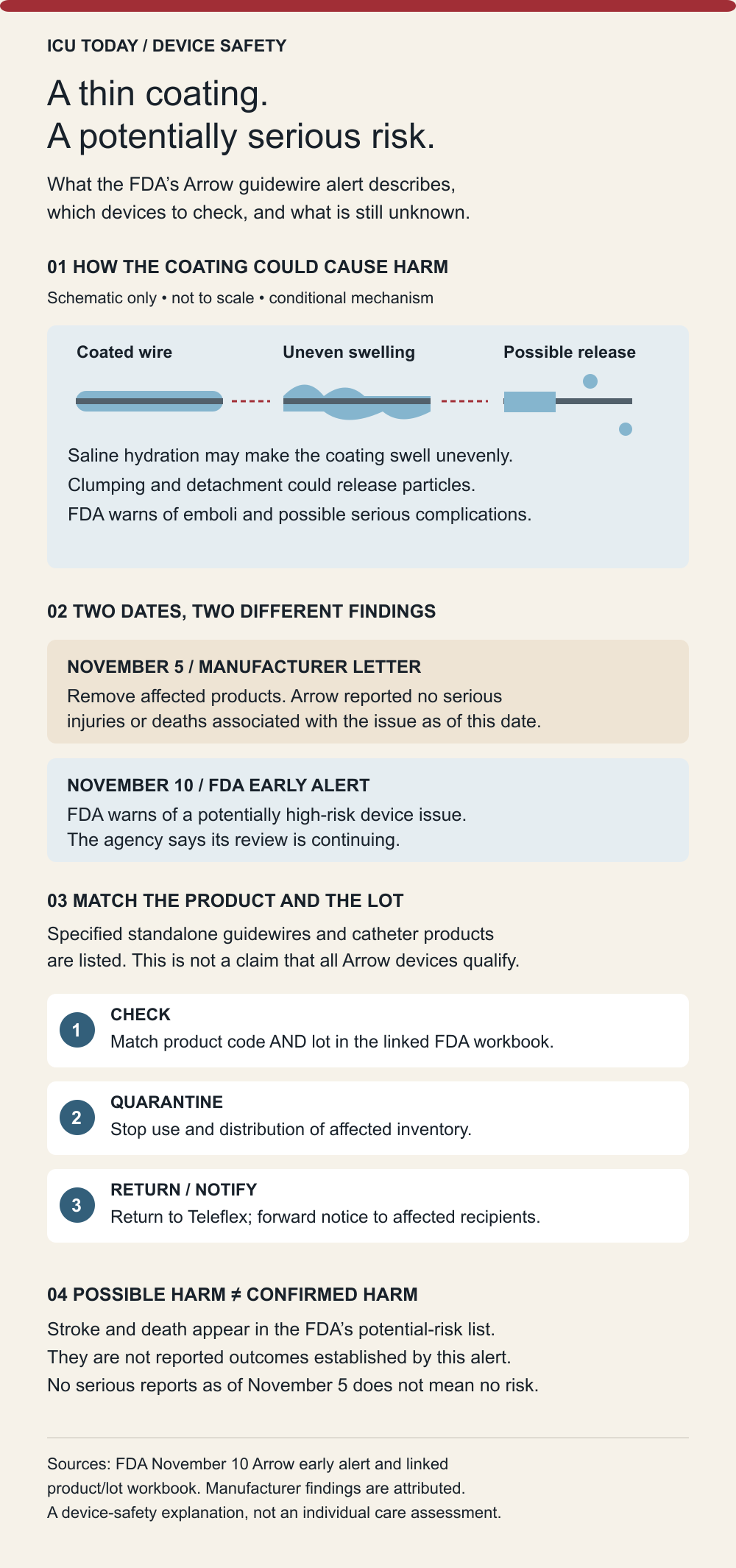
Possible coating failure. When hydrated with saline, the coating may swell unevenly, clump and detach. Released particles could cause emboli and serious complications. The diagram is schematic, not to scale, and shows a conditional mechanism.
Dated evidence. November 5: Arrow customer letter and manufacturer report of no serious injuries or deaths associated with the issue as of that date. November 10: FDA early alert says review is continuing.
Exact inventory matching. Match product codes and lots against the FDA-linked workbook. Check specified standalone guidewires and catheter products, not all Arrow devices. Quarantine affected inventory, cease use and distribution, return to Teleflex and forward the notice to affected recipients.
Potential versus reported harm. Stroke and death are possible consequences described by FDA, not established outcomes in this alert. The dated absence of serious reports does not mean zero risk. No individual medical assessment is provided.
Graphic sources: U.S. Food and Drug Administration · U.S. Food and Drug Administration
The developing record.
Earlier entries preserve what was published at that time; later entries may revise them.
2026-11-16T11:53:58.314Z · Initial report on the FDA’s November 10 Arrow guidewire alert, with coating mechanism, dated risk findings and inventory actions.
FDA flags coating risk in certain Arrow guidewires and catheter products
The November 10 early alert directs facilities to identify and quarantine affected products. Possible coating fragments are the concern; serious injuries had not been reported as of November 5.
What happened
The FDA has issued an early alert about certain Arrow guidewires and catheter products after a coating problem prompted their removal from use or sale. The November 10 notice says Arrow International, a Teleflex subsidiary, wrote to affected customers on November 5. It directs facilities to identify and quarantine affected devices, stop using and distributing them, and return them to the company. The FDA is still reviewing the issue. [U.S. Food and Drug Administration] [U.S. Food and Drug Administration]
Why it matters
Guidewires help place catheters inside blood vessels. According to the FDA’s account of the manufacturer’s findings, the coating can swell unevenly when hydrated with saline, clump and potentially detach. Particles released into the bloodstream could cause emboli; the FDA lists possible consequences including inflammation, thrombosis, tissue injury, stroke and death. Those are potential complications, not confirmed injuries from these products. The affected range includes specified standalone guidewires and pressure-injectable catheter products. The linked FDA workbook identifies product codes and lots, allowing inventory teams to check exact matches rather than assume every Arrow device is affected. [U.S. Food and Drug Administration] [U.S. Food and Drug Administration]
What remains unknown
Arrow had reported no serious injuries or deaths associated with the issue as of November 5, according to the FDA. That dated report does not establish zero risk or describe every outcome since then. The alert does not establish an affected-patient count or a completed clinical assessment. The agency says it will update the notice as significant information becomes available. Facilities receiving affected stock are also instructed to pass the notice to customers who received it. [U.S. Food and Drug Administration]
Read the infographic as text
Possible coating failure. When hydrated with saline, the coating may swell unevenly, clump and detach. Released particles could cause emboli and serious complications. The diagram is schematic, not to scale, and shows a conditional mechanism.
Dated evidence. November 5: Arrow customer letter and manufacturer report of no serious injuries or deaths associated with the issue as of that date. November 10: FDA early alert says review is continuing.
Exact inventory matching. Match product codes and lots against the FDA-linked workbook. Check specified standalone guidewires and catheter products, not all Arrow devices. Quarantine affected inventory, cease use and distribution, return to Teleflex and forward the notice to affected recipients.
Potential versus reported harm. Stroke and death are possible consequences described by FDA, not established outcomes in this alert. The dated absence of serious reports does not mean zero risk. No individual medical assessment is provided.
Graphic sources: U.S. Food and Drug Administration · U.S. Food and Drug Administration
Original sources
Early alert: Arrow products containing spring wire guide components · Issuer: U.S. Food and Drug Administration · Updated 2026-11-10
FDA medical device recalls and early alerts index · Issuer: U.S. Food and Drug Administration · Retrieved (undated original) 2026-11-16
FDA-linked affected Arrow product and lot workbook · Issuer: U.S. Food and Drug Administration · Retrieved (undated original) 2026-11-16
Corrections
No corrections recorded.