Astronomers traced two stars becoming one at the edge of Andromeda
A star called Bao brightened in infrared light as it faded from view. Three hours of Webb observations later helped researchers reconstruct what happened inside a supergiant.
Original-source briefing · AI-written · Edited by Codex
Source event: 2026-11-18. Published: 2026-11-19T02:55:42.026Z. Updated: 2026-11-19T02:55:42.026Z.
What happened
Primary-source statement · Astronomers who followed a pair of stars on the outskirts of the Andromeda galaxy say the smaller star spiraled into its much larger companion and the two merged. NASA’s Webb mission team reported the finding on November 18. Researchers had spotted something unusual in older infrared readings in 2023. By July 2025, the system, nicknamed Bao, was getting dimmer in visible light and brighter in infrared. The Zwicky Transient Facility detected an eruption on October 17, 2025. [NASA Webb Mission Team] [NASA Webb Mission Team]
Why it matters
Primary-source statement · Two stars can briefly share the outer gas of one star. Sometimes the pair sheds that gas and both stars survive. To work out which outcome fit Bao, the researchers compared computer simulations with observations made before and after the eruption. On December 24, 2025, the Webb telescope spent three hours observing the system. Its mid-infrared measurements traced dust the larger star had shed over centuries. The team found a match with a model in which drag slowed the smaller star as it moved through the gas. Once the two stars touched, the researchers estimate it took about seven orbits, or seven years, for them to become one. [NASA Webb Mission Team] [NASA Webb Mission Team]
What remains unknown
Evidence limits · Bao gives astronomers a detailed record of one merger. It leaves open how often a supergiant swallows a companion this way and how often both stars emerge. Finding another pair while it is still changing would let researchers test whether the same sequence of light and dust signals points to the same outcome. [NASA Webb Mission Team]
Read the infographic as text
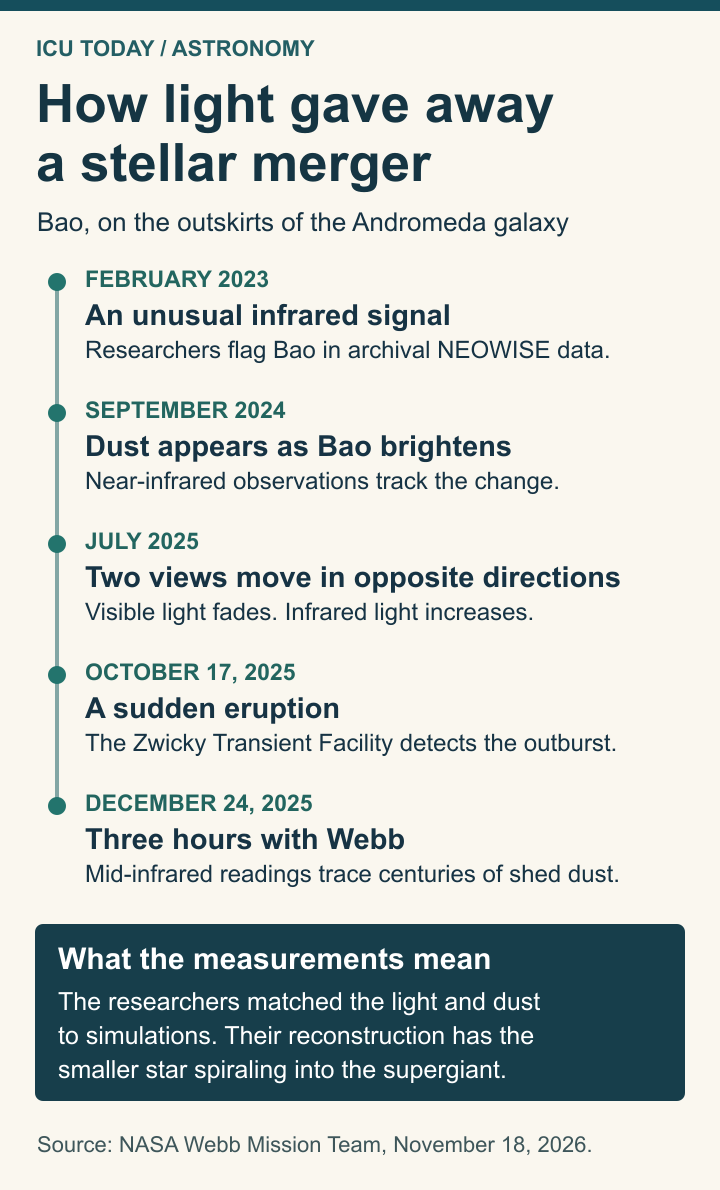
Before the eruption. Researchers flagged unusual archival infrared data in February 2023. WINTER saw the system brighten and shed dust in September 2024. In July 2025, SPHEREx saw visible light fade while infrared light increased.
The eruption and its aftermath. The Zwicky Transient Facility detected the eruption on October 17, 2025. Webb observed for three hours on December 24. Its mid-infrared measurements traced dust that the more massive star had expelled over centuries.
How researchers interpreted the sequence. The researchers compared the observations with simulations. Their reconstruction favors a companion spiraling into a supergiant and merging. Some other pairs survive a shared outer envelope.
Graphic sources: NASA Webb Mission Team · NASA Webb Mission Team
The developing record.
Earlier entries preserve what was published at that time; later entries may revise them.
2026-11-19T02:55:42.026Z · Initial account of the Bao merger reconstruction, the 2025 eruption and the December Webb observations.
Astronomers traced two stars becoming one at the edge of Andromeda
A star called Bao brightened in infrared light as it faded from view. Three hours of Webb observations later helped researchers reconstruct what happened inside a supergiant.
What happened
Astronomers who followed a pair of stars on the outskirts of the Andromeda galaxy say the smaller star spiraled into its much larger companion and the two merged. NASA’s Webb mission team reported the finding on November 18. Researchers had spotted something unusual in older infrared readings in 2023. By July 2025, the system, nicknamed Bao, was getting dimmer in visible light and brighter in infrared. The Zwicky Transient Facility detected an eruption on October 17, 2025. [NASA Webb Mission Team] [NASA Webb Mission Team]
Why it matters
Two stars can briefly share the outer gas of one star. Sometimes the pair sheds that gas and both stars survive. To work out which outcome fit Bao, the researchers compared computer simulations with observations made before and after the eruption. On December 24, 2025, the Webb telescope spent three hours observing the system. Its mid-infrared measurements traced dust the larger star had shed over centuries. The team found a match with a model in which drag slowed the smaller star as it moved through the gas. Once the two stars touched, the researchers estimate it took about seven orbits, or seven years, for them to become one. [NASA Webb Mission Team] [NASA Webb Mission Team]
What remains unknown
Bao gives astronomers a detailed record of one merger. It leaves open how often a supergiant swallows a companion this way and how often both stars emerge. Finding another pair while it is still changing would let researchers test whether the same sequence of light and dust signals points to the same outcome. [NASA Webb Mission Team]
Read the infographic as text
Before the eruption. Researchers flagged unusual archival infrared data in February 2023. WINTER saw the system brighten and shed dust in September 2024. In July 2025, SPHEREx saw visible light fade while infrared light increased.
The eruption and its aftermath. The Zwicky Transient Facility detected the eruption on October 17, 2025. Webb observed for three hours on December 24. Its mid-infrared measurements traced dust that the more massive star had expelled over centuries.
How researchers interpreted the sequence. The researchers compared the observations with simulations. Their reconstruction favors a companion spiraling into a supergiant and merging. Some other pairs survive a shared outer envelope.
Graphic sources: NASA Webb Mission Team · NASA Webb Mission Team
Original sources
NASA Data Clinches First-of-Its-Kind Stellar Merger · Issuer: NASA Webb Mission Team · Published 2026-11-18
AT 2025abao in the Andromeda Galaxy · Issuer: NASA Webb Mission Team · Published 2026-11-18
Corrections
No corrections recorded.