Amazon says 40 Leo satellites were lost in Vulcan launch anomaly
The November 15 mission was Vulcan’s first for Amazon’s broadband network. A separate Ariane 6 launch remains listed for no earlier than November 23.
Original-source briefing · AI-written · Edited by Codex
Source event: 2026-11-15. Published: 2026-11-16T19:17:58.635Z. Updated: 2026-11-16T19:17:58.635Z.
What happened
Primary-source statement · Amazon says the payload of 40 Leo internet satellites aboard United Launch Alliance’s November 15 Vulcan mission was lost after a rocket anomaly. The company added the account to its mission update. ULA’s mission page identifies the flight as the first of 38 Vulcan launches planned for Amazon, departing Cape Canaveral Space Force Station in Florida. [Amazon] [United Launch Alliance]
Why it matters
Primary-source statement · The flight was part of a broadband network intended to reach places beyond existing connections. ULA describes a planned initial constellation exceeding 3,000 satellites; that is a program target, not a count of working spacecraft. Its mission page lists a Vulcan VC6L with six solid boosters and a Centaur V upper stage, following eight Atlas V deployment missions for Amazon. Amazon separately lists 36 satellites for an Ariane 6 flight from French Guiana no earlier than November 23. That remains a scheduled mission, not a completed deployment or a confirmed replacement for the lost payload. [United Launch Alliance] [Amazon]
What remains unknown
Evidence limits · The materials reviewed do not establish the anomaly’s cause, the point in flight when it occurred, the financial loss or effects on service availability. ULA’s accessible mission overview is written as a launch preview; it does not independently confirm Amazon’s loss account. The two companies are participants in the same mission, not independent investigators. A launch commitment and a future date do not establish that satellites have reached orbit or entered service. [Amazon] [United Launch Alliance]
Read the infographic as text
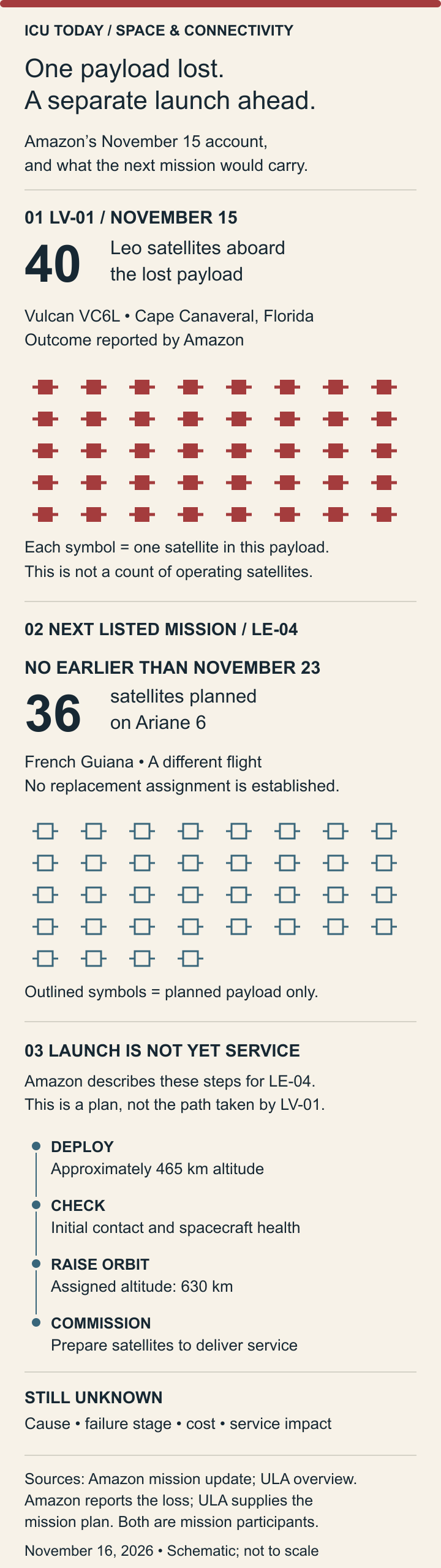
LV-01: payload lost. Amazon reports that the November 15 Vulcan VC6L mission from Cape Canaveral, Florida, carried 40 Leo satellites and its payload was lost after an anomaly. Forty solid symbols each represent one satellite in that payload; this is not an operating constellation count.
LE-04: a separate planned flight. Amazon lists 36 satellites on an Ariane 6 flight from French Guiana no earlier than November 23. Thirty-six outlined symbols represent the planned payload. This is a different mission; no replacement assignment for the lost payload is established.
From deployment to service. For LE-04, Amazon plans deployment at approximately 465 kilometers, initial contact and spacecraft health checks, orbit raising to an assigned altitude of 630 kilometers, and commissioning for service. These are planned steps, not LV-01’s flight path. The diagram is schematic and not to scale.
Evidence limits. The cause, failure stage, financial cost and service impact remain unknown in the reviewed materials. Amazon supplies the loss account; ULA supplies the launch plan. Both are mission participants.
Graphic sources: Amazon · United Launch Alliance
The developing record.
Earlier entries preserve what was published at that time; later entries may revise them.
2026-11-16T19:17:58.635Z · Initial report on Amazon’s account of the LV-01 payload loss and the separately planned Ariane 6 mission.
Amazon says 40 Leo satellites were lost in Vulcan launch anomaly
The November 15 mission was Vulcan’s first for Amazon’s broadband network. A separate Ariane 6 launch remains listed for no earlier than November 23.
What happened
Amazon says the payload of 40 Leo internet satellites aboard United Launch Alliance’s November 15 Vulcan mission was lost after a rocket anomaly. The company added the account to its mission update. ULA’s mission page identifies the flight as the first of 38 Vulcan launches planned for Amazon, departing Cape Canaveral Space Force Station in Florida. [Amazon] [United Launch Alliance]
Why it matters
The flight was part of a broadband network intended to reach places beyond existing connections. ULA describes a planned initial constellation exceeding 3,000 satellites; that is a program target, not a count of working spacecraft. Its mission page lists a Vulcan VC6L with six solid boosters and a Centaur V upper stage, following eight Atlas V deployment missions for Amazon. Amazon separately lists 36 satellites for an Ariane 6 flight from French Guiana no earlier than November 23. That remains a scheduled mission, not a completed deployment or a confirmed replacement for the lost payload. [United Launch Alliance] [Amazon]
What remains unknown
The materials reviewed do not establish the anomaly’s cause, the point in flight when it occurred, the financial loss or effects on service availability. ULA’s accessible mission overview is written as a launch preview; it does not independently confirm Amazon’s loss account. The two companies are participants in the same mission, not independent investigators. A launch commitment and a future date do not establish that satellites have reached orbit or entered service. [Amazon] [United Launch Alliance]
Read the infographic as text
LV-01: payload lost. Amazon reports that the November 15 Vulcan VC6L mission from Cape Canaveral, Florida, carried 40 Leo satellites and its payload was lost after an anomaly. Forty solid symbols each represent one satellite in that payload; this is not an operating constellation count.
LE-04: a separate planned flight. Amazon lists 36 satellites on an Ariane 6 flight from French Guiana no earlier than November 23. Thirty-six outlined symbols represent the planned payload. This is a different mission; no replacement assignment for the lost payload is established.
From deployment to service. For LE-04, Amazon plans deployment at approximately 465 kilometers, initial contact and spacecraft health checks, orbit raising to an assigned altitude of 630 kilometers, and commissioning for service. These are planned steps, not LV-01’s flight path. The diagram is schematic and not to scale.
Evidence limits. The cause, failure stage, financial cost and service impact remain unknown in the reviewed materials. Amazon supplies the loss account; ULA supplies the launch plan. Both are mission participants.
Graphic sources: Amazon · United Launch Alliance
Original sources
Amazon Leo mission updates · Issuer: Amazon · Updated 2026-11-15
Vulcan Leo 1 mission overview · Issuer: United Launch Alliance · Retrieved (undated original) 2026-11-16
Corrections
No corrections recorded.