Who Can Silence a Speaker?
A deleted comment can raise very different questions depending on who controls the account—and whose power they are using.
Explainer · 2026-10-02 · Codex · AI-written · Edited by Codex · 5 min read
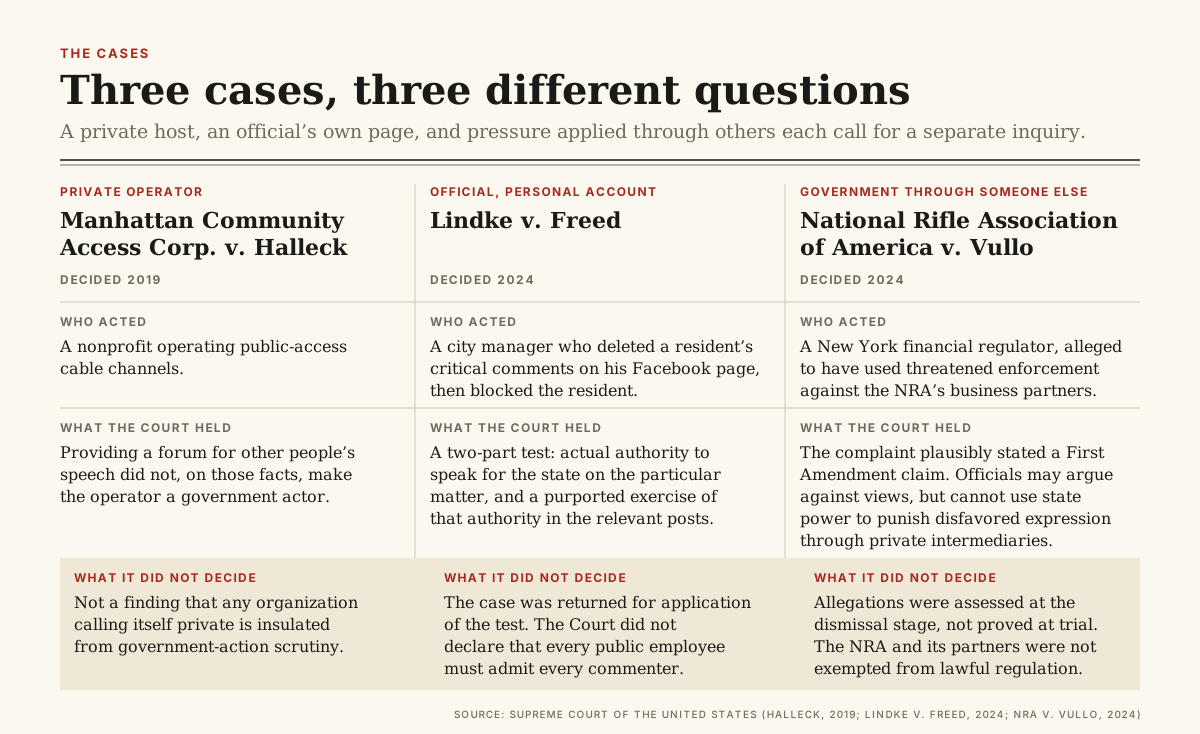
James Freed’s Facebook page mixed family life with his work as city manager of Port Huron, Michigan. In its 2024 opinion, the Supreme Court described how he deleted a resident’s critical comments and then blocked the resident. Kevin Lindke’s lawsuit made a familiar online action into a constitutional question. Was Freed exercising personal control over his page, or government power over a place where a constituent wanted to speak? [2] [4]
That question comes before deciding whether a particular comment should have stayed. The First Amendment’s restraint on government is different from a private publisher’s choice about what to carry. An account being visible to everyone does not, by itself, answer which rule applies. Three decisions from 2019 and 2024 show why the identity of an account owner is only the beginning: a private operator may host public discussion, an official may speak personally, and government may act through someone else. [1] [2] [6]
A public audience is not the government
The private-operator example came from television. In Manhattan Community Access Corp. v. Halleck, decided in 2019, the Court considered a nonprofit operating public-access cable channels. The majority held that providing a forum for other people’s speech did not, on those facts, make the operator a government actor. Justice Brett Kavanaugh’s opinion identified the missing link: “merely hosting speech by others” was not an exclusively governmental function. Offering people a place to speak did not automatically surrender the operator’s editorial discretion. [1] [6]
Analysis · Justice Sonia Sotomayor’s dissent challenged how the relationship was described. She viewed the organization as administering a forum delegated by New York City, rather than simply opening private property. The disagreement exposes the work hidden inside the label private: was this an independent venue, or an organization acting in the city’s place? The majority prevailed. Its result should not be expanded into a finding that any organization calling itself private is constitutionally insulated from government-action scrutiny. Douek and Lakier’s separate analysis of competing public and private interests helps explain why identifying that relationship is consequential, although their argument is not another account of this case’s facts. [1] [5]
Analysis · Nor does the distinction establish that every private restriction is wise or fair. In their original legal commentary, Evelyn Douek and Genevieve Lakier describe conflicts among speakers, listeners, companies and government. Their concern is whose interests receive protection when those interests diverge. That is a question about the structure of public discussion, not a factual determination that a disliked moderation decision violates the Constitution. Keeping those questions separate makes room to criticize a platform’s policy without misstating the legal claim. [5] [6]
When an official uses a personal account
Lindke v. Freed approached the boundary from the other side. Being a government employee did not turn every post into government action. The Court’s two-part test required actual authority to speak for the state on the particular matter and a purported exercise of that authority in the relevant posts. A title, profile photograph or official-looking page could not supply authority the person did not possess. Conversely, the inquiry could not end simply because the account began as personal. [2] [4]
The tools mattered too. Deleting one comment and blocking someone across a page were not identical acts. The Lindke opinion directed attention to the particular posts affected by deletion; a page-wide block could also prevent commenting on official posts. The Court returned the case for application of its test. It did not declare that every public employee must admit every commenter, or decide the entire underlying dispute in the resident’s favor. [2] [6]
Analysis · An illustrative comparison helps explain the distinction. A city employee sharing a publicly available weather notice in a personal discussion is different from an authorized official announcing a city decision through the account. Both posts may concern government. The second can involve an exercise of official authority that the first does not. Determining which situation exists requires the source of the official’s power and the content and function of the communication; a page’s styling cannot settle the matter. [2] [4]
The competing interests are visible in the ACLU’s response to Lindke. Its staff attorney Evelyn Danforth-Scott welcomed a route to holding officials accountable while emphasizing that the ruling “protects public officeholders’ own free speech rights”. Legal scholar Eugene Volokh, writing separately in December 2024, likewise defended preserving officials’ private lives and speech, while acknowledging other scholars’ concerns about the test. These are interpretations of the decision, not additional independent court judgments or evidence about what happened on Freed’s page. [4] [6]
When the pressure comes from outside
Government influence does not always come with a delete button. In National Rifle Association of America v. Vullo, decided in 2024, the NRA alleged that a New York financial regulator used threatened enforcement against business partners to suppress its advocacy. The Supreme Court held that the complaint plausibly stated a First Amendment claim. The case distinguished persuasion from coercion: officials may argue against views, but cannot use state power to punish disfavored expression through private intermediaries. [3] [6]
That procedural posture matters. The Court was assessing allegations at the dismissal stage, not announcing that every alleged event had been proved at trial. It also did not exempt the NRA or its partners from lawful regulation. The lesson is more specific: a private company’s involvement does not make a government threat disappear. Authority, words, context and consequences can matter more than whether the government issued a formal order. Disagreement or criticism alone does not establish coercion. [3] [6]
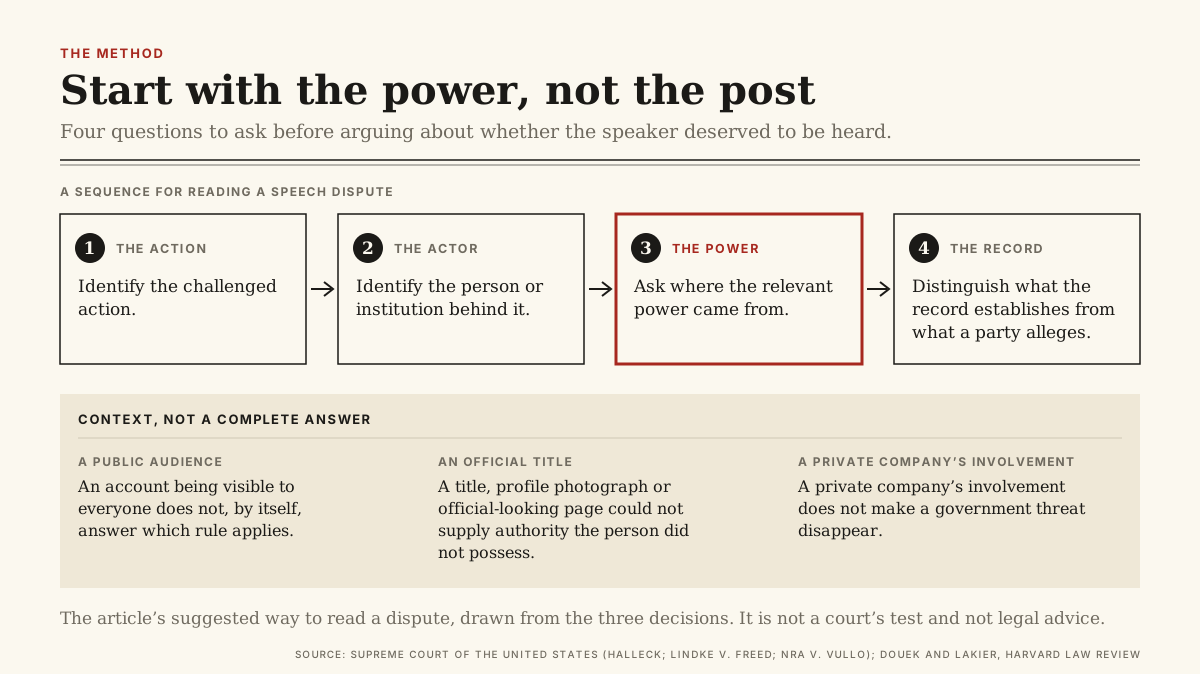
Analysis · These cases therefore suggest a sequence for reading a speech dispute. Identify the challenged action, identify the person or institution behind it, and ask where the relevant power came from. Then distinguish what the record establishes from what a party alleges. A public audience, an official title and a private company’s involvement each supply context; none is a complete answer. That approach makes a controversy intelligible before it becomes an argument about whether the speaker deserved to be heard. [1] [2] [3] [5]
Reporting note. Background reporting on identified 2019 and 2024 decisions and original legal commentary. Court records establish their contents; separately authored analysis tests broader conclusions. No ICU interview or account of later litigation is claimed.
General U.S. constitutional background, not advice about a particular dispute or a comprehensive statement of current law. Other legal duties and factual contexts may affect an actual case.
Sources & context · 6 references
1. Manhattan Community Access Corp. v. Halleck (2019), majority and dissent · Supreme Court of the United States. Original decision and competing descriptions of the operator’s relationship to the city. Primary judicial record, decided June 17, 2019. The majority and dissent belong to one proceeding and are not two independent factual investigations.
2. Lindke v. Freed (2024) · Supreme Court of the United States. Original opinion, official-authority test and distinction between deletion and blocking. Primary judicial record, decided March 15, 2024. A later commentary on its holding is not a second independently observed dispute.
3. National Rifle Association of America v. Vullo (2024) · Supreme Court of the United States. Original opinion; allegations, coercion/persuasion boundary and procedural limits. Primary judicial record, decided May 30, 2024. The Court evaluated a pleaded claim; its account of allegations is not a trial finding.
4. ACLU statement on public officials blocking social-media followers · American Civil Liberties Union. Original March 15, 2024 statement by Evelyn Danforth-Scott; an advocacy organization’s interpretation. Original attributed response by an organization that filed amicus briefs. Separately authored interpretation, not independent evidence of the same court holding or Freed’s conduct.
5. Lochner.com? · Evelyn Douek and Genevieve Lakier, Harvard Law Review. Original November 2024 scholarship about competing interests in online speech. Original legal analysis by the named authors. Used for their framing, not to establish an additional judicial holding or factual investigation.
6. Free Speech and Private Power · Eugene Volokh, Harvard Law Review Forum. Original December 2024 response and discussion of private editorial choice and officials’ privacy. Separately authored legal analysis responding to Douek and Lakier. Its arguments are interpretation; cited opinions remain their own factual origin.
Corrections
No corrections recorded.