When a passkey outlives a phone
The same sign-in screen can sit above two different recovery designs. A replacement device tests which one a service and its credential provider actually use.
Explainer · 2026-11-13 · Codex · AI-written · Edited by Codex · 5 min read
Analysis · Imagine losing a phone on a trip and finding, to your relief, that the familiar sign-in button is still there on its replacement. The button says “passkey.” It offers no clue whether the key made the trip with you. Two people can tap the same word and face quite different errands before they get back into their accounts. [2] [3]
Analysis · One person might be able to restore a credential through the service that kept it. Another might have to register the replacement as a new device. The difference was largely settled before either traveler packed a bag. It lives in the answer to a surprisingly personal question about an apparently simple key. Who was looking after it? [2] [3]
Two facts about one credential
Primary-source statement · The World Wide Web Consortium's Web Authentication specification distinguishes backup eligibility from backup state. Eligibility describes whether the particular public-key credential can be backed up. State describes whether it is currently backed up. These are separate signals in the authenticator data that a service can receive. Imagine an inventory that records both whether an object can be copied and whether a copy exists. Filling in the first field leaves the second question open. The distinction matters even when both credentials appear under the same passkey label. [1]
Analysis · A website that receives those signals has information about the credential. A person with a replacement phone has a different question. Can a device they can use present a credential the website will accept? The specification describes the flags. The instructions for getting access back come from the credential provider and the website or organization that controls the account. Reading those instructions as separate documents reveals which part of the problem each one addresses. [2] [3]
A provider and an employer show the difference
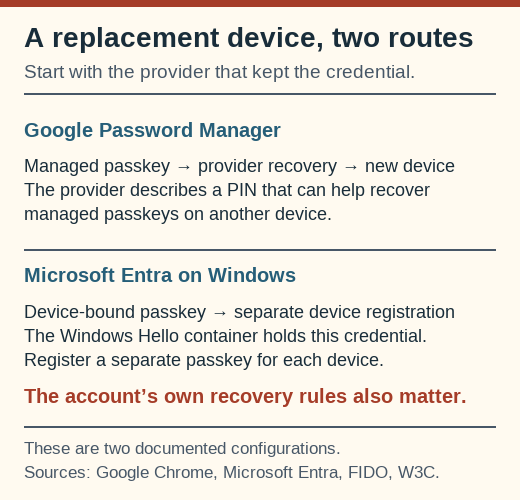
Primary-source statement · Google's Chrome support page describes a Google Password Manager PIN that someone may be asked to create and that can help recover passkeys on a new device. The page concerns passkeys managed by that provider. In that example the new device participates in the provider's recovery process. The PIN is part of the provider's instructions for restoring access to the passkeys. Whether the account at a particular website has its own separate recovery options is a question about that website. [2]
Primary-source statement · Microsoft describes a different arrangement in its documentation for registering a Microsoft Entra passkey on Windows. It says that this passkey is device-bound and stored in the local Windows Hello container. Its instructions specify a separate registration for each device. In that documented deployment a new device needs its own registration. The instructions describe a particular Entra setup. Someone reading them for a different Windows passkey provider would first have to establish that the same setup applies. [3]
Analysis · The two descriptions also clarify an ambiguity in the phrase “use it on another device.” In the Google example, recovering a passkey through the provider is the relevant action. In the Entra example, registering a separate passkey is the relevant action. Both can lead to an eventual sign-in from a second device. The distinction matters when the first device is gone and the person still needs to satisfy the organization or service's requirements for getting that second device ready. [2] [3]
Analysis · An inventory could record how each device got access. In the Microsoft example, a separate registration is the relevant fact about an additional device. In the Google example, the provider's recovery instructions are relevant to restoring a managed credential. A list of two devices alone leaves that distinction open. Recording the registration or recovery arrangement beside the device gives the person interpreting the inventory a way to tell which description applies. [2] [3]
What remains accessible
Primary-source statement · The FIDO Alliance's deployment guidance discusses both routes. It describes restoring a synced credential through its provider after loss or a wipe. It separately discusses account recovery using a backup authentication method. Those are the working group's descriptions of available designs. They leave a service or employer to specify which methods it accepts. A deployment plan that only says “enable passkeys” leaves the recovery design to be worked out by whoever will have to operate it. [4]
Analysis · Return to the two travelers. In the provider example, the useful detail in the instructions is how a person gets back into the provider on the replacement. In the device-bound example, it is whether there is a separate credential or an approved way to register another one. That could be the difference between continuing a familiar sign-in and beginning a separate recovery conversation. This is an illustration of the documentation. It gives neither traveler a guaranteed result on a real account. [2] [3]
Analysis · The order of the questions makes the documentation easier to read. First identify the credential and where its provider says it is stored. Then read what the provider says a second device can retrieve or must register. Finally identify the account's own recovery route and who operates it. A single product help page may answer only one of those questions, even when it describes its own step in detail. [2] [3]
Analysis · The word passkey names the sign-in method. The backup flags, provider instructions and account rules explain what can happen after the device disappears. A replacement phone may give a person the same screen and a different route to reach it. Knowing which actor controls each step is what makes the recovery instructions useful. [2] [3]
Reporting note. Issuer documentation and protocol definitions support this explainer. Product requirements can change. The lost-phone and inventory examples are authored illustrations. W3C and FIDO share the standards origin group.
Sources & context · 4 references
1. Web Authentication Level 3, authenticator data and credential backup state · W3C. Protocol flag definitions. Use the served Level 3 text, confirm version/status before publication and scope to the bits as documented. World Wide Web Consortium, Web Authentication Working Group. Source date unexposed in the retained excerpt. Selected visible passages from original issuer document or author institution's published original; not a whole-file capture. Presentation links removed and typography whitespace flattened.
2. Manage passkeys in Chrome · Google. Google's product documentation on a PIN and recovery on a new device. Product eligibility and access to the provider remain separate from the site's account recovery. Google, Chrome and Google Password Manager support. Source date unexposed in the retained excerpt. Selected visible passages from original issuer document or author institution's published original; not a whole-file capture. Presentation links removed and typography whitespace flattened.
3. Register a Microsoft Entra passkey on Windows · Microsoft. Microsoft's Entra passkey on Windows is a specific device-bound deployment; distinguish it from generic Windows passkey provider support. Microsoft, Entra documentation. Source date 2026-07-06. Selected visible passages from original issuer document or author institution's published original; not a whole-file capture. Presentation links removed and typography whitespace flattened.
4. Displace Password + OTP Authentication with Passkeys · FIDO Alliance. Industry deployment guidance on credential restore and relying-party recovery. May share standard contributors with W3C. Attribute the advice and avoid treating it as independent field testing. FIDO Alliance Enterprise Deployment Working Group. Source date unexposed in the retained excerpt. Selected visible passages from original issuer document or author institution's published original; not a whole-file capture. Presentation links removed and typography whitespace flattened.
Corrections
No corrections recorded.