What an iron test measures
Ferritin and hemoglobin answer different questions. A study that recruited women with fatigue and low ferritin shows why researchers can use both in the same eligibility rule.
Explainer · 2026-11-13 · Codex · AI-written · Edited by Codex · 5 min read
Primary-source statement · To enter one French fatigue study, a participant had to meet two conditions that look, at first glance, as though they ought to cancel each other out. Her ferritin had to be low or borderline, and she had to qualify as free of anemia. Researchers found 198 women who fit their study. The puzzle is in what the two tests measure. [3]
Analysis · One measurement offers a clue about the body's iron stores. The other looks at the oxygen-carrying protein in the blood. Picture two entries on a lab sheet, each opening a different door into the same investigation. What the researchers learned depends on who got through both doors, and on who stayed outside. [1] [2] [3]
A store marker and an oxygen carrier
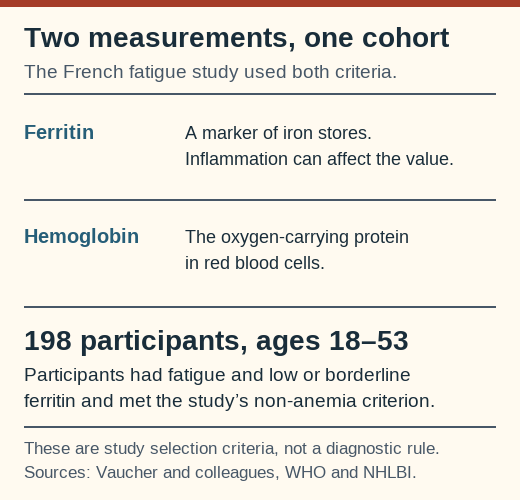
Primary-source statement · The World Health Organization describes ferritin concentration as a marker of iron stores. The idea of a marker matters. A measurement is used to learn about something the investigator is interested in. WHO's guidance also makes interpretation conditional on context. It says that inflammation can raise ferritin values and that this change has to be accounted for when ferritin is interpreted in individuals or in groups. The guidance therefore gives a reader both the measurement's purpose and a reason to pay attention to the circumstances in which it was taken. [1]
Primary-source statement · The U.S. National Heart, Lung, and Blood Institute describes hemoglobin as the iron-rich protein in red blood cells that carries oxygen. Its explanation places hemoglobin in the assessment of anemia. Here the measurement concerns a component of circulating blood with a different role from iron stores. The two institutional descriptions help explain why an iron study might report both measures. Calling them both “iron tests” in casual conversation can obscure the specific measurement in the paper. [2]
Analysis · It is useful to separate the questions even when they appear beside each other on a page. If a paper is describing stores, look for the store marker and the conditions the authors say affect it. If it describes anemia, look for how the authors assessed that condition. A summary that retains only the word iron loses the measurement, its meaning and the circumstances in which the study used it. Those details affect how much of the evidence can be transferred to a different study population. [1] [2] [3]
What one study asked of its participants
Primary-source statement · An original report by Paul Vaucher and colleagues illustrates the distinction. The study enrolled 198 women aged 18 to 53 through French primary care practices. The participants were menstruating women who had fatigue and met the investigators' criteria for low or borderline ferritin without anemia. That combination was part of the way the authors defined their study group. It shows that the two measures were useful for separating the people the study aimed to enroll from a broader group of patients. [3]
Analysis · The eligibility criteria are especially important when a paper is described in a headline. A report about selected participants cannot establish how frequently the same combination appears in everyone who reports fatigue. To answer a question about prevalence, a reader would need a sampling design that represents the population in question and a definition that can be applied consistently. The trial began after the selection step. Its population description is evidence of who was studied under that protocol. [1] [2] [3]
Primary-source statement · There is another distinction inside the word “low.” In a trial it can be part of the researchers' definition of the study population. In guidance it can be discussed alongside the setting and the factors that affect interpretation. In the Vaucher paper, the precise hemoglobin boundary is worded differently in the abstract and the methods. That is a reason to describe the enrolled group in ordinary language and leave the study's specific criteria in the original methods. The difference is material when readers try to turn an eligibility description into a universal rule. [3]
Analysis · The study's date belongs in the description too. Vaucher and colleagues' report was published in 2012, and WHO's recommendation page links back to its 2020 guideline. Those records let a reader identify which participant group and which guidance are being discussed. A later summary using the same test names can still be describing a different group, a different eligibility rule or another purpose for measurement. The original dates and methods provide the route back to those details. [1] [2] [3]
What the result can carry
Analysis · Put the WHO recommendation next to the trial and the point becomes more concrete. WHO identifies a condition that can affect the ferritin measurement. The trial reports a selection rule that brought together a store marker, the absence of anemia under its protocol and a symptom. One document explains an interpretation issue. The other identifies a group in which a specific research question could be studied. Together they show why the number, the context and the group belong in the same sentence when the study is summarized. [1] [2] [3]
Analysis · For readers comparing studies, a useful check is to read the eligibility and measurement sections before comparing conclusions. Look for the named measure, how the investigators used it and who could enter the study. The same symptom can lead researchers to recruit different groups, and two papers using the word iron can be discussing different measurements. The documents here describe what was measured and how one group was defined. Personal interpretation requires the clinical context of the individual result. [1] [2] [3]
Reporting note. This article concerns measurements and study selection. It makes no dosing or treatment-effect claim. The original trial uses different hemoglobin-boundary wording in its abstract and methods, so the manuscript avoids a numeric diagnostic rule.
This article explains research and measurement. Individual health decisions require a qualified care team.
Sources & context · 3 references
1. Use of ferritin concentrations to assess iron status in individuals and populations · World Health Organization. Recommendation page updated August 9, 2023. Original WHO guideline published April 21, 2020, ISBN 978-92-4-000012-4. Keep inflammation/population caveats and do not turn guideline values into personal cutoffs. World Health Organization, commissioned guideline and recommendation group. Source date 2023-08-09. Selected visible passages from original issuer document or author institution's published original; not a whole-file capture. Presentation links removed and typography whitespace flattened.
2. Anemia diagnosis · National Heart, Lung, and Blood Institute. Institutional definition of hemoglobin and its role. A definition and trial population are separate evidence types. U.S. National Heart, Lung, and Blood Institute. Source date unexposed in the retained excerpt. Selected visible passages from original issuer document or author institution's published original; not a whole-file capture. Presentation links removed and typography whitespace flattened.
3. Effect of iron supplementation on fatigue in nonanemic menstruating women with low ferritin · Vaucher, Druais, Waldvogel and Favrat. Published CMAJ version in author-institution repository DOI 10.1503/cmaj.110950. Use the documented enrolled phenotype only. The report's abstract and methods describe hemoglobin boundary differently, so avoid quoting a universal cutoff or a treatment inference. Vaucher, Druais, Waldvogel and Favrat, original participants recruited via French primary care practices. Source date 2012-08-07. Selected visible passages from original issuer document or author institution's published original; not a whole-file capture. Presentation links removed and typography whitespace flattened.
Corrections
No corrections recorded.