What happened to the first two amendments?
Freedom of speech stood third on the list Congress sent the states in 1789. A surviving state vote helps explain how it moved to the front.
Explainer · 2026-11-20 · Codex · AI-written · Edited by Codex · 5 min read
Primary-source statement · Go looking for freedom of speech at the top of the original Bill of Rights and you will walk straight into an arithmetic problem. The first article on the parchment in the National Archives starts counting people and seats in the House of Representatives. The second is about congressional pay. Freedom of religion, speech, press, assembly and petition finally turn up together in the third. Anyone who learned the First Amendment by heart has an excellent reason to turn back and check the heading. [1]
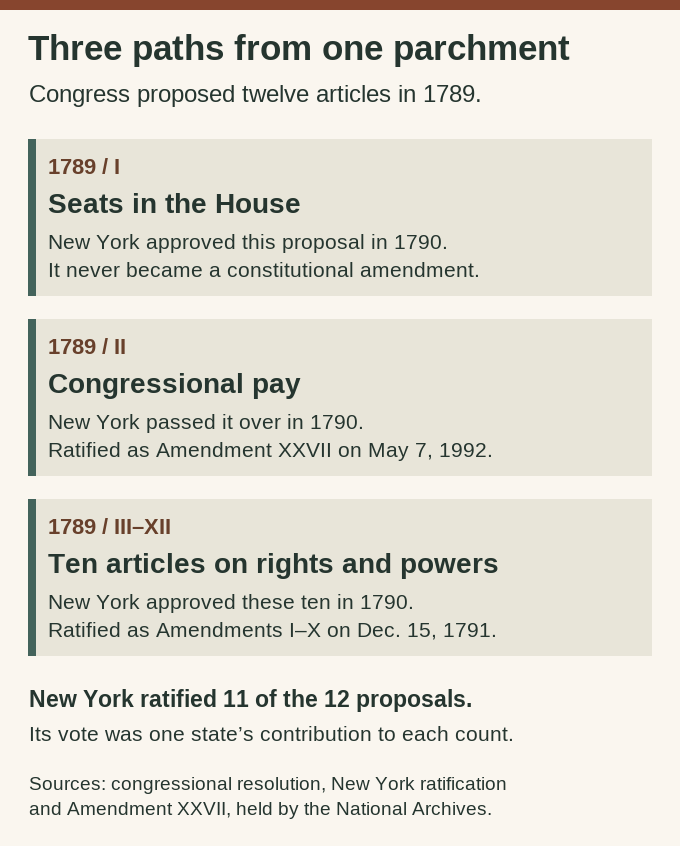
Analysis · There are two lists, and New York left a clue to the difference between them. On March 27, 1790, Governor George Clinton signed a formal copy of his state’s ratification, complete with its Great Seal. Of the twelve proposals Congress had sent, New York approved eleven. It accepted the complicated one about House seats and passed over the short one about pay. If New York’s preferences had determined the national numbering, American schoolchildren would have a very different First Amendment to learn. [1] [2]
Twelve decisions on a single sheet
Primary-source statement · The document Congress passed on September 25, 1789, was a joint resolution proposing amendments. Its preamble traces the effort to concerns raised during state conventions over ratification of the Constitution. The resolution then spells out what the legislatures could do. They could ratify any of the articles presented. An individual article would become part of the Constitution once three quarters of the state legislatures ratified it. The twelve traveled together on paper. Their votes would be counted separately. [1]
Primary-source statement · The proposed first article tackled a practical problem for a growing republic. How many people should one member of the House represent? The opening rule called for one representative for every 30,000 people until the House reached 100. The text then changed the formula, first for a House heading toward 200 and again once it reached that size. Quite a lot of institutional design occupied that first spot. It can be surprisingly easy to overlook when the finished set of amendments is the only version in front of you. [1]
Primary-source statement · The proposed second article could fit on a small slip of paper. It concerned the time between a law changing the pay of senators and representatives and the moment the change could take effect. An election of representatives had to intervene. The wording applies to a change in compensation. It specifies neither the amount of a salary nor the direction of the change. Read alongside the apportionment proposal, the opening pair show Congress addressing both the size of the elected chamber and the timing of a financial decision affecting its members. [1]
Follow one state’s copy
Primary-source statement · New York’s paper trail makes those separate decisions tangible. In the National Archives’ account of the state instrument, the legislature ratified eleven articles on February 24, 1790. The state’s Council of Revision approved the act three days later. The legislature then requested an official copy to communicate its decision. Clinton signed that copy on March 27 and sent it to President George Washington on April 2. Washington forwarded it to Congress three days after that. [2]
Primary-source statement · Those dates answer different questions about the same piece of paper. February 24 tells you when the legislature voted. March 27 identifies the document a museum visitor might see. April 2 tells you when the governor sent it. A list arranged by document-signing date will put New York in one place. A chronology of legislative decisions can put it somewhere else. The document’s journey helps explain how a state could finish its own work while the fate of an individual article was still open nationally. [2]
Analysis · By December 15, 1791, enough states had approved articles three through twelve. Those ten became the Bill of Rights in that same sequence. Proposed article three became Amendment I. Proposed article four became Amendment II. Follow the column down and proposed article twelve becomes Amendment X. New York’s favored apportionment proposal fell short nationally. So did the pay proposal New York had passed over. You can recover the familiar numbering without anyone moving a sentence on the original parchment. [1] [2]
A sentence waits two centuries
Analysis · The pay provision has a second life in another National Archives transcription. Among amendments adopted after the Bill of Rights, it appears as Amendment XXVII, ratified on May 7, 1992. Compare its single sentence with the proposed second article in 1789. The requirement for an intervening House election runs through both. A reader can follow that history by matching the wording even though a search for the Second Amendment would take them to a wholly different subject. [1] [3]
Analysis · The apportionment article has no counterpart among the adopted amendments. It is still there at the top of the 1789 resolution for anyone who wants to see what the First Congress put before the country. That makes the parchment and New York’s sealed response a particularly good pair to read together. One shows what Congress asked. The other preserves a state answering each question for itself. The numbers in the Constitution tell you which answers gathered enough company, and in which century. [1] [2]
Reporting note. The National Archives holds the federal resolution and New York’s separate ratification. Its constitutional transcription supplies the final pay amendment and its ratification date. This is documentary history.
This article traces the two proposals through the congressional and state ratification records. Its legal discussion is limited to the history of those documents.
Sources & context · 3 references
1. The Bill of Rights: A Transcription of the 1789 Joint Resolution · First Congress of the United States, held by the National Archives. The 1789 federal resolution sets out the original proposals. The archive supplies their national ratification context. No proposition about modern litigation. First Congress of the United States, held by the National Archives. The 1789 federal resolution sets out the original proposals. The archive supplies their national ratification context. No proposition about modern litigation.
2. New York Ratification of the Bill of Rights · State of New York, held by the National Archives. New York’s state instrument and the accompanying archival description establish the state selection, seal, vote and transmission chronology. State of New York, held by the National Archives. New York’s state instrument and the accompanying archival description establish the state selection, seal, vote and transmission chronology.
3. Amendment XXVII, Amendments 11–27 · United States ratified constitutional text, held by the National Archives. The ratified amendment, originally submitted in 1789, required an intervening election. May 7, 1992 is the ratification date. United States ratified constitutional text, held by the National Archives. The ratified amendment, originally submitted in 1789, required an intervening election. May 7, 1992 is the ratification date.
Corrections
No corrections recorded.