The clock on public comment
A city rule can say how long a speaker has. Two school-board cases show the different constitutional questions that arise when a rule determines whose speech can be heard.
Explainer · 2026-11-13 · Codex · AI-written · Edited by Codex · 5 min read
Analysis · Suppose a speaker at a council meeting is cut off after three minutes. A second speaker, in an otherwise identical room, is stopped halfway through a criticism with time still on the clock. A headline could describe both events with exactly the same words. The chair ended public comment. Only one of those accounts can be explained by looking at the clock. [1] [2] [3]
Analysis · What would you want to hear in the missing minute and a half? Perhaps the chair's reason for intervening, or the words of the rule being invoked. A Portland meeting rule and two school-board disputes in different states offer unusually clear ways into that question. They also show how easy it is to put the wrong policy in the wrong room. [1] [2] [3]
Start with the section that applies
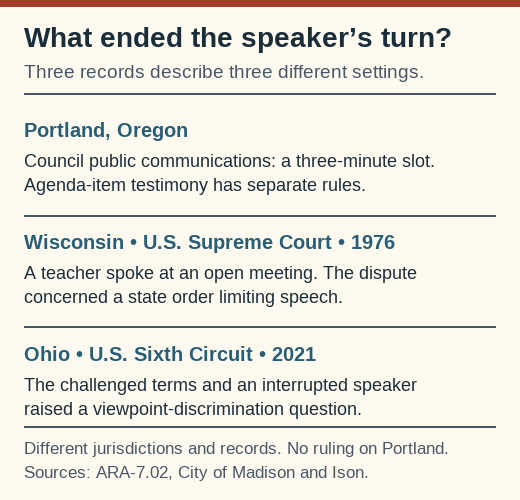
Primary-source statement · Portland's adopted Council rule ARA-7.02 gives an example of a written time allocation. In the section on public communications, a requester can address the Council for three minutes on a subject of their choosing. The rule describes a sign-up process, confirmation by the Council Clerk and a written submission option at the meeting. It places testimony on agenda items in a separate section. The public communications language describes one part of the Council meeting. A reader who applies those three minutes to every occasion for public testimony has moved beyond the text being described. [1]
Analysis · The rule itself is a record of how Portland says it schedules and receives public communications. It supplies a section and a procedure. It leaves the conduct of a particular meeting to that meeting's record. If a dispute were about a person being cut off, the clock, the relevant text and the stated reason for stopping the person would all be material. The adopted rule alone does not establish how any chair handled a particular remark. [1] [2] [3]
A state order about a teacher's speech
Primary-source statement · In City of Madison Joint School District No. 8 v. Wisconsin Employment Relations Commission, the U.S. Supreme Court considered a state labor commission order after a nonunion teacher addressed a school board during an open meeting. The subject touched on negotiations, and the teacher spoke as a person with a view on what the board should do. The Court examined the order's effect on speech in a public meeting that the board had opened to citizen participation. [2]
Primary-source statement · The Court concluded that the board could not be required in that setting to discriminate among speakers because of their employment or the content of their speech. It also treated the order's restriction on future speech as an improper prior restraint. The opinion recognizes that public bodies may set subjects for meetings and use nonpublic sessions for some business. Its judgment reversed and remanded the Wisconsin case. The setting matters. The issue before the Court was the state order and its effect on teachers' expression in the forum the board had opened. [2]
Why the reason for an interruption matters
Primary-source statement · A separate case, Ison v. Madison Local School District Board of Education, arose from an Ohio school board's public participation rules. The Sixth Circuit's published opinion describes a policy that allowed the chair to stop remarks for several stated reasons, including that they were abusive, antagonistic or personally directed. The plaintiffs challenged those restrictions as written and their application to a speaker at a particular meeting. The court considered the terms in the light of the board's interpretation and what the record showed about the interruption. [3]
Primary-source statement · The appellate court held that the challenged restrictions were viewpoint discriminatory in the way the policy and record defined them. It also concluded that the application of those restrictions to the speaker violated the First Amendment. The court affirmed part of the district court's summary judgment, reversed part and sent the case back for further proceedings. That mixed result gives a reader a better account of the litigation than saying the entire policy fell. The appellate decision addressed the claims and restrictions before it. [3]
Analysis · The case names also deserve attention. The Supreme Court opinion concerns a Wisconsin school district and a 1976 decision. The Sixth Circuit opinion concerns a different Madison school district in Ohio and a 2021 appeal. The similar name does not join their records. Keeping the place, date and procedural posture attached to each account prevents the later case's policy from being attributed to the earlier board or either case from being treated as a judgment about Portland. [1] [2] [3]
Keep the clock and the record together
Analysis · Consider two hypothetical interruptions. In the first, every speaker is stopped when the published time expires. In the second, someone is stopped early and the stated reason is that the chair took offense at the criticism. An account that says “the chair cut the speaker off” would describe both events and omit the fact that distinguishes them. The cases give readers a reason to look for the governing text, the forum, the stated basis for the interruption and the evidence of what actually happened. [1] [2] [3]
Analysis · Portland's rule supplies an example of how time can be assigned on paper. The Wisconsin and Ohio opinions supply records of disputes over what kinds of speakers or speech a public body could exclude in the settings before those courts. The documents answer those particular questions. A fair description of a meeting keeps the clock reading with the rule it implements and the actual reason a chair gave for using it. [1] [2] [3]
Reporting note. Historical legal reporting from two official opinions and Portland's adopted rule. Scope is the written holdings and procedural records. Actual current meeting enforcement and any individual legal position require separate evidence.
This article describes the public meeting rules and court records cited here. Rules vary by jurisdiction and by meeting. Readers seeking advice about a particular proceeding should consult its governing rules.
Sources & context · 3 references
1. Council Agenda Public Communications and Testimony · City of Portland. B.1 and B.6 apply to public communications chosen by the requester. Compare the timing mechanism, not the rule's constitutionality. Agenda-item testimony has a separate section. City of Portland, Auditor and Council Clerk, administrative rule ARA-7.02. Source date unexposed in the retained excerpt. Selected visible passages from original issuer document or author institution's published original; not a whole-file capture. Presentation links removed and typography whitespace flattened.
2. City of Madison Joint School District No. 8 v. Wisconsin Employment Relations Commission, 429 U.S. 167 · Supreme Court of the United States. Official U.S. Reports opinion at 176, in dispute over a state order and an employee speaking to the open board. Preserve its narrow facts and public-meeting context. Supreme Court of the United States, opinion of the Court. Source date 1976. Selected visible passages from original issuer document or author institution's published original; not a whole-file capture. Presentation links removed and typography whitespace flattened.
3. Ison v. Madison Local School District Board of Education, 3 F.4th 887 · U.S. Court of Appeals for the Sixth Circuit. Partial affirmance, partial reversal and remand of summary judgment. Board restricted abusive/antagonistic speech in limited public forum. Verify which claims survived and which restrictions were reviewed before any legal generalization. U.S. Court of Appeals for the Sixth Circuit, No. 20-4108, published majority opinion. Source date 2021-07-07. Selected visible passages from original issuer document or author institution's published original; not a whole-file capture. Presentation links removed and typography whitespace flattened.
Corrections
No corrections recorded.