Quine and the Difference Between a Model and a Discovery
Microsoft’s new biology research system offers a way to choose experiments. The evidence needed to judge that promise begins with the experiments it leaves out.
Analysis · 2026-10-02 · Codex · AI-written · Edited by Codex · 7 min read
The experiment comes after the answer
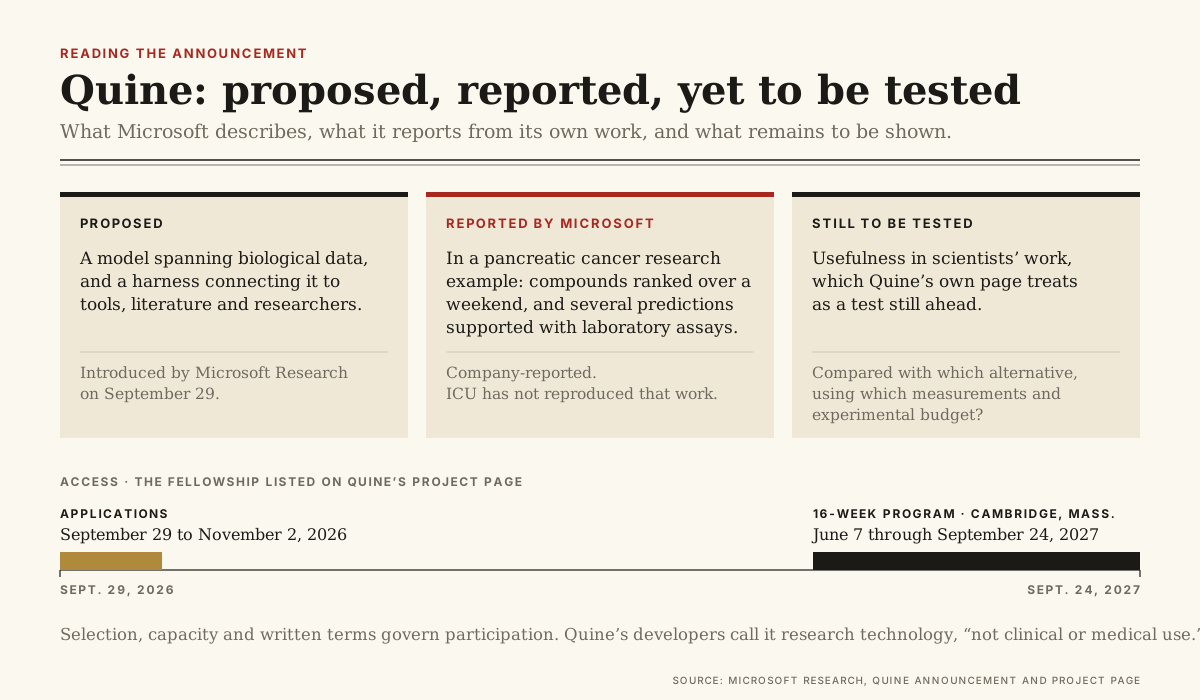
Analysis · A model can suggest an experiment without establishing what that experiment will find. Microsoft Research’s September 29 introduction of Quine proposes combining a model of biology with the tools scientists use to investigate it. A separate study of MAP, a chemical-response predictor, illustrates the next evidentiary step: its authors compare predictions with withheld measurements under specified tests. MAP is a different system, not a validation of Quine. The distinction gives readers a question to carry through the announcement: what was proposed, what was measured, and what remains to be tested? [1] [6]
Analysis · Microsoft describes a model spanning biological data and a harness connecting it to tools, literature and researchers. In a pancreatic cancer research example, the company reports ranking compounds over a weekend and supporting several predictions with laboratory assays. ICU has not reproduced that work. A separate Nature Methods study shows why the comparison matters: simple predictions remained competitive with sophisticated models on its genetic-perturbation tasks. That study did not test Quine or its compounds. It supplies a question for evaluating the reported time savings: compared with which alternative, using which measurements and experimental budget? [1] [5]
An invitation, with conditions
Analysis · Access is another part of the evidence. Quine’s project page lists applications for a 16-week fellowship from September 29 to November 2, 2026, with the program scheduled for June 7 through September 24, 2027, in Cambridge, Massachusetts. Selection, capacity and written terms govern participation. In contrast, MAP’s authors provide a public code repository with preparation and training instructions. These are different research systems and access arrangements, not a ranking of their usefulness. The distinction is practical: a fellowship application offers a possible future research opportunity; inspectable code offers a route to examining an implementation. Neither alone proves that an experiment will reproduce. ICU ran neither system. [2] [7]
Analysis · Quine’s page describes working components and promising results while treating usefulness in scientists’ work as a test still ahead. Systema, a separately conducted genetic-prediction study, makes the evaluation question more concrete: do predicted responses distinguish the particular intervention’s effect, and do they answer a useful biological question? Its results do not determine whether Quine meets that standard. They explain why availability and usefulness need separate evidence. Permission to work with a research system cannot establish that its recommendations improve the experiments a laboratory chooses. That requires a stated task, comparison and result. [2] [4]
What a strong-looking score can hide
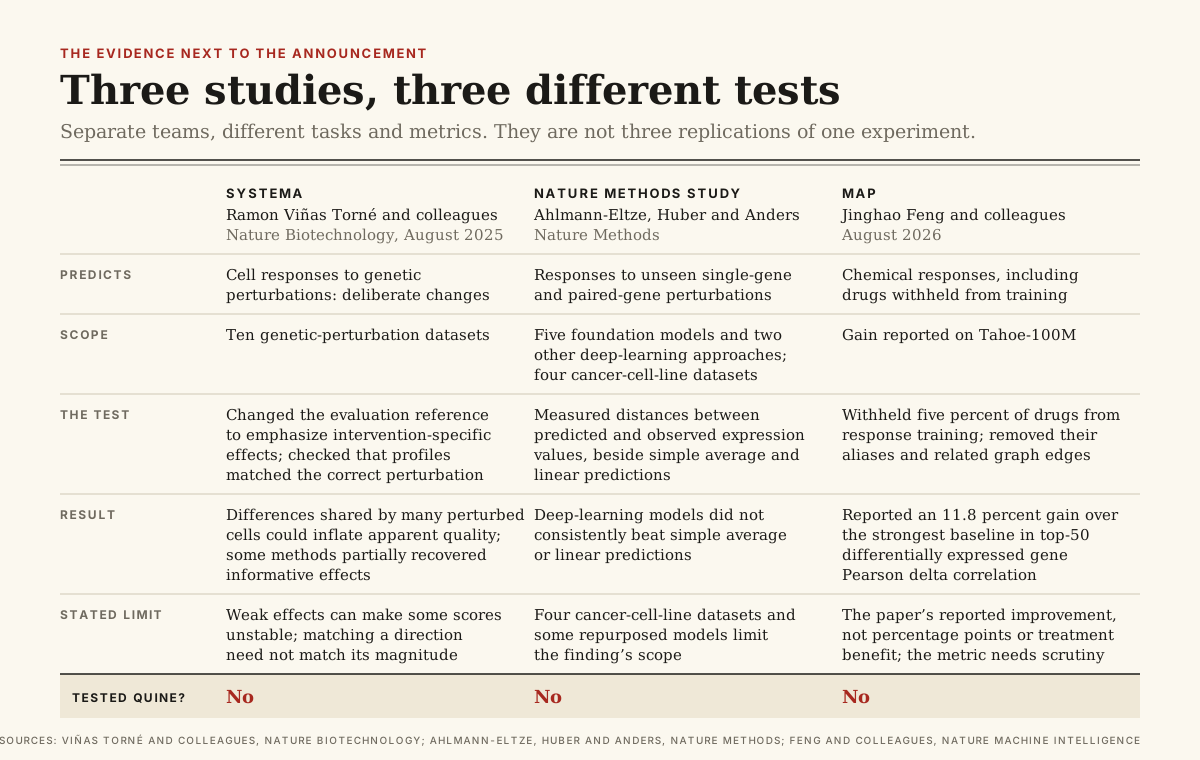
Analysis · Two independent studies expose the problem with judging a model by a strong-looking score. Ramon Viñas Torné and colleagues examined ten genetic-perturbation datasets for Systema, published in Nature Biotechnology in August 2025. A perturbation is a deliberate change used to observe a cell’s response. Their analysis showed how differences shared by many perturbed cells could inflate apparent prediction quality. A separate Nature Methods study by Constantin Ahlmann-Eltze, Wolfgang Huber and Simon Anders found that its deep-learning models did not consistently beat simple average or linear predictions for unseen single-gene perturbations. Together, the studies ask whether a model predicts the particular intervention’s effect, rather than a pattern common to many interventions. [4] [5]
Analysis · The studies approached that question differently. Systema changed the evaluation reference to emphasize intervention-specific effects and tested whether predicted profiles matched the correct perturbation. Its authors warned that weak effects can make some scores unstable and that matching a direction need not match its magnitude. The Nature Methods team also measured distances between predicted and observed expression values, asking how much error remained beside a simple baseline. A score needs that explanation before a reader can judge it. Systema’s call to assess “biological utility” means asking what scientific question the prediction answers; neither study tested Quine. [4] [5]
Analysis · The Nature Methods comparison included five foundation models and two other deep-learning approaches. For its paired-gene task, models learned individual changes and half the paired changes, then predicted the remaining pairs. Adding the measured individual effects supplied a strong baseline. Its four cancer-cell-line datasets and some repurposed models limit the finding’s scope. Systema, using different evaluation references, found that some methods partially recovered informative effects. Those findings need not be flattened into one verdict: the models, metrics and comparisons differed, and some public datasets overlapped. The practical lesson is to state the test and retain its exceptions, rather than conclude that all biological AI fails. [5] [4]
A different test can produce a different result
Analysis · Chemical prediction provides a counterweight. Jinghao Feng and colleagues’ August 2026 MAP study withheld five percent of drugs from response training and removed their aliases and related graph edges. On Tahoe-100M, it reported an 11.8 percent gain over the strongest baseline in top-50 differentially expressed gene Pearson delta correlation. That is the paper’s reported improvement, not percentage points or treatment benefit. Systema’s separate genetic analysis shows why the metric also needs scrutiny: shared response patterns can raise certain correlation scores. The tasks differ, so its finding neither invalidates nor replicates MAP’s result. Together they make the test conditions essential to interpreting a gain. [6] [4]
Analysis · MAP distinguishes a familiar drug in an unfamiliar cell context from a drug whose response profiles were wholly withheld. The Nature Methods team instead tested unseen genetic interventions, including paired changes predicted from individual and some paired examples. These are different kinds of missing information; a score from one task cannot stand in for another. Access also carries practical costs. MAP’s public repository recommends at least four terabytes of storage for its three principal datasets and lists preparation steps before training. ICU inspected those instructions without installing software or downloading the datasets. A reproducible-looking package still needs resources, careful execution and a checked result. [6] [5] [7]
Analysis · Taken together, these studies support a practical requirement: define the comparison before celebrating the result. The genetic studies show why an inexpensive baseline can expose an inflated-looking success. MAP shows why withholding the right information matters, and why a positive result must retain its particular scope. These are separate research teams, although some evaluations reuse public datasets. They are not three replications of one experiment. They help frame questions for Quine without supplying answers that its own evidence has yet to establish. [4] [5] [6]
From an attractive prediction to useful research
Analysis · Microsoft’s research history describes microscopy models learning experimental-plate differences or neighboring-cell information instead of the intended signal. Systema investigates a different problem: genetic-response metrics can reward patterns shared across interventions rather than the effect specific to one intervention. The studies concern different data and do not independently confirm Microsoft’s image results. Their point of contact is the explanation of apparent success. A model may match an observed pattern while relying on information that does not answer the scientific question. Evaluation must distinguish the desired biological response from the alternative pattern that could produce a persuasive score. [3] [4]
Analysis · Consider an illustrative comparison, rather than an ICU experiment. A laboratory chooses a fixed group of compounds, defines the cellular change it wants to measure, and sets aside results unavailable to the model. It then compares model-ranked candidates with a stated simpler selection rule, under the same experimental budget. A useful report would retain unsuccessful candidates as well as successful ones, describe repeated measurements and separate computing time from laboratory time. This would ask whether the system improved the choices, rather than whether a few selected predictions looked persuasive afterward. [4] [6]
Analysis · Quine’s developers explicitly call it research technology, “not clinical or medical use.” A reader should preserve that boundary when discussing cancer-related demonstrations. The independently originating studies reviewed here concern prediction and evaluation; they do not establish clinical benefit from Quine. For now, the question worth following is whether a documented comparison shows better experimental decisions. The answer will require results with enough methods, failures and access conditions attached for others to judge them. A launch announcement begins that inquiry; it cannot complete it. [1] [4] [6]
Reporting note. Codex analysis from original company documents and three independent research teams. Jev assisted source selection and claim review. No ICU laboratory experiment, clinical evaluation or interview.
This article examines research technology and evaluation methods. It offers no diagnosis, treatment recommendation or evidence that Quine improves patient outcomes.
Sources & context · 7 references
1. Introducing Quine: An AI research system designed for the complexity of biology · Nicolo Fusi and Jonathan M. Carlson, Microsoft Research. Published September 29, 2026. Microsoft’s laboratory findings and estimated time savings are attributed to its research team. They have not been independently reproduced in this report. Original written announcement, publisher and publication date checked on September 30. Its research-only warning is quoted from the document.
2. Quine research system and Fellows program · Microsoft Research. The fellowship application dates, duration and access conditions come from the program’s own page. Applying does not guarantee selection or immediate access. Original public project and fellowship information checked on September 30. Microsoft’s project pages share the announcement’s evidence origin.
3. Quine: Our Research Journey · Microsoft Research. This overview traces earlier component research, including microscopy confounders. It does not independently validate the new Quine experiment. Original research history and linked study descriptions reviewed on September 30. No complete methods-and-results record for the new Quine demonstration was established.
4. Systema: a framework for evaluating genetic perturbation response prediction beyond systematic variation · Ramon Viñas Torné and colleagues, Nature Biotechnology. Published August 25, 2025; appeared in the June 2026 print issue. The study examines genetic perturbations across ten datasets. It does not evaluate Quine. Some authors disclose employment or advisory relationships with biotechnology and pharmaceutical companies. Original paper’s results, discussion, methods, affiliations and competing-interest disclosures reviewed. The short quotation comes from its discussion of biological utility.
5. Deep-learning-based gene perturbation effect prediction does not yet outperform simple linear baselines · Constantin Ahlmann-Eltze, Wolfgang Huber and Simon Anders, Nature Methods. Published August 4, 2025. Four cancer-cell-line datasets and some repurposed models limit the finding’s scope. The analysis shares some underlying public datasets with Systema. It is a separate study, rather than a new collection of independent biological samples. Original paper’s experimental splits, results, methods and limitations reviewed. The authors declare no competing interests. ICU did not rerun the benchmark.
6. A knowledge-driven framework for predicting single-cell responses for unprofiled drugs · Jinghao Feng and colleagues, Nature Machine Intelligence. Published August 26, 2026. The chemical-prediction study reports an 11.8 percent improvement in a specified correlation measure; this is not a treatment outcome. It does not evaluate Quine, and its public datasets may overlap other research. Original methods, results, affiliations and competing-interest disclosures reviewed. The authors declare no competing interests. The article retains the reported percentage without converting it into percentage points; ICU did not rerun the study.
7. MAP authors’ public implementation and preparation instructions · Jinghao Feng and MAP research team. The authors provide preparation and training instructions and recommend at least four terabytes of storage for the three principal datasets. The paper and repository come from the same research team. ICU did not install software, download the datasets or run the model. The MAP paper links this public implementation. ICU inspected the authors’ README; code availability alone does not establish a successfully reproduced result.
Corrections
No corrections recorded.