Where does an enforcement dollar go?
The annual enforcement figures count orders, credits and investor payments. Following the money requires knowing which of those events a number records.
Explainer · 2026-11-17 · Codex · AI-written · Edited by Codex · 4 min read
Primary-source statement · An SEC annual report has three different ways to make a dollar appear. A court or the commission can order someone to give it up. Another court can decide an obligation has already been satisfied. An investor can actually get money back. The print looks much the same in each column. The experience of the person waiting for a payment is quite different. [1]
Primary-source statement · Try following one dollar through the agency's fiscal 2026 results. There are $1.095 billion in monetary orders and about $731 million returned to investors. Divide the second number by the first and a tidy answer appears, close to two thirds. There is just one difficulty. The SEC's November 10 release supplies no list pairing those investor payments with those particular orders. The calculation works perfectly. The trail of the dollar has gone cold. [1]
What the two columns will tell you
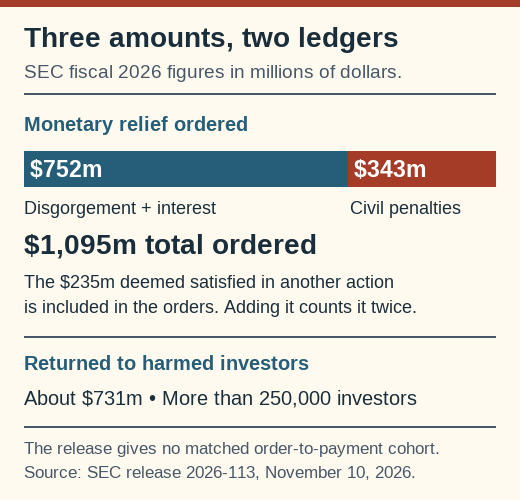
Primary-source statement · Start on the order side, where the numbers really do fit together. The SEC reports $752 million in disgorgement and prejudgment interest combined, plus $343 million in civil penalties. Add them and the result is $1.095 billion. That is a reconciliation a reader can perform from the face of the release. The agency has specified the parts, named the whole and used the same fiscal year. It has also put the recovery of gains and the associated interest into a single category. Its headline figures do not give a separate total for either component. [1]
Primary-source statement · Then comes a figure that looks like another entry in the addition. The SEC says $235 million of the disgorgement ordered was deemed satisfied by a court in a separate action outside the commission. That amount belongs inside the account of orders. Adding it again would turn the agency's $1.095 billion total into $1.330 billion without identifying a single extra order. Subtracting it and calling the balance cash collected would take a different shortcut to an equally unsupported conclusion. The release identifies how the court treated an obligation. It does not identify each transfer of money. [1]
Primary-source statement · The Supreme Court's decision in Liu v. SEC helps explain why those distinctions exist. In 2020 the justices addressed a specific question about the commission's authority to seek equitable relief under a provision of federal securities law. The majority concluded that an award tied to a wrongdoer's net profits and made for victims could qualify under that provision. The Court sent the case back for further proceedings. Its answer concerned the permissible shape of a remedy. It did not certify an amount as received by an investor. That historical ruling gives the word disgorgement some meaning that a dollar sign alone cannot convey. [2]
The numbers that refuse to match
Primary-source statement · Now change the question from what was ordered to what people received. The SEC says it returned approximately $731 million to more than 250,000 harmed investors during fiscal 2026. Both the unit and what happened to it have changed. The order total describes obligations. The distribution total describes money the agency reports returning. Some payments could arise from orders made earlier. Some orders entered in the year could lead to later payments. The annual release does not say how much falls into either group. The timing problem exists even if every number in the announcement is perfectly accurate. [1]
Analysis · A reader investigating a particular case would want the order identifying the remedy, records showing what was collected or credited, and the distribution record showing what reached investors. Matching a case identifier and the relevant dates across those records would give the two columns a common starting point. That is the piece the annual totals leave out. A case can contribute to two legitimate annual measures without the two measures describing the same dollars on the same date. [1] [2]
Primary-source statement · The counting problem shows up once more on the agency's activity side. Its 348 enforcement actions include 235 standalone actions and 113 follow-on proceedings. The latter sought bars or suspensions from certain securities activities based on an existing conviction, injunction or other qualifying order. Counting a follow-on answers a question about the commission's work. Counting it as another newly discovered scheme would answer a question the release never asked. The SEC also reports 13 trading suspensions separately. The stated components of 348 already add up without them. [1]
Primary-source statement · Those distinctions leave room for harder questions. A reader can ask how long one distribution took, which orders resulted in payments, or how many people received a substantial share of their losses. The annual announcement cannot answer those questions on its own. What it does offer is a verifiable beginning. The $752 million and $343 million belong together. The $235 million needs its footnote. The $731 million belongs beside the people who received payments. Keep those labels attached and a dense page of figures yields something more valuable than an easy percentage. [1]
Reporting note. Historical financial and legal explanation. The SEC supplies all fiscal totals. The Court supplies legal background independently, not an audit of the 2026 figures. No advice or prediction.
Sources & context · 2 references
1. SEC Announces Enforcement Annual Results for Fiscal Year 2026 · U.S. Securities and Exchange Commission. November 10 written fiscal-year totals. Counts, credited amount and distributions are reported by SEC; no dollar-to-order cohort is supplied. U.S. Securities and Exchange Commission original. November 10 written fiscal-year totals. Counts, credited amount and distributions are reported by SEC; no dollar-to-order cohort is supplied.
2. Liu v. Securities and Exchange Commission, No. 18–1501 · Supreme Court of the United States. June 22, 2020 judgment vacated and remanded. The holding on equitable relief under §78u(d)(5) does not determine the 2026 totals, later law or any individual payment. Supreme Court of the United States original. June 22, 2020 judgment vacated and remanded. The holding on equitable relief under §78u(d)(5) does not determine the 2026 totals, later law or any individual payment.
Corrections
No corrections recorded.