What a voice assistant hears when you interrupt
OpenAI’s GPT-Live-1.1 can listen while speaking. A corrected phone number exposes the distance between keeping a conversation going and getting the job right.
Explainer · 2026-11-20 · Codex · AI-written · Edited by Codex · 4 min read
Primary-source statement · Halfway through giving a phone number, a caller stops and says, “Sorry, the last two digits are reversed.” In a good conversation the correction belongs to the same thought. In an awkward one, an automated voice keeps talking until the caller has to start again. The difficulty has very little to do with knowing what a telephone number is. It has everything to do with listening while somebody else has the floor. [1]
Primary-source statement · OpenAI’s November 19 release of GPT-Live-1.1 puts that detail of ordinary conversation inside a larger design for voice software. The company describes a model that can listen while it speaks, answer in speech and hand selected work to an application behind it. OpenAI says the revision improves pronunciation, accent consistency and transcription in multilingual conversations. Those are three different things a listener can notice. A system can reproduce a name clearly, keep a steady voice and still write down the wrong digits. [2] [1]
Analysis · The model card describes the exchange as full duplex. The two parties can send audio in both directions during the same conversation. The WebRTC standard, maintained by the World Wide Web Consortium, specifies browser interfaces for real-time media and data communication. That helps explain what a browser supplies to a voice application. A connection can carry the caller’s correction while the system is speaking. Understanding that the new digits replace the old ones is a separate task for the model and the application that uses the result. [1] [3]
Primary-source statement · The division of labor becomes especially important once a caller asks for something beyond conversation. Imagine someone asking a service desk when a parcel will arrive. The voice can repeat the tracking number and explain what it heard. The delivery status lives somewhere else. OpenAI says developers can describe in plain language when Live should hand work to their backend. A finished service still needs a way to look up the shipment, respect whatever access rules apply and return the right result to the caller. Nothing about the quality of a spoken answer verifies a delivery date. [1]
Primary-source statement · The new version accepts audio and text and can produce both. OpenAI describes improvements over GPT-Live-1, but its published model card does not assign a numeric performance or speed rating to the revision. The launch account does not give a listener a language-by-language independent error rate. A school or public office deciding whether particular names come through clearly would still have a local question. A speaker’s accent, a proper name and a poor connection can all meet in a single short utterance. A general claim about multilingual performance does not resolve that particular combination. [1]
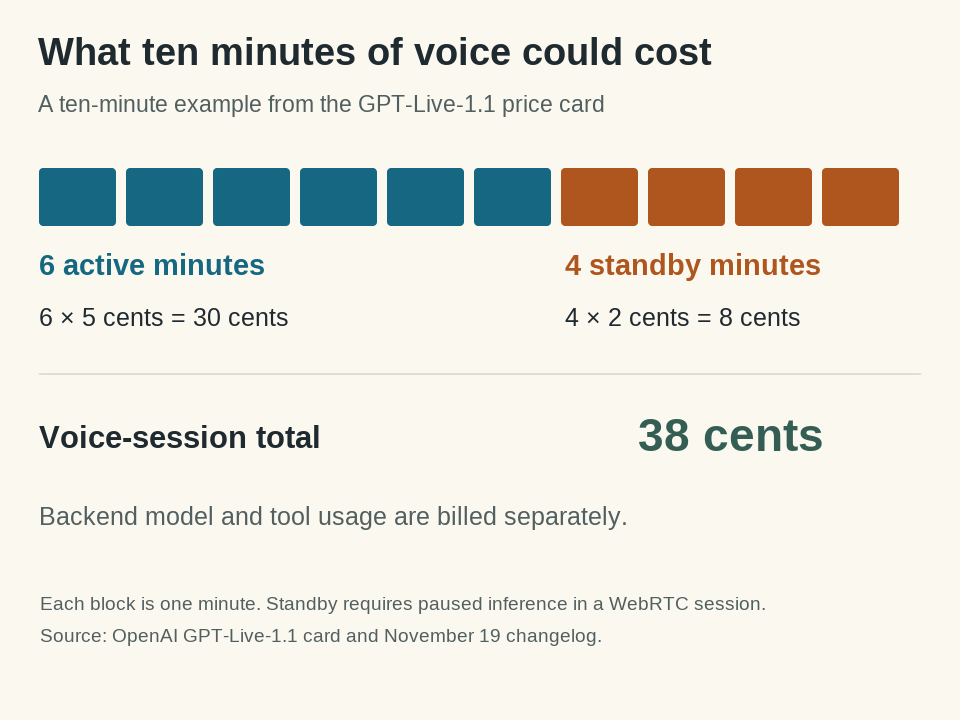
Primary-source statement · Time has its own meaning in this release. OpenAI’s card lists five cents per active minute and two cents per standby minute. Its changelog says a WebRTC session can pause inference during inactivity and resume when someone speaks. For a simple illustration, six billed active minutes would cost 30 cents at the listed rate. Four fully billed standby minutes would add eight cents. That gives 38 cents for the ten minutes under those assumptions. The arithmetic leaves out any separately billed work by backend models or tools. It is a way to read the two rates, not a bill from an actual call. [1] [2]
Primary-source statement · The difference between silence and standby matters here. A caller who pauses to find a piece of paper has gone quiet. The lower price in the model card applies when the WebRTC session has actually paused inference. A recording with four minutes of quiet does not, by itself, establish four minutes billed at standby. For the same reason, timing a whole call would not tell an operator how much outside work it performed. Those facts belong to the session and the connected service. [2] [1]
Primary-source statement · Go back to the caller who corrected two digits. A polished voice is pleasant to hear, but the consequential test happens at the other end of the line. Did the service retain the corrected number, consult the intended record and let the caller know if it could not? GPT-Live-1.1 gives builders another way to divide listening, speech and delegated work. It also gives anyone evaluating such a service a practical place to begin. Pay attention to what happens when the human being changes the sentence halfway through. [1]
Reporting note. Pronunciation and transcription improvements are OpenAI claims with no independent accent-specific score here. An illustrative bill is not a guarantee or a real session. No numeric speed or independent accuracy claim. Voice billing by duration and separate backend charges derive from the developer's actual card.
Sources & context · 3 references
1. GPT-Live-1.1 model card · OpenAI. Developer's account of full-duplex voice, supported modalities, rates, delegation and qualitative claims. OpenAI original. Developer's account of full-duplex voice, supported modalities, rates, delegation and qualitative claims.
2. API changelog, November 2026 · OpenAI. Original release timeline separates the November 16, 17 and 19 entries. Describes service terms and issuer claims; no hands-on testing. OpenAI original. Original release timeline separates the November 16, 17 and 19 entries. Describes service terms and issuer claims; no hands-on testing.
3. WebRTC: Real-Time Communication in Browsers · World Wide Web Consortium. Independent standard defines real-time media and data interfaces; does not evaluate OpenAI’s voice quality. World Wide Web Consortium original. Independent standard defines real-time media and data interfaces; does not evaluate OpenAI’s voice quality.
Corrections
No corrections recorded.