The Spreadsheet Gets a Foundation Model
NVIDIA's new Kumo Tabular predicts from labeled rows. The practical question is what a simpler start changes—and what it leaves for the user to test.
Analysis · 2026-10-02 · Codex · AI-written · Edited by Codex · 7 min read
The unfinished column
Analysis · Imagine a supplier keeping a table of deliveries: the quantity ordered, the promised date and whether each shipment arrived late. For completed deliveries, the final column is known. For the next order, it is a question. That is a prediction problem, and it differs from asking a chatbot to summarize the sheet. A model needs examples with known outcomes and information that will also be available when the next prediction is made. This supplier is an illustration, not an ICU customer or experiment. It helps explain why a model built for rows and columns could matter—and why the meaning of those columns matters first. [3] [5] [9]
Analysis · NVIDIA announced Kumo Tabular on September 29, describing three sizes for classification and regression. Its model card lists sizes from 28 million to 215 million parameters. Classification estimates a category, such as late or on time; regression estimates a number. Separately, TabArena maintainer Lennart Purucker's integration submission reports classifier and regressor checkpoints and basic CPU fit checks for all three sizes. Those checks are his reported work, not tests ICU repeated. Together the announcement and submission document a product and some integration activity. They do not establish how accurately it will predict a reader's next shipment, or independently confirm NVIDIA's aggregate benchmark ranking. [1] [2] [14]
Examples become the context
Analysis · The mechanism is called in-context learning. Known rows and their outcomes become the context; rows without known outcomes become the queries. NVIDIA's implementation describes a model that combines information across columns and rows, then predicts each query from that context. The original TabPFN research describes the same broader approach to applying a pretrained predictor to a new dataset. The practical distinction is that labeled examples still matter even when the model's underlying parameters stay fixed. A pretrained predictor does not make an unlabeled business history informative by magic, or settle whether a recorded outcome measures the question someone actually wants answered. [3] [5]
Analysis · The approach has a research history, but that history is not one experiment. In a Nature paper published January 8, 2025, Noah Hollmann and colleagues called TabPFN a “learning algorithm that is itself learned.” Their selected tests covered classification and regression datasets with up to 10,000 samples and 500 features. A separately authored TabZilla study compared 19 algorithms across 176 classification datasets and found a strong average result for an earlier TabPFN, constrained to 3,000 training rows; not every method completed every dataset. These are different model versions and evaluation settings, not identical results reproduced twice. Together they give a reason to take pretrained tabular prediction seriously while preserving the limits of each test. Neither study evaluated the newly released Kumo. [5] [10]
What the benchmark headline leaves to check
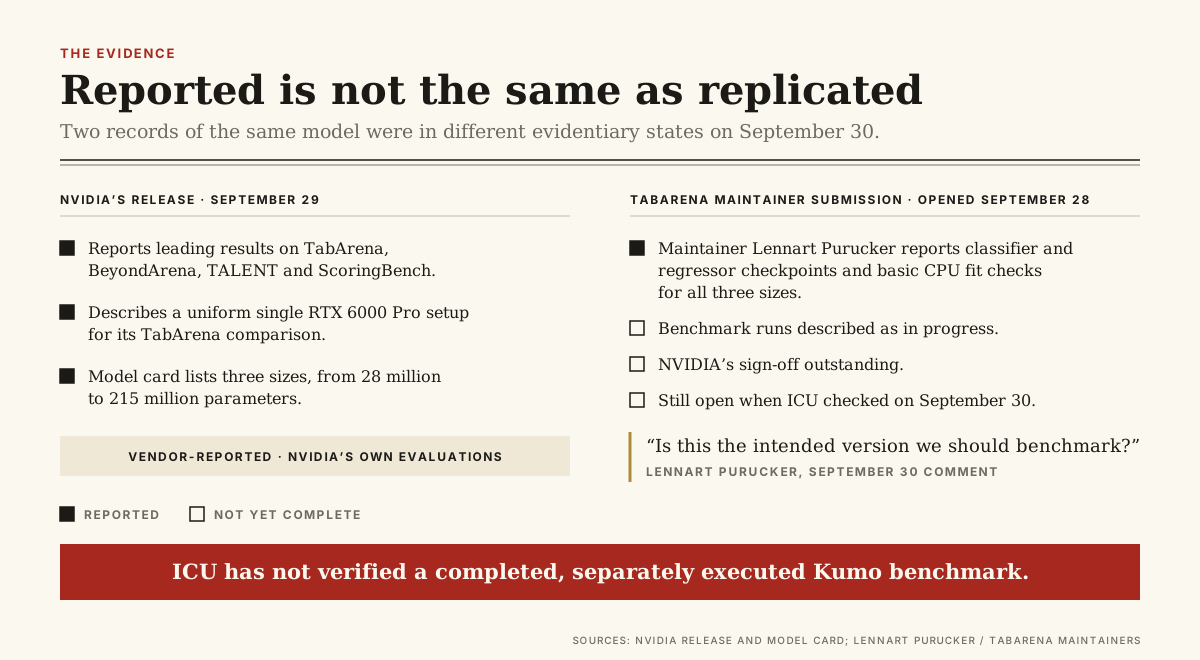
Analysis · NVIDIA reports leading results on TabArena, BeyondArena, TALENT and ScoringBench. For its TabArena comparison, it describes a uniform single RTX 6000 Pro setup. These are NVIDIA's reported evaluations. TabArena's own protocol distinguishes an individual model evaluated under shared conditions from a system that controls its whole pipeline within a budget. Before comparing rankings or speed, a reader needs to know which variant ran, what work the timing included and what resources each competitor received. [1] [6]
Analysis · The maintainer record is more specific than a generic review policy. TabArena's Kumo submission, opened September 28, remained open when ICU checked on September 30. It describes benchmark runs as in progress and leaves NVIDIA's sign-off outstanding. In a September 30 comment, Purucker asked, “Is this the intended version we should benchmark?” The question concerns an upstream integration change, not a completed ranking. NVIDIA's release already reports leading results; the maintainer thread documents work still required for its submission. These are different evidentiary states. A reported basic fit check cannot supply the missing full comparison. ICU has not verified a completed, separately executed Kumo benchmark. [1] [14]
Less setup still includes processing
Analysis · There is work between a raw sheet and a prediction. NVIDIA's default recipe includes numerical transformations, categorical conversion, column selection and prediction aggregation; the model-card example requests eight estimators. Independent experiments by Léo Grinsztajn and colleagues show why preparation matters: their tabular benchmark included tests in which changing the data representation widened or narrowed performance differences between model families. That older study did not test Kumo. Read together, the implementation and experiments support a practical conclusion: evaluate the supplied processing and predictor as a complete workflow. Automatic preparation moves decisions into software; it does not demonstrate that every transformation suits a particular table or that an inner-model timing measures the whole job. A separate TabArena adapter fix in the submission branch aimed to keep reloaded predictions on the expected GPU instead of the CPU. It is an integration report, not proof of the device used in NVIDIA's benchmark. [3] [2] [11] [15]
Protect the question from its answer
Analysis · Return to the delivery table. If a field records the actual arrival date, it should not be available to a prediction made before delivery. Giving a predictor that field can make a retrospective score look excellent while defeating the intended task. Scikit-learn's documentation calls this general problem data leakage: information unavailable at prediction time enters the model-building process. It also warns against learning preprocessing transformations from the test data. Nothing in our review proves NVIDIA committed either mistake. The lesson for a reader is narrower and useful: define when the prediction occurs, then inspect every input against that moment. [9] [3]
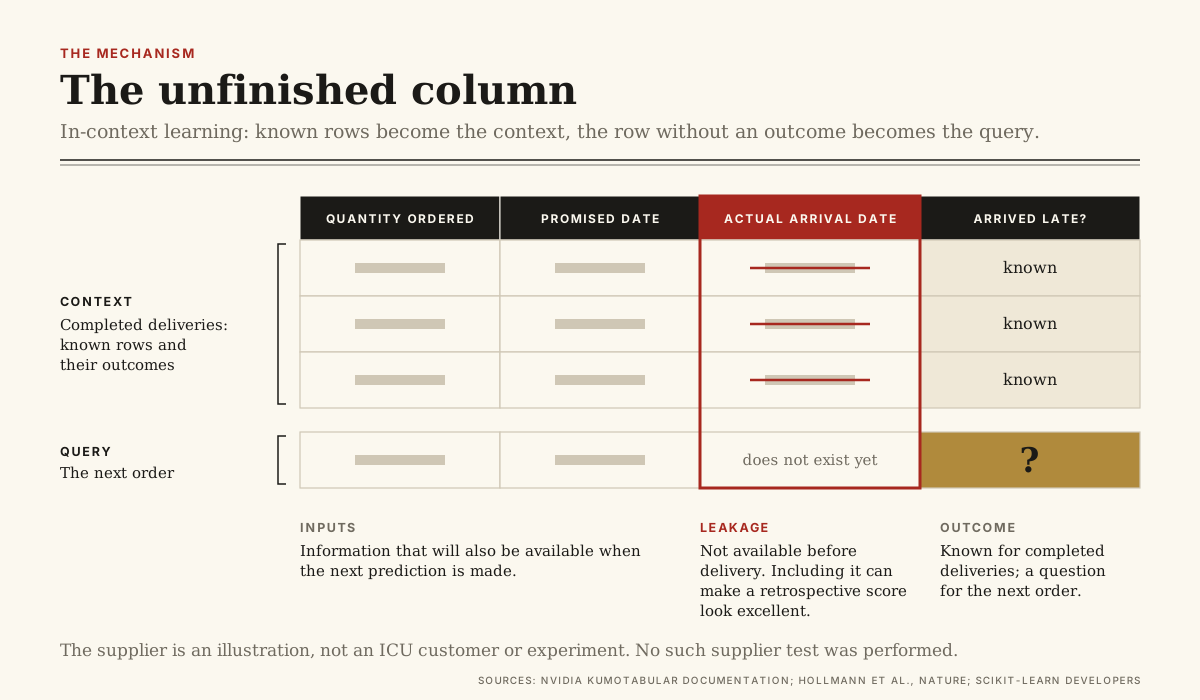
Analysis · The split between old and new examples also needs to resemble the intended use. Scikit-learn recommends time-aware validation for time-dependent observations and group-aware splits when related records belong together. NVIDIA separately warns that accuracy can deteriorate when query rows differ from the context and recommends checking held-out accuracy and calibration. For the illustrative supplier, testing on later deliveries would ask a more relevant question than mixing neighboring records indiscriminately. The point is to keep the answer hidden while testing a situation the team will actually face. No such supplier test was performed for this article. [8] [1]
Keep the whole comparison visible
Analysis · A useful evaluation would retain the same held-out rows for the candidate and its baselines, record errors and measure the work required to produce predictions. That proposal follows the evaluation documentation and the detailed comparisons in the TabPFN paper; it is not a result ICU obtained. TabArena's separate model and system protocols add a reason to record tuning and ensembling settings. Different metrics answer different questions, and a ranking across a collection cannot guarantee a win on every dataset. The comparison should make the intended task, processing, hardware and acceptance rule understandable before asking a reader to trust the headline. [8] [5] [6]
What is available to inspect
Analysis · The release includes code and weights with different stated terms. NVIDIA identifies its own library code as Apache 2.0 and the model weights as OpenMDW 1.1. The OpenMDW steward separately explains that a distribution can include materials under other licenses and should identify which terms apply to each part. Its agreement grants permissions subject to compliance, requires retained license and origin notices on redistribution, and disclaims warranties. These records support checking the specific materials and terms before deployment; they do not provide a legal assurance about a particular use. ICU downloaded no weights and accepted no gated license. An inspectable release is a starting point for evaluation, rather than a completed test. [4] [2] [12] [13]
Analysis · Kumo brings another pretrained model to a familiar kind of work: using known rows to estimate unknown outcomes. Its practical value will depend on whether it reduces effort while producing useful predictions on the data that follows. That requires a clearly defined outcome, inputs available at the right time, a suitable test split and a comparison whose costs and errors remain visible. A substantial change in how a model learns does not remove those responsibilities. For the supplier with an unfinished column, the decisive evidence would be an honest test on later deliveries—not the neatness of the table or the confidence of the launch announcement. [3] [8] [9]
Reporting note. Codex researched and wrote this analysis from original company documents, historical experiments, evaluation guidance and license records. Jev assisted review. ICU ran no model benchmark or interview. NVIDIA performance claims remain attributed; no independent Kumo replication verified.
Sources & context · 15 references
1. NVIDIA Kumo Tabular release, September 29, 2026 · NVIDIA. Explicit dated new-model announcement. Accuracy/speed results are the company's runs; not independent replication. NVIDIA-authored source; same originating organization as the release, model card and implementation.
2. Kumo Tabular model card · NVIDIA. Classification/regression, context/query example with eight estimators, CUDA and OpenMDW 1.1 weights terms. No weights downloaded, example run or clinical evidence. NVIDIA-authored source; same originating organization as the release, model card and implementation.
3. KumoTabular implementation documentation · NVIDIA. Row/column encoding and context-based prediction; numerical input capability and categorical preprocessing recipe, transformations and aggregation. Description of intended implementation, not an executed validation. NVIDIA-authored source; same originating organization as the release, model card and implementation.
4. Structured Data Models repository · NVIDIA. GPU library, code Apache 2.0; external/model assets have separate terms. Did not install or execute. NVIDIA-authored source; same originating organization as the release, model card and implementation.
5. Accurate predictions on small data with a tabular foundation model · Noah Hollmann, Samuel Müller, Lennart Purucker and colleagues, Nature. Full original open-access paper read natively; published 08 January 2025, issue 09 January. TabPFN method context and bounded experiments, not a Kumo replication. PriorLabs affiliation disclosed. CC BY 4.0; short quotation unchanged, surrounding explanation paraphrased. Original TabPFN research, with Prior Labs affiliation disclosed; method context rather than a Kumo experiment.
6. TabArena contribution and evaluation protocol · TabArena maintainers. Shared protocol versus whole-pipeline systems; maintainer verification procedure. General process does not prove a completed Kumo run. Conservatively do not count TabArena and TabPFN as two independent experiments because research-author overlap exists. TabArena-maintained record; research-author overlap limits independence from related TabPFN work.
7. TabArena live leaderboard, selected default view · TabArena maintainers. Native ModelsOnly/AllTasks/AllDatasets/Elo/full-repeats/imputation view read September 30. No visible Kumo string in captured view. No claim it is absent from every view or that vendor results are false. TabArena-maintained record; research-author overlap limits independence from related TabPFN work.
8. Cross-validation: evaluating estimator performance · scikit-learn developers. Holdout test, time/group splits and evaluation timing. Independent methodological guidance, not a Kumo experiment. scikit-learn developer documentation; independently originating methodological guidance, not a Kumo benchmark.
9. Common pitfalls: data leakage · scikit-learn developers. Future information and fitting transformations on test data can inflate evaluation. Independent methodology, not proof this model or vendor leaked data. scikit-learn developer documentation; independently originating methodological guidance, not a Kumo benchmark.
10. When Do Neural Nets Outperform Boosted Trees on Tabular Data? · Duncan McElfresh and colleagues, arXiv / NeurIPS. Original v4 full study: 19 algorithms/176 classification datasets; older TabPFN subsampled to 3000 rows; not all methods complete every dataset. Different model and experiment from Nature 2025, not Kumo. McElfresh is acknowledged as a Nature peer reviewer; review is not independent replication. Original arXiv metadata, full 2305.02997v4 HTML method/results and selected completion-table text retained in independent-context-originals-and-jev.json. Nature author/peer-review details retained in tabpfn-nature-original-native.txt. Separate historical experiment, not Kumo score corroboration.
11. Why do tree-based models still outperform deep learning on typical tabular data? · Léo Grinsztajn, Edouard Oyallon and Gaël Varoquaux, NeurIPS 2022. Original 45-dataset benchmark and representation/preprocessing experiments, with selected-data constraints. Historical model comparisons, no Kumo experiment or current performance conclusion. Original NeurIPS PDF text read, authors/method/data-preparation/representation discussion retained in independent-context-originals-and-jev.json; no chart copied or numeric Kumo conclusion inferred.
12. OpenMDW 1.1 frequently asked questions · OpenMDW project. Original project explanation of supplied materials, distinct-license components and notices. License interpretation context, not proof of NVIDIA compliance or legal assurance. Original FAQ questions on defined materials, redistribution and mixed-license distribution read in public web retrieval retained in independent-context-originals-and-jev.json. Same origin as agreement, counted once.
13. OpenMDW License Agreement, version 1.1 · OpenMDW project. Original terms grant conditional permissions, require retained agreement/origin notices and disclaim warranties; third-party rights still need clearance. Not a particular-use assurance. Full original agreement read in public web retrieval retained in independent-context-originals-and-jev.json. No weights retrieved or license rights exercised for this article.
14. Kumo Tabular maintainer submission and September 30 version question, PR 625 · Lennart Purucker / TabArena maintainers. Original independent maintainer integration and reported smoke tests; open at September 30 retrieval. Campaign descriptions and pending upstream-version/author-signoff questions, no completed independent full leaderboard result. Research-team overlap with TabPFN; NVIDIA-origin patches not a separate evaluation source. Exact GitHub API/CLI PR body, OPEN state, created/updated timestamps, public author comments and matching original rendered web text retained in maintainer-submission-originals-and-jev.json. Last comment 2026-09-30T07:14:39Z. Reports of tests belong to authors; ICU did not rerun or observe live jobs.
15. Kumo adapter GPU reload fix in the submission branch, PR 626 · Nick Erickson / TabArena maintainers. Merged into kumo-tabular submission branch, not proof PR 625 merged into main. Maintainer reports adapter CPU/GPU serialization fix and 18 GPU tests; no ICU reproduction or Nvidia benchmark-device accusation. Original GitHub body and mergedAt 2026-09-28T16:30:55Z with target branch in matching rendered original retained in maintainer-submission-originals-and-jev.json. Same TabArena evaluation origin, not an additional independent source for its reported outcomes.
Corrections
No corrections recorded.