The date at the end of the Greenland agreement
An agreement, an agenda item and a parliamentary announcement each answer a different question. The agreement gives a fourth document the last word.
Explainer · 2026-11-20 · Codex · AI-written · Edited by Codex · 5 min read
Primary-source statement · Suppose someone asks you to circle the day the Greenland defense agreement took effect. September 22 looks irresistible. There it is in the closing lines, alongside New York and the names of the three languages in which the agreement was made. Now move your finger up one sentence. The governments chose how to determine when the agreement would take effect. To find it, they send you looking for an entirely different piece of paper. [3]
Primary-source statement · A second date has an equally good claim on your attention. On November 19, Denmark’s parliament announced its consent, and the news was important enough in its own right. Greenland’s legislature had already approved the agreement. Anyone keeping score could put a check beside both names. Yet the Danish announcement shifts tenses at just this point. The votes are things the parliaments have done. Sending an official notice to the United States is something the government can now do. An entire diplomatic step fits inside that little verb. [1]
Start with the signature page
Primary-source statement · What, then, does September 22 settle? The text published by the White House identifies the agreement made in New York that day by the United States and the Kingdom of Denmark together with Greenland’s government. It amends and supplements the 1951 agreement concerning Greenland’s defense. The distinction matters even before you get to a date. A reader who pulls only the 1951 text will miss the changes. A reader who pulls only the 2026 text will encounter references whose meaning is partly supplied by the earlier agreement. The parties left a list of related instruments in an annex. [3]
Primary-source statement · The closing lines say the agreement was made in English, Danish and Greenlandic. They also specify which version prevails if the versions conflict or their meaning is ambiguous. For that purpose the parties selected English. There is a practical reading lesson in those lines. To check what the governments agreed about a disputed phrase, start with their published text. To check what a particular legislature did with that agreement, open its proceedings. The first document can settle a question about wording while leaving a question about votes wide open. [3]
Find item 249
Primary-source statement · On the Inatsisartut website, the most useful directions are almost comically short. Open the agenda for the nineteenth meeting day of Greenland’s parliament. Look for item 249. The entry gives October 12 for the first reading and November 3 for the second. Beneath the dates sits a single Danish word, Vedtaget, meaning adopted. The long title immediately below identifies the motion about Greenland entering into the agreement amending the 1951 arrangements. Other items on the same agenda also say adopted. The item number and title are what attach this particular decision to the right piece of business. [2]
Analysis · That small block of type gives Greenland’s decision an identity of its own. A person reading only the subsequent announcement in Copenhagen could learn that Greenland had approved the agreement. Someone who opens item 249 can see the legislature’s record of the proposal, both reading dates and the result. The heading at the top of the agenda even gives an hour for the meeting. It does not give an hour for the vote on item 249. Using the meeting’s start time as the time of adoption would manufacture a precision the record never offered. [2] [1]
Primary-source statement · Denmark’s Folketing supplies a different record. Its November 19 announcement reports consent at the second reading. The parliament says the government could then send the United States an official communication about the two approvals. Imagine clipping off the bottom of the announcement just after the sentence reporting the vote. You would still have good evidence of Denmark’s decision. You would have lost the sentence that tells you what the government expected to happen next. Restoring it adds an important fact about the process. It still leaves you looking for the communication itself. [1]
Read the condition all the way through
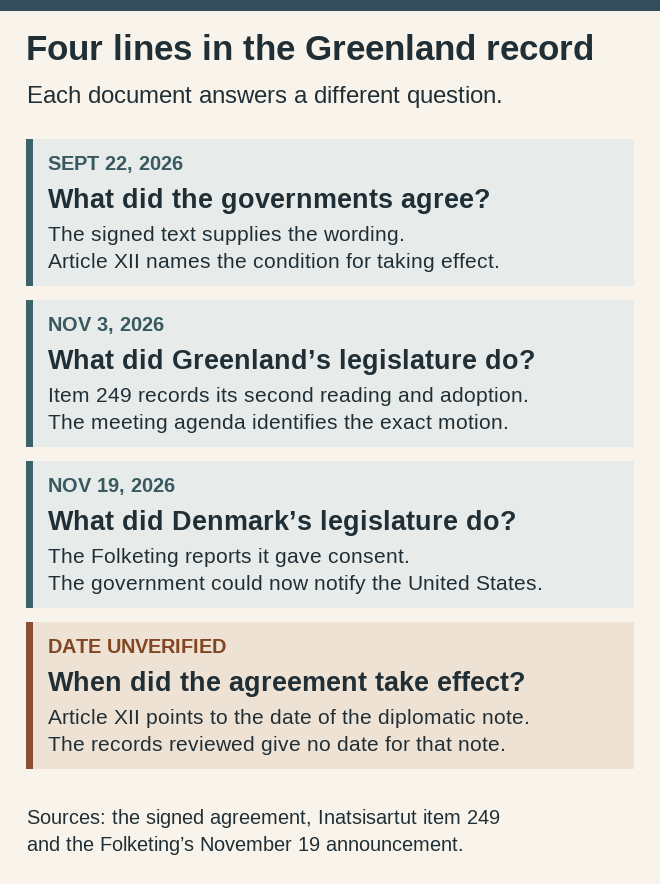
Primary-source statement · Article XII specifies what that communication is for. The Kingdom of Denmark, together with Greenland, must inform the United States that the required parliamentary steps are complete. The agreement ties entry into force to the date on that diplomatic note. The object of the sentence is quite precise. The notice concerns completed parliamentary procedures. The date identified is the date of the note. The agreement does not tell the reader to use the date of the last vote, the date its text appeared online, or the date of a later newspaper account. None of the three documents examined here identifies the date of that diplomatic note. [3]
Primary-source statement · What difference could such close reading make outside a parliament? Consider a Greenlandic company interested in supplying goods or services. The agreement directs the United States to place covered commercial contracts with Greenlandic sources to the extent possible, taking account of those suppliers’ capabilities and whether they can carry out the contracts. Those qualifications belong in the account a business owner reads. They describe how the parties framed an obligation. The clause identifies no winning company, names no contract price and supplies no award date. A business looking for that kind of answer would need a procurement record for an actual award. [3]
Analysis · There are three dates you can safely write on the folder. New York, September 22, belongs to the agreement. November 3 belongs to the Greenlandic parliament’s adoption of item 249. November 19 belongs to the Danish parliament’s consent. A fourth line can say exactly what would fill it, the date of the diplomatic note specified in Article XII. Leaving that line open records something more informative than a guess. It tells the next reader where the paperwork has taken us and which piece of paper could take us further. [3] [2] [1]
Reporting note. Documentary explainer based on the joint text, Greenland’s agenda and Denmark’s parliamentary announcement. The diplomatic note that would date entry into force was outside the reviewed record.
Sources & context · 3 references
1. Folketinget godkender aftale om forsvaret af Grønland · Danish Parliament. Folketing reports the date, second reading and consent, and says a notification could now be sent. The issuer does not give its date. Folketinget original. Folketing reports the date, second reading and consent, and says a notification could now be sent. The issuer does not give its date.
2. Inatsisartut, November 3 meeting agenda, item 249 · Inatsisartut. Item 249 links the second reading and adoption to the particular motion; the 10:00 meeting start is not a vote timestamp. Inatsisartut original. Item 249 links the second reading and adoption to the particular motion; the 10:00 meeting start is not a vote timestamp.
3. Agreement amending and supplementing the 1951 Defense of Greenland agreement · The White House. Instrument identifies amendment and supplementation of the previous agreement, language precedence, supplier conditions and the diplomatic-note condition. United States, Denmark and Greenland original. Instrument identifies amendment and supplementation of the previous agreement, language precedence, supplier conditions and the diplomatic-note condition.
Corrections
No corrections recorded.