An authenticated email can still ask for the wrong thing
SPF, DKIM and DMARC answer questions about domains and message handling. The request inside an email still needs a reason to be trusted.
Explainer · 2026-10-30 · Codex · AI-written · Edited by Codex · 5 min read
Primary-source statement · A message can pass an authentication check without establishing that its payment instructions are honest. That boundary is built into the email standards. RFC 9989, the May 2026 Standards Track DMARC specification, explicitly leaves content analysis outside its scope. It also excludes authentication of people rather than domains. The result is useful, but narrower than an everyday reading of the word authenticated: a successful check is not an endorsement of the story, attachment or business request carried by the message. [2]
Primary-source statement · NIST separates these problems in its February 2019 Trustworthy Email guidance. Its account of sending-domain authentication covers SPF, DKIM and DMARC. Other sections address protection of messages during transmission and protection of their contents. The division matters because a message takes several steps between a sender and a reader. A control at one step answers a particular question; it does not automatically supply the protections discussed in the other sections. [1]
Primary-source statement · SPF starts with the system delivering a message. A domain publishes information in the Domain Name System about which systems are authorized to send mail using its identity. A receiving mail server can compare that policy with the sending system. In NIST’s explanation, this concerns the domain used in the mail-transfer exchange. That identity is not necessarily the same address that an email application prominently displays to its reader. [1]
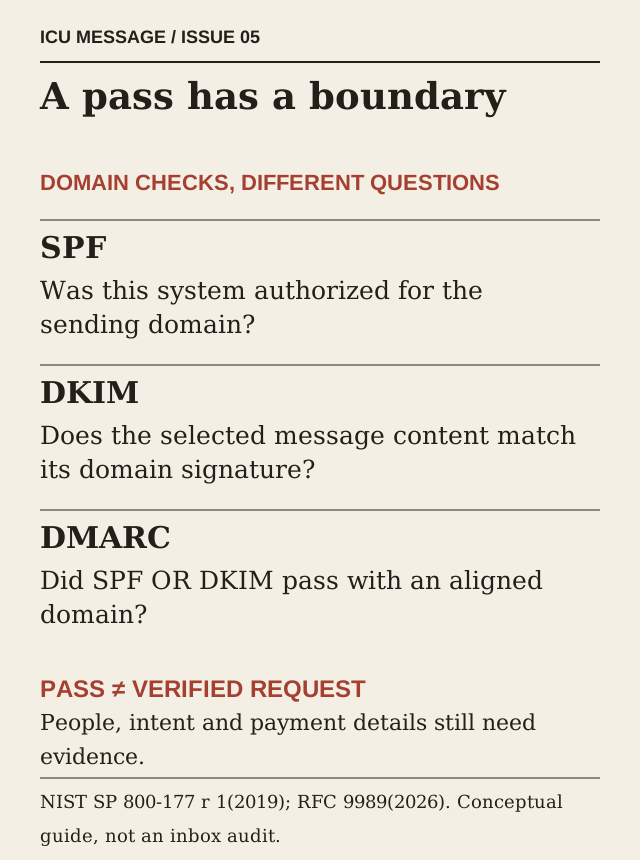
Primary-source statement · DKIM takes another route. A sender signs selected parts of a message using a private key. The receiving system obtains a corresponding public key through DNS and checks the signature. NIST describes this as a way for a domain to take responsibility for a message. It can also support an authorized outside service sending on an organization’s behalf. Successful verification therefore concerns the signature and its signing domain, rather than the personal judgment of everyone who appears in the message. [1]
Primary-source statement · DMARC connects the authentication result with the domain in the visible From address, called the Author Domain in RFC 9989. The specification calls this identifier alignment. At least one supported mechanism must both pass and produce an aligned domain identifier. It is not a rule that SPF and DKIM must always pass together. Nor does any valid signature from any unrelated domain suffice. The connection between the successful check and the apparent author’s domain is the point of the additional test. [2]
Primary-source statement · The specification also describes different alignment modes. Depending on the selected mode, the relevant domains must match exactly or may share an organizational domain. This is a technical comparison between domain names, rather than a comparison between the sender’s display name and a person in an address book. Two messages that look alike in a mail application may therefore produce different results. Conversely, a familiar-looking name is not the identifier being authenticated. [2]
Primary-source statement · A domain owner can publish a policy describing how a receiver should handle mail that fails the DMARC checks. RFC 9989 distinguishes monitoring from requests to quarantine or reject failing messages; RFC 9990 and RFC 9991 separately describe aggregate and failure reporting. Having a published record does not by itself say which handling policy was requested. The specification leaves room for a receiver’s own handling decisions. A policy request is not proof that every receiver applied it identically. [2] [3] [4]
Primary-source statement · The limits are especially clear for lookalike names. RFC 9989 says DMARC does not address visually similar domains or abuse of the human-readable display name. A message using a different domain can be authenticated as coming from that different domain. No failure is required for the reader to mistake one name for another. The protocol is answering whether an identity lines up with its authentication, not whether that identity is the organization the reader intended to deal with. [2]
Primary-source statement · NIST provides a concrete example of the limit in its SPF discussion: spam sent using a domain the spammer controls can pass that domain’s SPF checks. The sending system can be authorized while the content remains unwanted. Its separate discussion of what users see says passing domain-based checks does not mean the contents are authentic or valid. Those statements explain why a pass cannot independently settle whether a payment request describes a real obligation. [1]
Primary-source statement · Encryption has its own boundary. NIST discusses Transport Layer Security as protection for transmission and S/MIME as protection for message content. Those mechanisms can protect against particular forms of interception or alteration. They do not turn the meaning of a request into a verified business fact. An encrypted exchange and an authenticated domain describe security properties of the communication; the correctness of a requested transaction remains a different question. [1]
Primary-source statement · NIST’s advice to administrators follows this boundary: users should understand what the authentication results mean rather than assuming a positive result establishes a completely secure channel. The domain checked by the receiving system, the person represented in the message and the requested transaction are different questions. NIST’s distinction between domain checks and authentic content explains why a result about the first question does not, on its own, answer the others. [1]
Primary-source statement · The RFC’s stated exclusions give the result a practical stopping point. A domain check does not examine the request’s content, authenticate a person or rule out a visually similar name. Keeping those limits visible preserves the value of the mechanism without assigning it a larger purpose. A result labeled pass is most useful with its question attached: which domain and which mechanism passed, and what has that left unanswered? [2]
Reporting note. Technical standards, not an inbox audit or a measured fraud claim. NIST and IETF share protocol foundations; they are not independent attack studies.
Sources & context · 4 references
1. Trustworthy Email, SP800-177 Revision1 · National Institute of Standards and Technology. Original checked October 24,2026 Central; retrieval and document dates remain separate. February 2019 technical guidance; not an audit of an inbox or a measured fraud rate.
2. RFC 9989, Domain-Based Message Authentication, Reporting, and Conformance (DMARC) · IETF. Current protocol text checked October 26, 2026. Standards publication, retrieval and planned issue dates are distinct; implementation or inbox auditing is not claimed. May 2026 Standards Track protocol specification; obsoletes RFC 7489 and RFC 9091. Domain validation does not certify content, people or a business request.
3. RFC 9990, DMARC Aggregate Reporting · IETF. Original checked October 26, 2026 for the reporting-format distinction; no current-deployment survey or security guarantee. May 2026 Standards Track aggregate-reporting specification; part of the same IETF DMARC family, not independent evidence of protection rates.
4. RFC 9991, DMARC Failure Reporting · IETF. Original checked October 26, 2026 for the reporting-format distinction; no current-deployment survey or security guarantee. May 2026 Standards Track failure-reporting specification; part of the same IETF DMARC family, not independent evidence of protection rates.
Corrections
No corrections recorded.