The trail a feed bag leaves behind
A Utah feed recall shows how a product name, a batch identifier and a record of a handoff answer three different questions.
Explainer · 2026-11-17 · Codex · AI-written · Edited by Codex · 5 min read
Analysis · A 1,500-pound tote makes a memorable delivery. A few scoops of the same hay cubes in somebody else's bin may carry little evidence of the trip. The feed can move again while the name of the original seller stays behind on a receipt. When a recall begins upstream, that small separation between a product and its paperwork becomes a very practical problem downstream. [1] [3]
Primary-source statement · In November 2026, Laub's Feeding and Cubing described exactly why a map drawn from its first two sales points could only go so far. The company named a farm and a feed store in Utah where its Grade A Mini Hay Cubes had been sold. Some customers, it said, might have passed the cubes on. The product had gone out in large totes and in bulk. A reader looking for one neat string of digits to match against a bag would find a different set of clues in the public notice. [1]
What identifies one sale?
Primary-source statement · The company's November 10 announcement, published by the Food and Drug Administration, named the product, a sales period of October 3 through October 31, and initial points of sale in Paragonah and St. George. It reported an upper estimate of 89 tons in the recall. These details identify a product, a time interval, two starting points and a maximum quantity. Together they can narrow a search. None identifies one particular downstream sale. The notice's possible reach included Utah, northern Arizona, Nevada and southern California. Those locations describe where the company said feed might have gone. They do not establish that a particular buyer in any one place received it. [1]
Primary-source statement · There is a useful comparison in the global traceability standard published by GS1, the organization behind a widely used system of product identifiers. In that standard, a trade item can carry a Global Trade Item Number. Many units of the same product can share it. Add a batch or lot identifier and records can distinguish one production group from another. Pair the product identifier with a serial identifier instead and a record can refer to one individual instance. Each choice answers a different version of the question, “Which one?” The standard gives us a vocabulary for reading the notice. The company's account does not establish that any particular GS1 system was used for these cubes. [3]
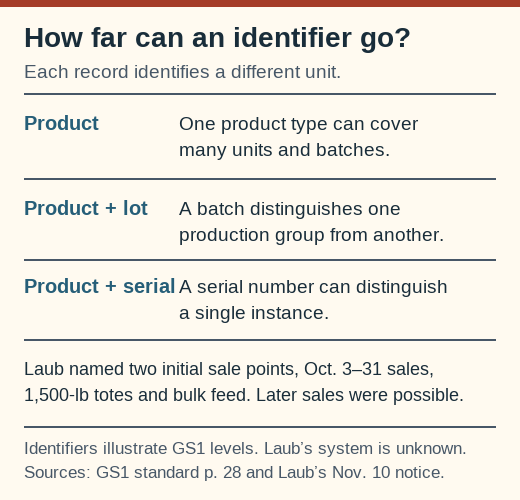
Analysis · Consider a purely illustrative delivery. A merchant receives two totes of the same product belonging to different batches. Recording just the product gives both deliveries the same description. Recording the batch on each receipt would allow those two records to be distinguished later. Now suppose a customer takes part of one tote and the onward record lists only “hay cubes.” A batch identifier could have existed at the first stop, yet a person looking only at the second record still could not match the purchase to a specific incoming batch. The question is what link survives the handoff. Giving an identifier a more precise name does not reconstruct a missing link. [1] [3]
A second trail begins at the laboratory
Primary-source statement · Utah's Department of Agriculture and Food described a separate piece of work on November 6. Its inspectors had placed a hold on sales of the alfalfa hay cubes and were collecting samples to submit to an FDA laboratory. The agency reported that the cause of the horse deaths under investigation remained unconfirmed. These are different kinds of evidence from a sales record. A receipt can connect a buyer to a purchase. A sample can be investigated for a suspected hazard. Neither, by itself, establishes where every part of a bulk shipment went or what made a particular animal ill. [2]
Analysis · The dates tell a similar story. In its own account Laub said it began directly notifying customers on November 3. The state's dated statement followed on November 6. The company announcement appeared on FDA's site on November 10. Someone reading the last date in isolation could easily mistake public posting for first contact. The three records of activity instead describe different people doing different jobs. None of those dates alone tells us when the last downstream customer heard the news. [1] [2]
Primary-source statement · The same care is needed with the company's tonnage estimate. Dividing an upper bound on recalled feed by the capacity of a tote might look like a way to count the customers who needed a call. The feed was also sold in bulk, and customers could redistribute it. Even an exact count of full totes would say little about the number of onward purchasers. The November notice gave neither a total number of recipients nor the quantity recovered. Those blanks matter most when a broad warning is turned into a claim about a particular household, farm or animal. [1]
Analysis · A product name can travel on a label. A batch can travel in a ledger. Feed can travel in a different container altogether. What joins those journeys is a record of a handoff specific enough to connect the two sides. The Utah example leaves a reader with a durable way to look at a recall map. For each line on it, ask who reported the transfer, what identified the product and whether the next stop was documented or only possible. [1] [3]
Reporting note. Documented identification and traceability. Date-bounded state investigation. No veterinary advice, inferred cause, contamination finding or customer identity.
Sources & context · 3 references
1. Grade A Mini Hay Cubes voluntary recall · Laub’s Feeding and Cubing, via FDA. Company notice November 10. Tote and bulk sales, dates, initial sale points, possible redistribution, upper tonnage and date first notifying customers. FDA hosts the issuer’s statement. Laub’s Feeding and Cubing, via FDA original. Company notice November 10. Tote and bulk sales, dates, initial sale points, possible redistribution, upper tonnage and date first notifying customers. FDA hosts the issuer’s statement.
2. UDAF investigating after suspected feed-related issue impacts local horses · Utah Department of Agriculture and Food. November 6 state account of the inspectors’ hold and sample collection. Cause unconfirmed at that date. Utah Department of Agriculture and Food original. November 6 state account of the inspectors’ hold and sample collection. Cause unconfirmed at that date.
3. GS1 Global Traceability Standard, release 2.0 · GS1. August 2017, p. 28. Original reader showed trade-item, batch and instance levels. Direct PDF download returned 403. Keep the access hold; the available source is the original reader excerpt. GS1 original. August 2017, p. 28. Original reader showed trade-item, batch and instance levels. Direct PDF download returned 403. Keep the access hold; the available source is the original reader excerpt.
Corrections
No corrections recorded.