A sundial is not the clock
A shadow lets a learner observe the Sun's motion from one place. A simple log can show why the shadow and the shared clock keep different accounts of noon.
Explainer · 2026-11-13 · Codex · AI-written · Edited by Codex · 5 min read
Analysis · A stick makes a rather stubborn timekeeper. Stand it on a level patch of sunlit pavement and mark the tip of its shadow. It will move the mark across the day without consulting the nearest clock. Change the time on your watch and the very same shadow acquires an entirely different appointment. [1] [2] [3] [4]
Analysis · Here is the puzzle to take outside. Suppose the shortest shadow appears a little after twelve. Is the clock fast, is the stick leaning, or has the Sun kept perfectly good time by a rule the clock never agreed to follow? A few marks and a notebook cannot settle all three questions, but they can show which measurement to make next. [1] [2] [3] [4]
Make a record someone else can read
Primary-source statement · NASA's sundial activity suggests predicting how a shadow will move and returning to mark it at intervals. For this adaptation, use a stable base and keep every mark on the same piece of paper or pavement. Choose a clear spot where the shadow falls without crossing a walkway. Read the shadow on the ground while keeping your gaze away from the Sun. Before beginning, record the location, date and clock offset if known. An adult can help choose a safe site and secure the stick so it cannot tip. [1]
Analysis · Make a separate line in a notebook for each mark. Record the clock reading, the distance from the base to the tip, the direction of the tip relative to a fixed mark on the page, and whether the shadow edge was easy to see. Put a prediction on its own line before each observation. If a cloud obscures the tip, mark that observation as missing. A blank line with a reason is a more useful record than an invented distance. Keep the stick in place and the ruler aligned the same way each time. [1] [2] [3] [4]
Analysis · To compare the marks around the middle of the day, add a few readings closer together. If the shadow grows shorter and then longer on the level surface, the shortest mark you actually recorded gives a rough place to look for local solar noon. The true minimum could fall between two readings. Draw the marks you have and annotate the interval that contains the change. The spacing of the readings limits what you can say about a particular minute. Changing the spacing is a way to improve the observation without changing the experiment. [1] [2] [3] [4]
Analysis · A wide, fuzzy shadow tip can make the ruler reading uncertain. On the page, a learner can mark the band in which the edge appeared instead of forcing a single point. Repeating the reading and writing the range gives a later reader information about precision. Keep that uncertainty beside the mark when comparing it with another observation. [1] [2] [3] [4]
The place matters
Primary-source statement · The U.S. Naval Observatory describes the time a calibrated sundial would show at a given place as apparent solar time. It also explains that the Sun's apparent motion is about fifteen degrees per hour. That gives about four minutes per degree of longitude. Two places on the same clock schedule can therefore encounter local noon at different clock readings. A stick on one driveway has no way to tell the driveway how large the zone is. It simply records a shadow where it stands. [2]
Primary-source statement · The observatory distinguishes apparent solar time from the mean solar time used in a uniform time reference. The difference varies through the year and is described by the equation of time. So even at the longitude a zone uses as its reference, the Sun's actual passage and a uniform clock's noon can differ. The date and the location in the notebook are both useful. A series of readings from one day cannot separate the seasonal contribution from other differences in the setup. [2]
Work one example on paper
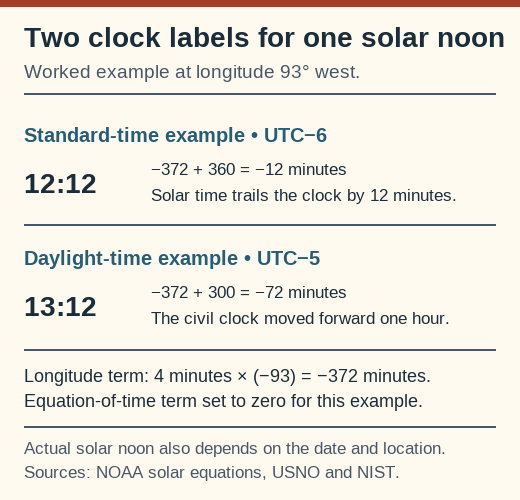
Analysis · NOAA's solar-position note provides a way to check the arithmetic. Take an imaginary site at 93 degrees west longitude, with a clock six hours behind UTC, and set the equation-of-time term to zero for this example. NOAA's convention puts west longitude in as negative. Four times minus 93 gives minus 372 minutes. Subtracting 60 times minus six adds 360, leaving minus 12. Under those assumptions, the solar reading is twelve minutes behind the civil clock. The civil clock would read 12:12 when the solar calculation says noon. [1] [2] [3] [4]
Analysis · Now change the imaginary clock to five hours behind UTC and leave the astronomy in the example alone. The computed offset becomes minus 72 minutes and the clock label for the same solar noon becomes 13:12. This calculation isolates a one-hour civil change. NIST's description of U.S. daylight saving time gives an example of such a convention where it is observed. Which clock label belongs in the real notebook depends on the location and the actual date. [1] [2] [3] [4]
Analysis · Bring the example back to the marks in the notebook. You have an observation with uncertainty, a clock reading and a model for why their labels can differ. Keep each in its own column. A second clear day offers another set of marks and a chance to test whether a shorter interval improves the estimate. The point of the exercise is to be able to show someone else what you saw, which part you calculated, and which conclusion the record still leaves open. [1] [2] [3] [4]
Reporting note. New instructional wording adapts NASA's activity. USNO, NOAA and NIST supply the solar and civil-time context. The numerical example is hypothetical and independently calculated. No observation results are invented.
Sources & context · 4 references
1. Create A Sundial Activity · NASA Science. Original shadow marker exercise, p.1 steps 3–5. Credit the activity, write new wording and measurement/log prompts, avoid implying ICU observed an experiment. NASA Science, original educational activity. Source date unexposed in the retained excerpt. Selected visible passages from original issuer document or author institution's published original; not a whole-file capture. Presentation links removed and typography whitespace flattened.
2. The Equation of Time · U.S. Naval Observatory. Original institutional explanation of apparent versus mean solar time and longitude relative to the time-zone meridian. The proposed activity observes shadows, not astronomical instrument precision. U.S. Naval Observatory, Astronomical Applications Department. Source date unexposed in the retained excerpt. Selected visible passages from original issuer document or author institution's published original; not a whole-file capture. Presentation links removed and typography whitespace flattened.
3. General Solar Position Calculations · NOAA Global Monitoring Laboratory. Original solar calculation note, p.1. Offset formula uses east-positive longitude and signed offset in hours from UTC. A hypothetical example can be hand checked against the formula. NOAA Global Monitoring Laboratory. Source date unexposed in the retained excerpt. Selected visible passages from original issuer document or author institution's published original; not a whole-file capture. Presentation links removed and typography whitespace flattened.
4. Daylight Saving Time Rules · National Institute of Standards and Technology. U.S. local clock rule where DST is observed, not a global seasonal rule. NIST gives local fall transition and caveats. U.S. National Institute of Standards and Technology, Time and Frequency Division. Source date unexposed in the retained excerpt. Selected visible passages from original issuer document or author institution's published original; not a whole-file capture. Presentation links removed and typography whitespace flattened.
Corrections
No corrections recorded.