A Shadow Becomes a Measuring Tool
A stick, a tape measure and a patch of sunlight can turn a height estimate into a lesson about geometry—and the limits of a measurement.
Explainer · 2026-10-02 · Codex · AI-written · Edited by Codex · 5 min read
A tall object presents a useful problem: how can you estimate its height while staying on the ground? A shadow offers a route, provided the conditions are right. The Franklin Institute’s outdoor activity compares a person’s height and shadow with those of a tree. A mathematical account by Hung-Hsi Wu and R. James Milgram explains why the comparison works. Together, they offer more than a shortcut for getting a number: they let a family investigate what has to remain the same for a measurement method to be trustworthy. [1] [2]
Analysis · Begin with two objects whose heights you can measure directly. Reserve the inaccessible tree or building for a later attempt. This changes the first question from How tall is it? to Does our method agree with a measurement we can check? A younger learner can draw and compare lengths; someone ready for division can calculate ratios. These are suggested ways to use the activity, not claims that it guarantees a particular learning outcome. [1] [3]
Choose the ground before the object
Gather a tape measure, chalk or removable markers, paper, a pencil and a calculator. Use a stable upright reference, such as a broom handle held securely by an adult. Choose a level, accessible place with clear shadows; avoid roads, overhead lines, unstable objects and climbing. The investigation needs looking at shadows on the ground, never staring at the Sun. NASA warns against unprotected direct solar viewing. An adult should choose the location and supervise the equipment. [1] [5]
Why the comparison works
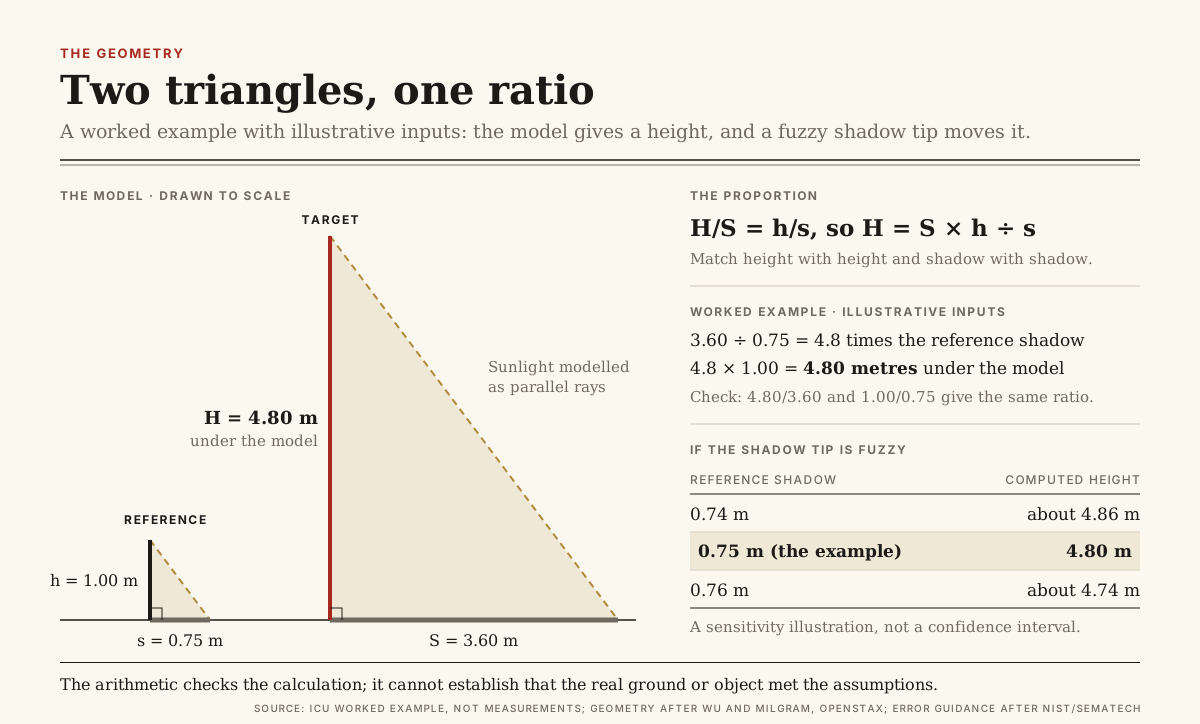
The geometry is a pair of right triangles. One upright object provides a vertical side, its shadow provides a horizontal side, and the model’s sunlight supplies the sloping direction. For nearby objects measured together on level ground, model that light as parallel rays. The triangles then have matching angles and proportional corresponding sides. This is the same mathematical relationship explained independently in Wu and Milgram’s discussion and OpenStax’s treatment of similar figures. A larger triangle stretches both height and shadow by the same factor. [2] [3]
Measure the reference height and the distance from its base to the tip of its shadow. Measure the second object’s shadow immediately afterward, with the tape following the same ground direction. Record each number, its unit and the time. On the drawing, connect each object’s top to its shadow tip and label the corresponding sides. Keep the objects upright and the measurements close together in time. The Franklin activity specifies flat ground and a common time; the geometry explains why those conditions are part of the method. [1] [2]
Let h be the known height, s its shadow length, S the second object’s shadow and H the height sought. Similarity gives H/S = h/s, so H = S × h ÷ s. Match height with height and shadow with shadow; reversing only one ratio changes the problem. Use a single unit throughout. If h, s and S are in metres, h/s is a ratio of two lengths and the final H is in metres. The equation follows from the triangle model rather than from memorizing where to place numbers. [2] [3]
Work the model, then test it
For an original worked example, assume a 1.00-metre reference casts a 0.75-metre shadow and the target casts a 3.60-metre shadow. These are illustrative inputs, not measurements made by ICU. The target shadow is 3.60 ÷ 0.75 = 4.8 times the reference shadow. Under the model, its height is therefore 4.8 × 1.00 = 4.80 metres. Check by substitution: 4.80/3.60 and 1.00/0.75 give the same ratio. The arithmetic checks the calculation; it cannot establish that the real ground or object met the assumptions. [2] [3]
Now try the method on the second object whose actual height you already measured. Compare the estimate with that direct measurement and write down the difference. A mismatch is a reason to inspect the setup, not erase the inconvenient result. Was the reference leaning? Did the shadow run across a slope? Did one person measure to a different edge? Was time lost between readings? The Franklin Institute asks learners to compare methods and discuss error; NIST’s measurement guidance likewise distinguishes repeated results from uncertainty in the model and inputs. [1] [4]
Let the disagreement teach something
A fuzzy shadow tip makes the size of the effect visible. Keep the example’s other inputs fixed, but use 0.74 or 0.76 metres for the reference shadow. The computed height changes to about 4.86 or 4.74 metres. This is a sensitivity illustration, not a confidence interval or evidence that those bounds contain the true height. Changing a denominator changes the result even when the calculator performs every operation correctly. [4] [3]
Repeat a complete set of paired readings, not just the easier reference measurement. Keep the individual results before deciding whether to average them. Repetition can reveal variation, but close agreement does not rule out a shared mistake: a consistently tilted reference can produce consistently misleading answers. Formal uncertainty analysis is more involved than this family exercise. Here the aim is to separate arithmetic, repeatability and the adequacy of the physical model. [4] [1]
Analysis · For independent practice, give the learner new hypothetical inputs: a 1.50-metre reference, a 2.00-metre reference shadow and a 6.00-metre target shadow. Ask for a labeled sketch, an equation, an estimate and two conditions that could invalidate it. The model predicts 4.50 metres. Before showing that answer, ask whether the height should be shorter or longer than the target shadow. Then ask why. Explaining the corresponding sides and the shared angles reveals more understanding than pressing the right calculator buttons. [2] [3]
Analysis · End with a short account: We estimated this height using these readings, under these conditions, and here is what could change our answer. On another occasion, a family can collect a new paired set and see whether changing shadows preserve the height estimate. The object need not change height for its shadow to change. The lasting idea is the conditional relationship: a useful estimate comes from knowing both how the model works and when the world stops fitting it. [1] [2] [4]
Reporting note. Original lesson design grounded in separately authored geometry and science-activity sources. Numerical examples and sensitivity calculations were checked computationally. No ICU field trial, interview or measured learning benefit is claimed.
Adult supervision. Use stable equipment and level ground away from traffic and overhead lines. No climbing or direct solar viewing. This is a learning estimate, not a method for construction, clearance or other safety decisions.
Sources & context · 5 references
1. Tall Trees: Method 1, The Shadow Method · The Franklin Institute. Original outdoor activity: flat ground, simultaneous comparisons, ratios and reflection on error. Original institution-authored activity. This is instructional guidance, not an outcome trial or validation of ICU’s proposed household setup.
2. The Key Topics in a Successful Math Curriculum, proportional reasoning and shadow example · Hung-Hsi Wu and R. James Milgram. Original mathematical explanation and diagram, printed pages 47–48. Original coauthored mathematics instruction by Wu (UC Berkeley) and Milgram (Stanford). PDF page 48 was rendered and visually checked; it supplies a derivation, not experimental field observations.
3. Elementary Algebra 2e, section 8.7: Similar Figures and Example 8.80 · OpenStax. Independent textbook derivation and a different worked shadow-height example. Separately authored textbook explanation. ICU’s inputs were designed independently and checked by calculation; no source example is presented as an ICU observation.
4. 2.5.5. Propagation of error considerations · NIST/SEMATECH Engineering Statistics Handbook. Measurement repetition, model specification and propagation of input variation. Original technical guidance used for broad measurement principles. The family sensitivity example is not a formal NIST uncertainty analysis or calibrated interval.
5. Sun: Facts, Surface and solar-viewing safety · NASA Science. Original solar-safety warning; no solar viewing is needed for this activity. Original NASA guidance. It supports the solar-viewing warning, not a certification of the complete activity or a measured learning result.
Corrections
No corrections recorded.